 Add to Chrome
 Add to Firefox
 Add to Edge
Generative Engine Optimization: A VLM and Agent Framework for Pinterest Acquisition Growth
Feb 03, 2026
Large Language Models are fundamentally reshaping content discovery through AI-native search systems such as ChatGPT, Gemini, and Claude. Unlike traditional search engines that match keywords to documents, these systems infer user intent, synthesize multimodal evidence, and generate contextual answers directly on the search page, introducing a paradigm shift from Search Engine Optimization (SEO) to Generative Engine Optimization (GEO). For visual content platforms hosting billions of assets, this poses an acute challenge: individual images lack the semantic depth and authority signals that generative search prioritizes, risking disintermediation as user needs are satisfied in-place without site visits. We present Pinterest GEO, a production-scale framework that pioneers reverse search design: rather than generating generic image captions describing what content is, we fine-tune Vision-Language Models (VLMs) to predict what users would actually search for, augmented this with AI agents that mine real-time internet trends to capture emerging search demand. These VLM-generated queries then drive construction of semantically coherent Collection Pages via multimodal embeddings, creating indexable aggregations optimized for generative retrieval. Finally, we employ hybrid VLM and two-tower ANN architectures to build authority-aware interlinking structures that propagate signals across billions of visual assets. Deployed at scale across billions of images and tens of millions of collections, GEO delivers 20\% organic traffic growth contributing to multi-million monthly active user (MAU) growth, demonstrating a principled pathway for visual platforms to thrive in the generative search era.

ActionFlow: A Pipelined Action Acceleration for Vision Language Models on Edge
Dec 23, 2025Vision-Language-Action (VLA) models have emerged as a unified paradigm for robotic perception and control, enabling emergent generalization and long-horizon task execution. However, their deployment in dynamic, real-world environments is severely hin dered by high inference latency. While smooth robotic interaction requires control frequencies of 20 to 30 Hz, current VLA models typi cally operate at only 3-5 Hz on edge devices due to the memory bound nature of autoregressive decoding. Existing optimizations often require extensive retraining or compromise model accuracy. To bridge this gap, we introduce ActionFlow, a system-level inference framework tailored for resource-constrained edge plat forms. At the core of ActionFlow is a Cross-Request Pipelin ing strategy, a novel scheduler that redefines VLA inference as a macro-pipeline of micro-requests. The strategy intelligently batches memory-bound Decode phases with compute-bound Prefill phases across continuous time steps to maximize hardware utilization. Furthermore, to support this scheduling, we propose a Cross Request State Packed Forward operator and a Unified KV Ring Buffer, which fuse fragmented memory operations into efficient dense computations. Experimental results demonstrate that ActionFlow achieves a 2.55x improvement in FPS on the OpenVLA-7B model without retraining, enabling real-time dy namic manipulation on edge hardware. Our work is available at https://anonymous.4open.science/r/ActionFlow-1D47.
Dynamic Customer Embeddings for Financial Service Applications
Jun 22, 2021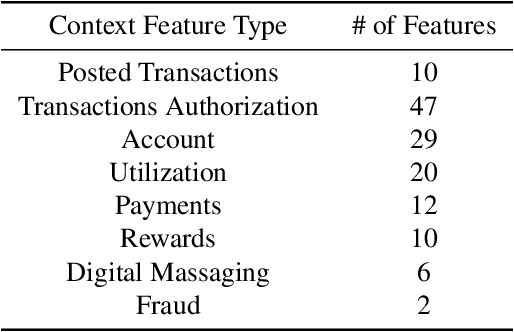
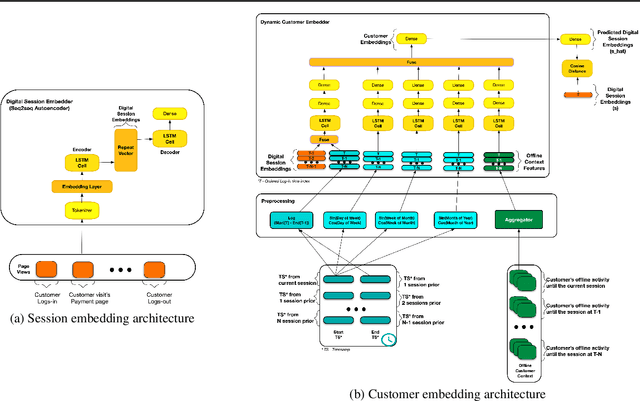
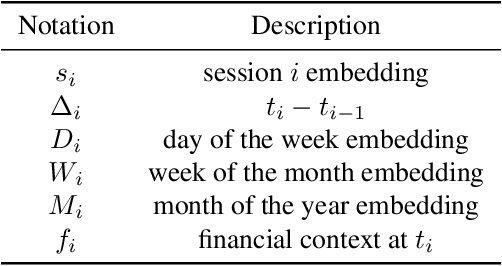

As financial services (FS) companies have experienced drastic technology driven changes, the availability of new data streams provides the opportunity for more comprehensive customer understanding. We propose Dynamic Customer Embeddings (DCE), a framework that leverages customers' digital activity and a wide range of financial context to learn dense representations of customers in the FS industry. Our method examines customer actions and pageviews within a mobile or web digital session, the sequencing of the sessions themselves, and snapshots of common financial features across our organization at the time of login. We test our customer embeddings using real world data in three prediction problems: 1) the intent of a customer in their next digital session, 2) the probability of a customer calling the call centers after a session, and 3) the probability of a digital session to be fraudulent. DCE showed performance lift in all three downstream problems.