 Add to Chrome
 Add to Firefox
 Add to Edge
TraceNAS: Zero-shot LLM Pruning via Gradient Trace Correlation
Feb 02, 2026
Structured pruning is essential for efficient deployment of Large Language Models (LLMs). The varying sensitivity of LLM sub-blocks to pruning necessitates the identification of optimal non-uniformly pruned models. Existing methods evaluate the importance of layers, attention heads, or weight channels in isolation. Such localized focus ignores the complex global structural dependencies that exist across the model. Training-aware structured pruning addresses global dependencies, but its computational cost can be just as expensive as post-pruning training. To alleviate the computational burden of training-aware pruning and capture global structural dependencies, we propose TraceNAS, a training-free Neural Architecture Search (NAS) framework that jointly explores structured pruning of LLM depth and width. TraceNAS identifies pruned models that maintain a high degree of loss landscape alignment with the pretrained model using a scale-invariant zero-shot proxy, effectively selecting models that exhibit maximal performance potential during post-pruning training. TraceNAS is highly efficient, enabling high-fidelity discovery of pruned models on a single GPU in 8.5 hours, yielding a 10$\times$ reduction in GPU-hours compared to training-aware methods. Evaluations on the Llama and Qwen families demonstrate that TraceNAS is competitive with training-aware baselines across commonsense and reasoning benchmarks.

TopoPrune: Robust Data Pruning via Unified Latent Space Topology
Feb 02, 2026Geometric data pruning methods, while practical for leveraging pretrained models, are fundamentally unstable. Their reliance on extrinsic geometry renders them highly sensitive to latent space perturbations, causing performance to degrade during cross-architecture transfer or in the presence of feature noise. We introduce TopoPrune, a framework which resolves this challenge by leveraging topology to capture the stable, intrinsic structure of data. TopoPrune operates at two scales, (1) utilizing a topology-aware manifold approximation to establish a global low-dimensional embedding of the dataset. Subsequently, (2) it employs differentiable persistent homology to perform a local topological optimization on the manifold embeddings, ranking samples by their structural complexity. We demonstrate that our unified dual-scale topological approach ensures high accuracy and precision, particularly at significant dataset pruning rates (e.g., 90%). Furthermore, through the inherent stability properties of topology, TopoPrune is (a) exceptionally robust to noise perturbations of latent feature embeddings and (b) demonstrates superior transferability across diverse network architectures. This study demonstrates a promising avenue towards stable and principled topology-based frameworks for robust data-efficient learning.
TSkips: Efficiency Through Explicit Temporal Delay Connections in Spiking Neural Networks
Nov 22, 2024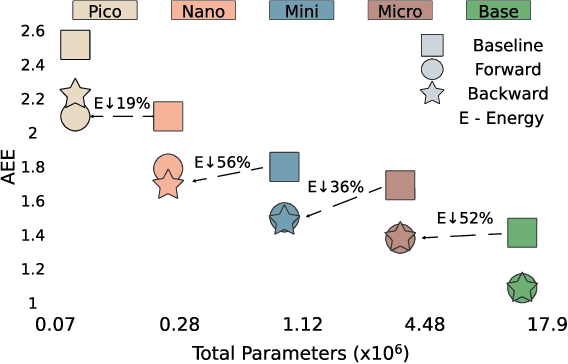
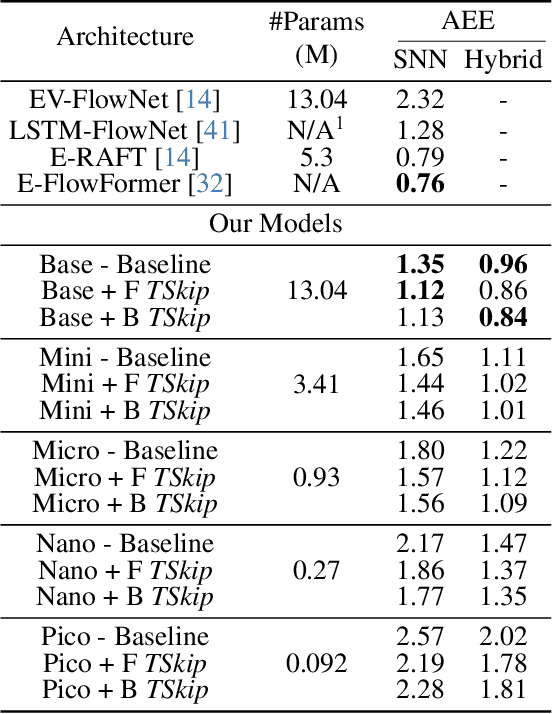
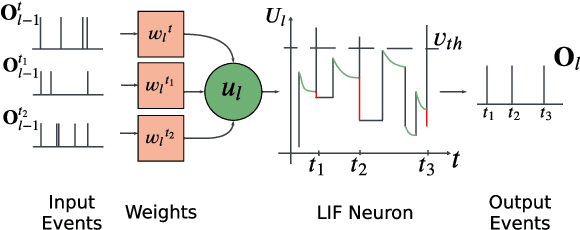
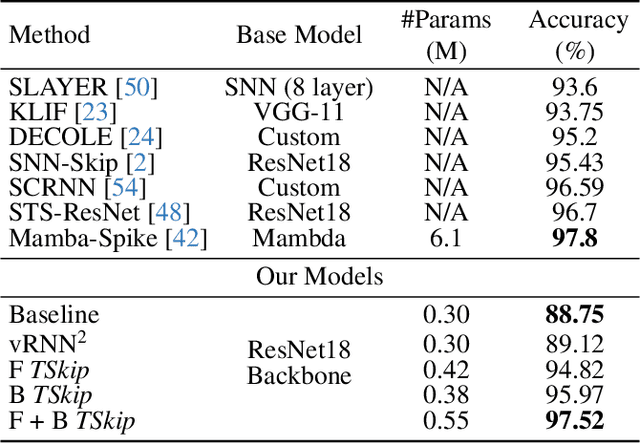
Spiking Neural Networks (SNNs) with their bio-inspired Leaky Integrate-and-Fire (LIF) neurons inherently capture temporal information. This makes them well-suited for sequential tasks like processing event-based data from Dynamic Vision Sensors (DVS) and event-based speech tasks. Harnessing the temporal capabilities of SNNs requires mitigating vanishing spikes during training, capturing spatio-temporal patterns and enhancing precise spike timing. To address these challenges, we propose TSkips, augmenting SNN architectures with forward and backward skip connections that incorporate explicit temporal delays. These connections capture long-term spatio-temporal dependencies and facilitate better spike flow over long sequences. The introduction of TSkips creates a vast search space of possible configurations, encompassing skip positions and time delay values. To efficiently navigate this search space, this work leverages training-free Neural Architecture Search (NAS) to identify optimal network structures and corresponding delays. We demonstrate the effectiveness of our approach on four event-based datasets: DSEC-flow for optical flow estimation, DVS128 Gesture for hand gesture recognition and Spiking Heidelberg Digits (SHD) and Spiking Speech Commands (SSC) for speech recognition. Our method achieves significant improvements across these datasets: up to 18% reduction in Average Endpoint Error (AEE) on DSEC-flow, 8% increase in classification accuracy on DVS128 Gesture, and up to 8% and 16% higher classification accuracy on SHD and SSC, respectively.