 Add to Chrome
 Add to Firefox
 Add to Edge
Physics-Informed Tree Search for High-Dimensional Computational Design
Jan 10, 2026
High-dimensional design spaces underpin a wide range of physics-based modeling and computational design tasks in science and engineering. These problems are commonly formulated as constrained black-box searches over rugged objective landscapes, where function evaluations are expensive, and gradients are unavailable or unreliable. Conventional global search engines and optimizers struggle in such settings due to the exponential scaling of design spaces, the presence of multiple local basins, and the absence of physical guidance in sampling. We present a physics-informed Monte Carlo Tree Search (MCTS) framework that extends policy-driven tree-based reinforcement concepts to continuous, high-dimensional scientific optimization. Our method integrates population-level decision trees with surrogate-guided directional sampling, reward shaping, and hierarchical switching between global exploration and local exploitation. These ingredients allow efficient traversal of non-convex, multimodal landscapes where physically meaningful optima are sparse. We benchmark our approach against standard global optimization baselines on a suite of canonical test functions, demonstrating superior or comparable performance in terms of convergence, robustness, and generalization. Beyond synthetic tests, we demonstrate physics-consistent applicability to (i) crystal structure optimization from clusters to bulk, (ii) fitting of classical interatomic potentials, and (iii) constrained engineering design problems. Across all cases, the method converges with high fidelity and evaluation efficiency while preserving physical constraints. Overall, our work establishes physics-informed tree search as a scalable and interpretable paradigm for computational design and high-dimensional scientific optimization, bridging discrete decision-making frameworks with continuous search in scientific design workflows.

ChatVis: Automating Scientific Visualization with a Large Language Model
Oct 07, 2024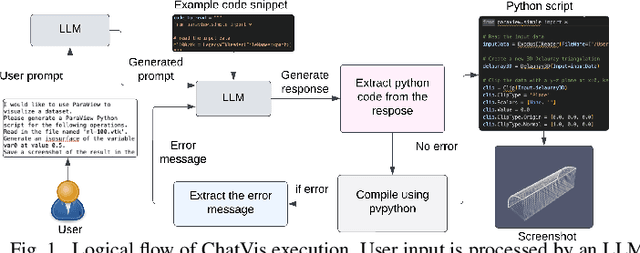
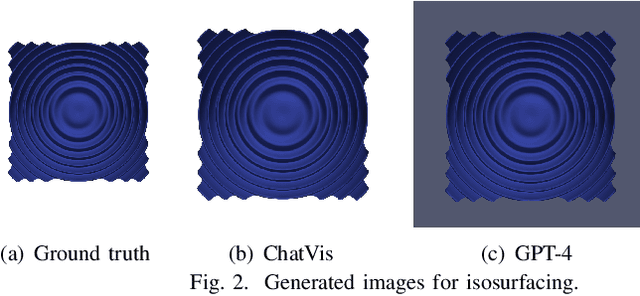

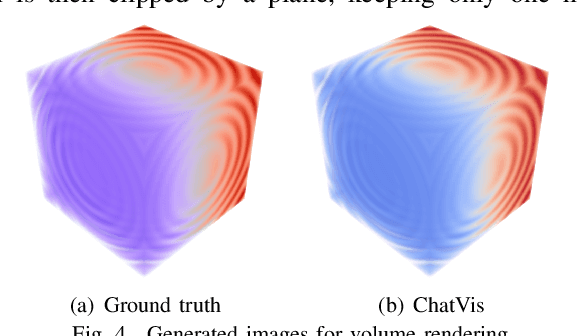
We develop an iterative assistant we call ChatVis that can synthetically generate Python scripts for data analysis and visualization using a large language model (LLM). The assistant allows a user to specify the operations in natural language, attempting to generate a Python script for the desired operations, prompting the LLM to revise the script as needed until it executes correctly. The iterations include an error detection and correction mechanism that extracts error messages from the execution of the script and subsequently prompts LLM to correct the error. Our method demonstrates correct execution on five canonical visualization scenarios, comparing results with ground truth. We also compared our results with scripts generated by several other LLMs without any assistance. In every instance, ChatVis successfully generated the correct script, whereas the unassisted LLMs failed to do so. The code is available on GitHub: https://github.com/tanwimallick/ChatVis/.