 Add to Chrome
 Add to Firefox
 Add to Edge
Open-Vocabulary Functional 3D Human-Scene Interaction Generation
Jan 28, 2026
Generating 3D humans that functionally interact with 3D scenes remains an open problem with applications in embodied AI, robotics, and interactive content creation. The key challenge involves reasoning about both the semantics of functional elements in 3D scenes and the 3D human poses required to achieve functionality-aware interaction. Unfortunately, existing methods typically lack explicit reasoning over object functionality and the corresponding human-scene contact, resulting in implausible or functionally incorrect interactions. In this work, we propose FunHSI, a training-free, functionality-driven framework that enables functionally correct human-scene interactions from open-vocabulary task prompts. Given a task prompt, FunHSI performs functionality-aware contact reasoning to identify functional scene elements, reconstruct their 3D geometry, and model high-level interactions via a contact graph. We then leverage vision-language models to synthesize a human performing the task in the image and estimate proposed 3D body and hand poses. Finally, the proposed 3D body configuration is refined via stage-wise optimization to ensure physical plausibility and functional correctness. In contrast to existing methods, FunHSI not only synthesizes more plausible general 3D interactions, such as "sitting on a sofa'', while supporting fine-grained functional human-scene interactions, e.g., "increasing the room temperature''. Extensive experiments demonstrate that FunHSI consistently generates functionally correct and physically plausible human-scene interactions across diverse indoor and outdoor scenes.

FlexNeRF: Photorealistic Free-viewpoint Rendering of Moving Humans from Sparse Views
Mar 25, 2023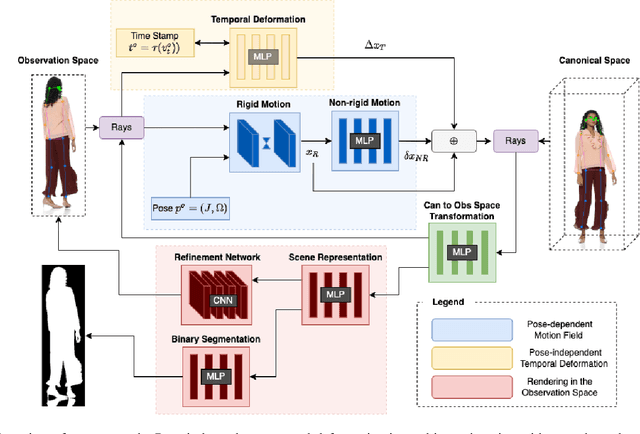
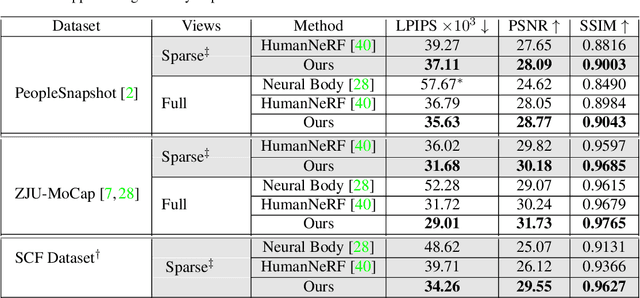
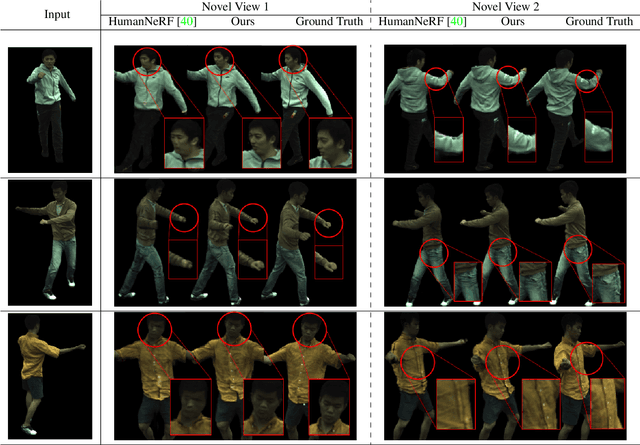
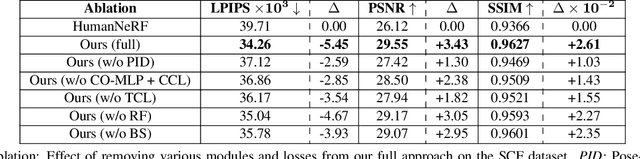
We present FlexNeRF, a method for photorealistic freeviewpoint rendering of humans in motion from monocular videos. Our approach works well with sparse views, which is a challenging scenario when the subject is exhibiting fast/complex motions. We propose a novel approach which jointly optimizes a canonical time and pose configuration, with a pose-dependent motion field and pose-independent temporal deformations complementing each other. Thanks to our novel temporal and cyclic consistency constraints along with additional losses on intermediate representation such as segmentation, our approach provides high quality outputs as the observed views become sparser. We empirically demonstrate that our method significantly outperforms the state-of-the-art on public benchmark datasets as well as a self-captured fashion dataset. The project page is available at: https://flex-nerf.github.io/