 Add to Chrome
 Add to Firefox
 Add to Edge
Benchmarking Uncertainty Calibration in Large Language Model Long-Form Question Answering
Jan 30, 2026
Large Language Models (LLMs) are commonly used in Question Answering (QA) settings, increasingly in the natural sciences if not science at large. Reliable Uncertainty Quantification (UQ) is critical for the trustworthy uptake of generated answers. Existing UQ approaches remain weakly validated in scientific QA, a domain relying on fact-retrieval and reasoning capabilities. We introduce the first large-scale benchmark for evaluating UQ metrics in reasoning-demanding QA studying calibration of UQ methods, providing an extensible open-source framework to reproducibly assess calibration. Our study spans up to 20 large language models of base, instruction-tuned and reasoning variants. Our analysis covers seven scientific QA datasets, including both multiple-choice and arithmetic question answering tasks, using prompting to emulate an open question answering setting. We evaluate and compare methods representative of prominent approaches on a total of 685,000 long-form responses, spanning different reasoning complexities representative of domain-specific tasks. At the token level, we find that instruction tuning induces strong probability mass polarization, reducing the reliability of token-level confidences as estimates of uncertainty. Models further fine-tuned for reasoning are exposed to the same effect, but the reasoning process appears to mitigate it depending on the provider. At the sequence level, we show that verbalized approaches are systematically biased and poorly correlated with correctness, while answer frequency (consistency across samples) yields the most reliable calibration. In the wake of our analysis, we study and report the misleading effect of relying exclusively on ECE as a sole measure for judging performance of UQ methods on benchmark datasets. Our findings expose critical limitations of current UQ methods for LLMs and standard practices in benchmarking thereof.

Kaleidoscope: In-language Exams for Massively Multilingual Vision Evaluation
Apr 09, 2025The evaluation of vision-language models (VLMs) has mainly relied on English-language benchmarks, leaving significant gaps in both multilingual and multicultural coverage. While multilingual benchmarks have expanded, both in size and languages, many rely on translations of English datasets, failing to capture cultural nuances. In this work, we propose Kaleidoscope, as the most comprehensive exam benchmark to date for the multilingual evaluation of vision-language models. Kaleidoscope is a large-scale, in-language multimodal benchmark designed to evaluate VLMs across diverse languages and visual inputs. Kaleidoscope covers 18 languages and 14 different subjects, amounting to a total of 20,911 multiple-choice questions. Built through an open science collaboration with a diverse group of researchers worldwide, Kaleidoscope ensures linguistic and cultural authenticity. We evaluate top-performing multilingual vision-language models and find that they perform poorly on low-resource languages and in complex multimodal scenarios. Our results highlight the need for progress on culturally inclusive multimodal evaluation frameworks.
Embedded Named Entity Recognition using Probing Classifiers
Mar 18, 2024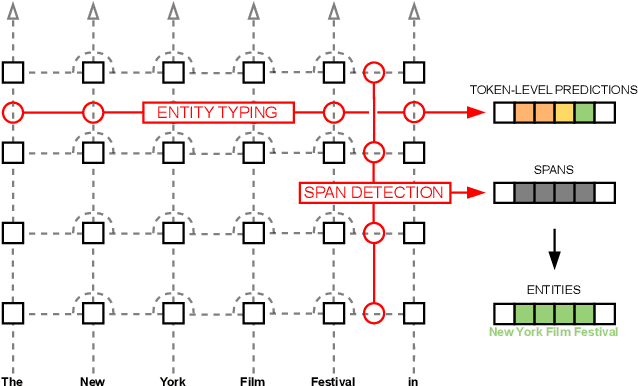
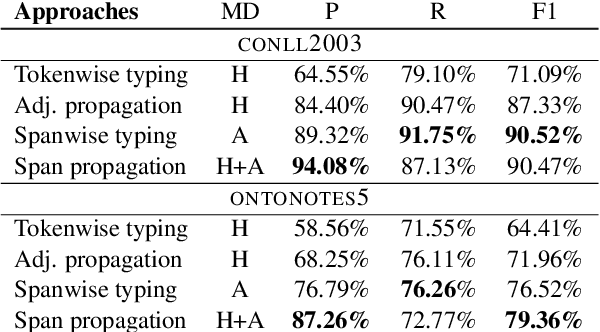
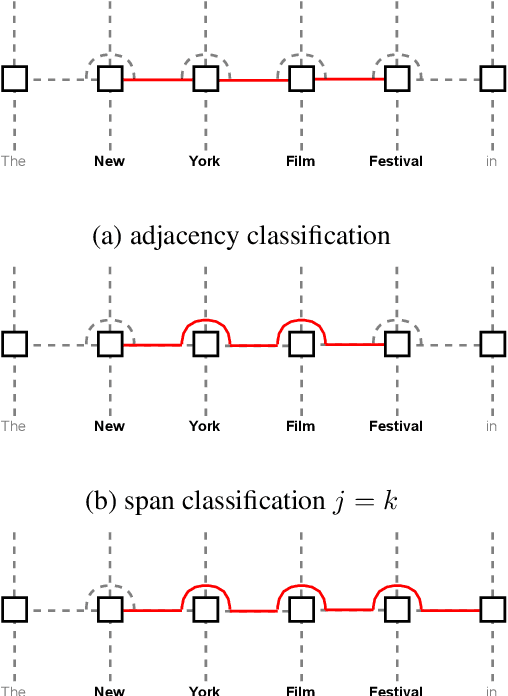
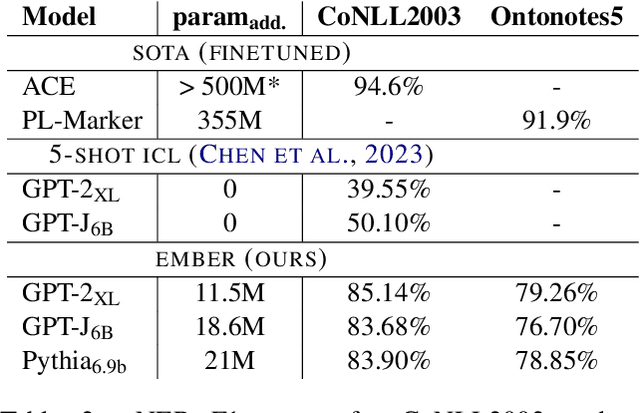
Extracting semantic information from generated text is a useful tool for applications such as automated fact checking or retrieval augmented generation. Currently, this requires either separate models during inference, which increases computational cost, or destructive fine-tuning of the language model. Instead, we propose directly embedding information extraction capabilities into pre-trained language models using probing classifiers, enabling efficient simultaneous text generation and information extraction. For this, we introduce an approach called EMBER and show that it enables named entity recognition in decoder-only language models without fine-tuning them and while incurring minimal additional computational cost at inference time. Specifically, our experiments using GPT-2 show that EMBER maintains high token generation rates during streaming text generation, with only a negligible decrease in speed of around 1% compared to a 43.64% slowdown measured for a baseline using a separate NER model. Code and data are available at https://github.com/nicpopovic/EMBER.