 Add to Chrome
 Add to Firefox
 Add to Edge
Evaluating Deep Learning-Based Face Recognition for Infants and Toddlers: Impact of Age Across Developmental Stages
Jan 04, 2026
Face recognition for infants and toddlers presents unique challenges due to rapid facial morphology changes, high inter-class similarity, and limited dataset availability. This study evaluates the performance of four deep learning-based face recognition models FaceNet, ArcFace, MagFace, and CosFace on a newly developed longitudinal dataset collected over a 24 month period in seven sessions involving children aged 0 to 3 years. Our analysis examines recognition accuracy across developmental stages, showing that the True Accept Rate (TAR) is only 30.7% at 0.1% False Accept Rate (FAR) for infants aged 0 to 6 months, due to unstable facial features. Performance improves significantly in older children, reaching 64.7% TAR at 0.1% FAR in the 2.5 to 3 year age group. We also evaluate verification performance over different time intervals, revealing that shorter time gaps result in higher accuracy due to reduced embedding drift. To mitigate this drift, we apply a Domain Adversarial Neural Network (DANN) approach that improves TAR by over 12%, yielding features that are more temporally stable and generalizable. These findings are critical for building biometric systems that function reliably over time in smart city applications such as public healthcare, child safety, and digital identity services. The challenges observed in early age groups highlight the importance of future research on privacy preserving biometric authentication systems that can address temporal variability, particularly in secure and regulated urban environments where child verification is essential.

Liveness Detection Competition -- Noncontact-based Fingerprint Algorithms and Systems (LivDet-2023 Noncontact Fingerprint)
Oct 01, 2023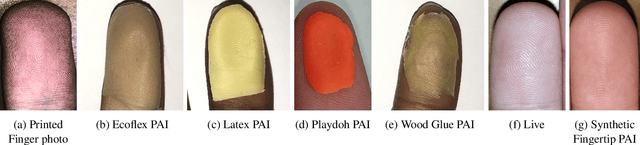
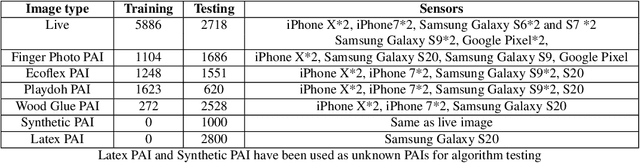

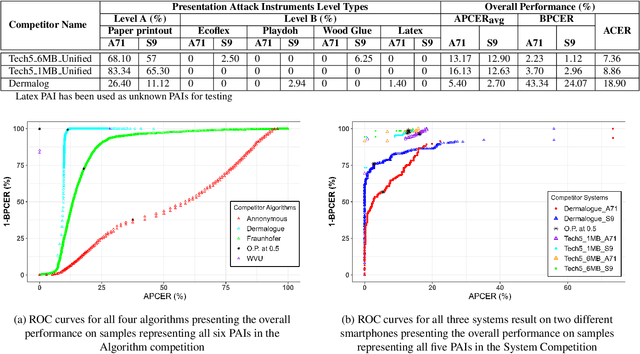
Liveness Detection (LivDet) is an international competition series open to academia and industry with the objec-tive to assess and report state-of-the-art in Presentation Attack Detection (PAD). LivDet-2023 Noncontact Fingerprint is the first edition of the noncontact fingerprint-based PAD competition for algorithms and systems. The competition serves as an important benchmark in noncontact-based fingerprint PAD, offering (a) independent assessment of the state-of-the-art in noncontact-based fingerprint PAD for algorithms and systems, and (b) common evaluation protocol, which includes finger photos of a variety of Presentation Attack Instruments (PAIs) and live fingers to the biometric research community (c) provides standard algorithm and system evaluation protocols, along with the comparative analysis of state-of-the-art algorithms from academia and industry with both old and new android smartphones. The winning algorithm achieved an APCER of 11.35% averaged overall PAIs and a BPCER of 0.62%. The winning system achieved an APCER of 13.0.4%, averaged over all PAIs tested over all the smartphones, and a BPCER of 1.68% over all smartphones tested. Four-finger systems that make individual finger-based PAD decisions were also tested. The dataset used for competition will be available 1 to all researchers as per data share protocol