 Add to Chrome
 Add to Firefox
 Add to Edge
Mitigating Longitudinal Performance Degradation in Child Face Recognition Using Synthetic Data
Jan 04, 2026
Longitudinal face recognition in children remains challenging due to rapid and nonlinear facial growth, which causes template drift and increasing verification errors over time. This work investigates whether synthetic face data can act as a longitudinal stabilizer by improving temporal robustness of child face recognition models. Using an identity disjoint protocol on the Young Face Aging (YFA) dataset, we evaluate three settings: (i) pretrained MagFace embeddings without dataset specific fine-tuning, (ii) MagFace fine-tuned using authentic training faces only, and (iii) MagFace fine-tuned using a combination of authentic and synthetically generated training faces. Synthetic data is generated using StyleGAN2 ADA and incorporated exclusively within the training identities; a post generation filtering step is applied to mitigate identity leakage and remove artifact affected samples. Experimental results across enrollment verification gaps from 6 to 36 months show that synthetic-augmented fine tuning substantially reduces error rates relative to both the pretrained baseline and real only fine tuning. These findings provide a risk aware assessment of synthetic augmentation for improving identity persistence in pediatric face recognition.

Evaluating Deep Learning-Based Face Recognition for Infants and Toddlers: Impact of Age Across Developmental Stages
Jan 04, 2026Face recognition for infants and toddlers presents unique challenges due to rapid facial morphology changes, high inter-class similarity, and limited dataset availability. This study evaluates the performance of four deep learning-based face recognition models FaceNet, ArcFace, MagFace, and CosFace on a newly developed longitudinal dataset collected over a 24 month period in seven sessions involving children aged 0 to 3 years. Our analysis examines recognition accuracy across developmental stages, showing that the True Accept Rate (TAR) is only 30.7% at 0.1% False Accept Rate (FAR) for infants aged 0 to 6 months, due to unstable facial features. Performance improves significantly in older children, reaching 64.7% TAR at 0.1% FAR in the 2.5 to 3 year age group. We also evaluate verification performance over different time intervals, revealing that shorter time gaps result in higher accuracy due to reduced embedding drift. To mitigate this drift, we apply a Domain Adversarial Neural Network (DANN) approach that improves TAR by over 12%, yielding features that are more temporally stable and generalizable. These findings are critical for building biometric systems that function reliably over time in smart city applications such as public healthcare, child safety, and digital identity services. The challenges observed in early age groups highlight the importance of future research on privacy preserving biometric authentication systems that can address temporal variability, particularly in secure and regulated urban environments where child verification is essential.
Post-Mortem Human Iris Segmentation Analysis with Deep Learning
Aug 06, 2024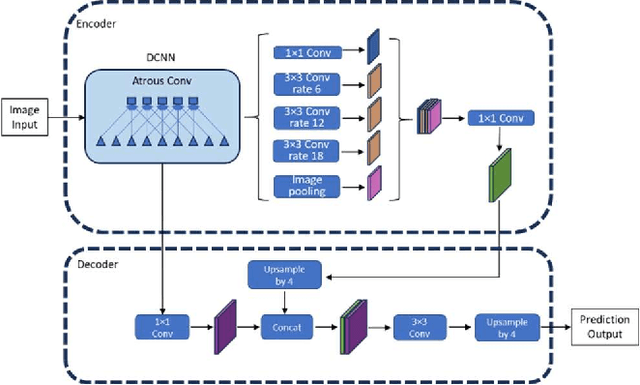
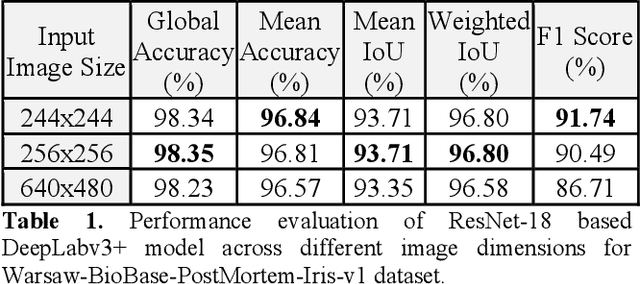
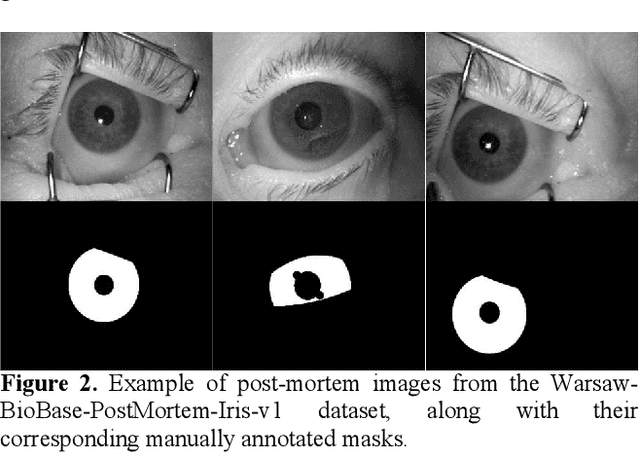
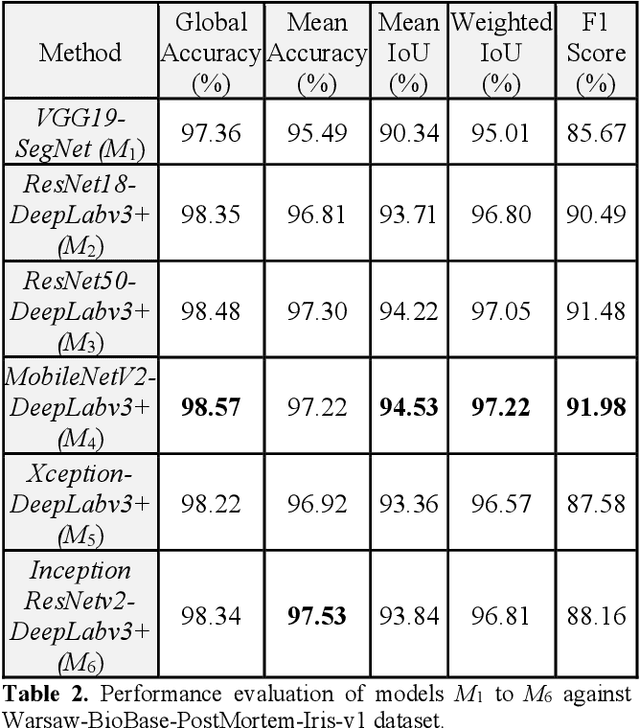
Iris recognition is widely used in several fields such as mobile phones, financial transactions, identification cards, airport security, international border control, voter registration for living persons. However, the possibility of identifying deceased individuals based on their iris patterns has emerged recently as a supplementary or alternative method valuable in forensic analysis. Simultaneously, it poses numerous new technological challenges and one of the most challenging among them is the image segmentation stage as conventional iris recognition approaches have struggled to reliably execute it. This paper presents and compares Deep Learning (DL) models designed for segmenting iris images collected from the deceased subjects, by training SegNet and DeepLabV3+ semantic segmentation methods where using VGG19, ResNet18, ResNet50, MobileNetv2, Xception, or InceptionResNetv2 as backbones. In this study, our experiments demonstrate that our proposed method effectively learns and identifies specific deformations inherent in post-mortem samples and providing a significant improvement in accuracy. By employing our novel method MobileNetv2 as the backbone of DeepLabV3+ and replacing the final layer with a hybrid loss function combining Boundary and Dice loss, we achieve Mean Intersection over Union of 95.54% on the Warsaw-BioBase-PostMortem-Iris-v1 dataset. To the best of our knowledge, this study provides the most extensive evaluation of DL models for post-mortem iris segmentation.
Deep Learning Approach for Ear Recognition and Longitudinal Evaluation in Children
Aug 02, 2024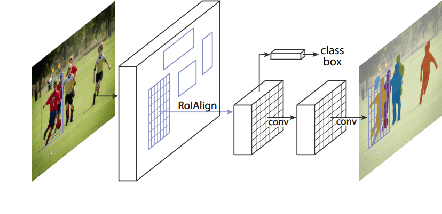
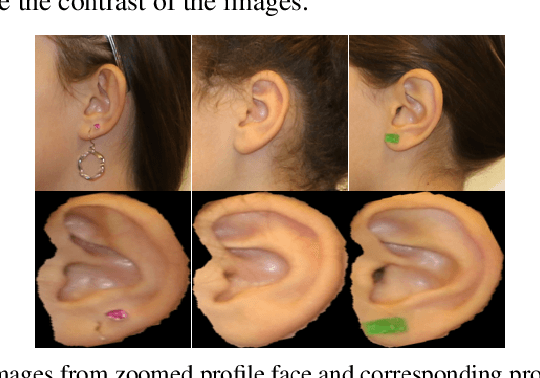
Ear recognition as a biometric modality is becoming increasingly popular, with promising broader application areas. While current applications involve adults, one of the challenges in ear recognition for children is the rapid structural changes in the ear as they age. This work introduces a foundational longitudinal dataset collected from children aged 4 to 14 years over a 2.5-year period and evaluates ear recognition performance in this demographic. We present a deep learning based approach for ear recognition, using an ensemble of VGG16 and MobileNet, focusing on both adult and child datasets, with an emphasis on longitudinal evaluation for children.