 Add to Chrome
 Add to Firefox
 Add to Edge
Auditory Attention Decoding without Spatial Information: A Diotic EEG Study
Jan 23, 2026
Auditory attention decoding (AAD) identifies the attended speech stream in multi-speaker environments by decoding brain signals such as electroencephalography (EEG). This technology is essential for realizing smart hearing aids that address the cocktail party problem and for facilitating objective audiometry systems. Existing AAD research mainly utilizes dichotic environments where different speech signals are presented to the left and right ears, enabling models to classify directional attention rather than speech content. However, this spatial reliance limits applicability to real-world scenarios, such as the "cocktail party" situation, where speakers overlap or move dynamically. To address this challenge, we propose an AAD framework for diotic environments where identical speech mixtures are presented to both ears, eliminating spatial cues. Our approach maps EEG and speech signals into a shared latent space using independent encoders. We extract speech features using wav2vec 2.0 and encode them with a 2-layer 1D convolutional neural network (CNN), while employing the BrainNetwork architecture for EEG encoding. The model identifies the attended speech by calculating the cosine similarity between EEG and speech representations. We evaluate our method on a diotic EEG dataset and achieve 72.70% accuracy, which is 22.58% higher than the state-of-the-art direction-based AAD method.

New metal-plastic hybrid additive manufacturing strategy: Fabrication of arbitrary metal-patterns on external and even internal surfaces of 3D plastic structures
Dec 22, 2021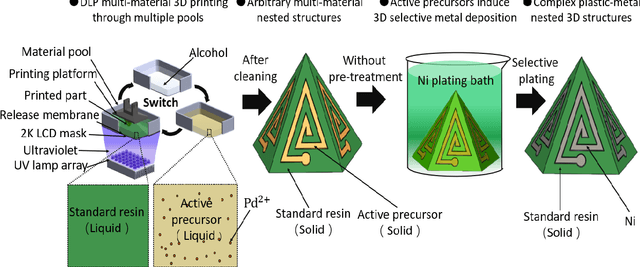
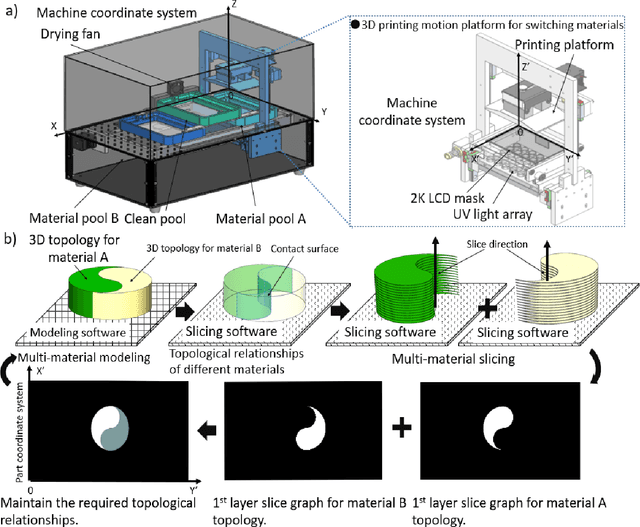
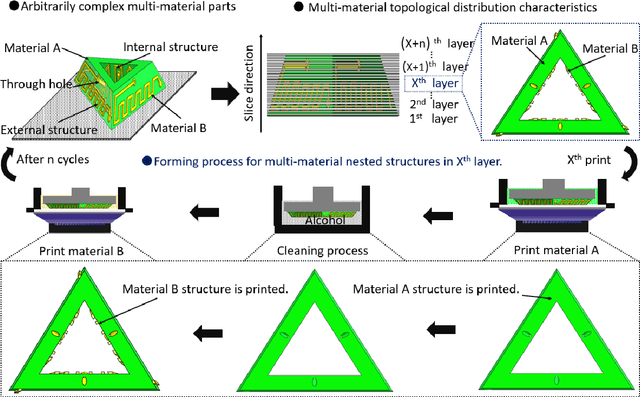
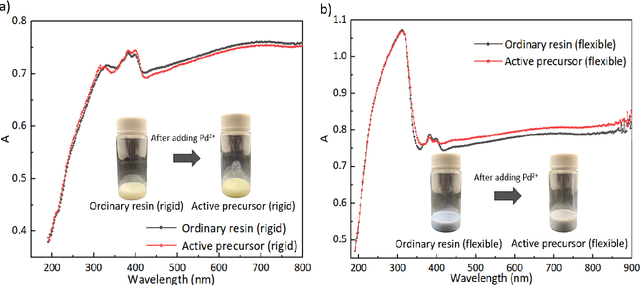
Constructing precise micro-nano metal patterns on complex three-dimensional (3D) plastic parts allows the fabrication of functional devices for advanced applications. However, this patterning is currently expensive and requires complex processes with long manufacturing lead time. The present work demonstrates a process for the fabrication of micro-nano 3D metal-plastic composite structures with arbitrarily complex shapes. In this approach, a light-cured resin is modified to prepare an active precursor capable of allowing subsequent electroless plating (ELP). A multi-material digital light processing 3D printer was newly developed to enable the fabrication of parts containing regions made of either standard resin or active precursor resin nested within each other. Selective 3D ELP processing of such parts provided various metal-plastic composite parts having complicated hollow micro-nano structures with specific topological relationships on a size scale as small as 40 um. Using this technique, 3D metal topologies that cannot be manufactured by traditional methods are possible, and metal patterns can be produced inside plastic parts as a means of further miniaturizing electronic devices. The proposed method can also generate metal coatings exhibiting improved adhesion of metal to plastic substrate. Based on this technique, several sensors composed of different functional nonmetallic materials and specific metal patterns were designed and fabricated. The present results demonstrate the viability of the proposed method and suggest potential applications in the fields of smart 3D micro-nano electronics, 3D wearable devices, micro/nano-sensors, and health care.