 Add to Chrome
 Add to Firefox
 Add to Edge
Serialized Red-Green-Gray: Quicker Heuristic Validation of Edges in Dynamic Roadmap Graphs
Mar 30, 2026
Motion planning in dynamic environments, such as robotic warehouses, requires fast adaptation to frequent changes in obstacle poses. Traditional roadmap-based methods struggle in such settings, relying on inefficient reconstruction of a roadmap or expensive collision detection to update the existing roadmap. To address these challenges we introduce the Red-Green-Gray (RGG) framework, a method that builds on SPITE to quickly classify roadmap edges as invalid (red), valid (green), or uncertain (gray) using conservative geometric approximations. Serial RGG provides a high-performance variant leveraging batch serialization and vectorization to enable efficient GPU acceleration. Empirical results demonstrate that while RGG effectively reduces the number of unknown edges requiring full validation, SerRGG achieves a 2-9x speedup compared to the sequential implementation. This combination of geometric precision and computational speed makes SerRGG highly effective for time-critical robotic applications.

SPITE: Simple Polyhedral Intersection Techniques for modified Environments
Jun 28, 2024
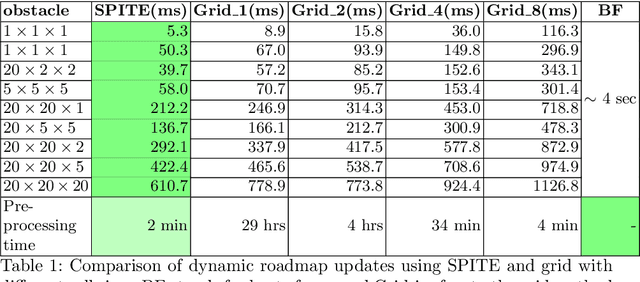
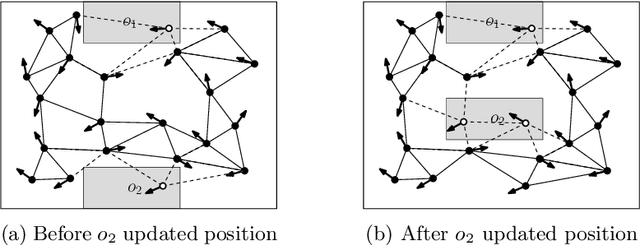
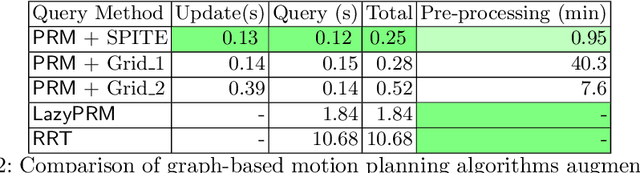
Motion planning in modified environments is a challenging task, as it compounds the innate difficulty of the motion planning problem with a changing environment. This renders some algorithmic methods such as probabilistic roadmaps less viable, as nodes and edges may become invalid as a result of these changes. In this paper, we present a method of transforming any configuration space graph, such as a roadmap, to a dynamic data structure capable of updating the validity of its nodes and edges in response to discrete changes in obstacle positions. We use methods from computational geometry to compute 3D swept volume approximations of configuration space points and curves to achieve 10-40 percent faster updates and up to 60 percent faster motion planning queries than previous algorithms while requiring a significantly shorter pre-processing phase, requiring minutes instead of hours needed by the competing method to achieve somewhat similar update times.