 Add to Chrome
 Add to Firefox
 Add to Edge
Improve the autonomy of the SE2(3) group based Extended Kalman Filter for Integrated Navigation: Application
Jan 25, 2026
One of the core advantages of SE2(3) Lie group framework for navigation modeling lies in the autonomy of error propagation. In the previous paper, the theoretical analysis of autonomy property of navigation model in inertial, earth and world frames was given. A construction method for SE2(3) group navigation model is proposed to improve the non-inertial navigation model toward full autonomy. This paper serves as a counterpart to previous paper and conducts the real-world strapdown inertial navigation system (SINS)/odometer(ODO) experiments as well as Monte-Carlo simulations to demonstrate the performance of improved SE2(3) group based high-precision navigation models.

SP-VIO: Robust and Efficient Filter-Based Visual Inertial Odometry with State Transformation Model and Pose-Only Visual Description
Nov 12, 2024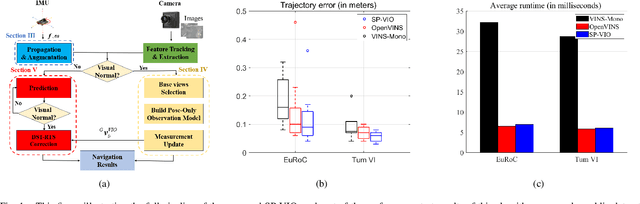
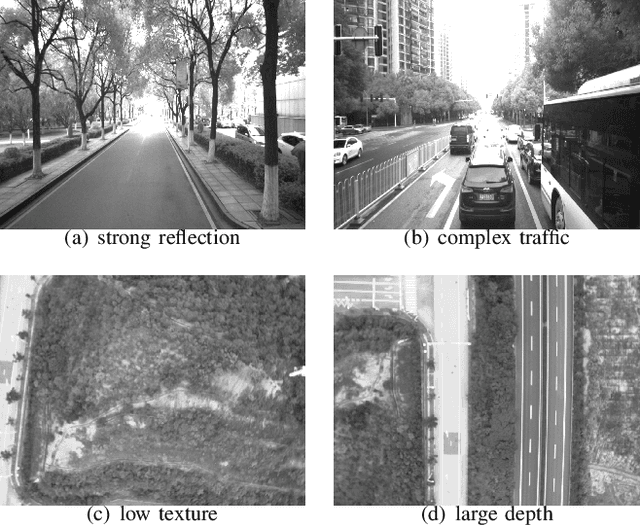
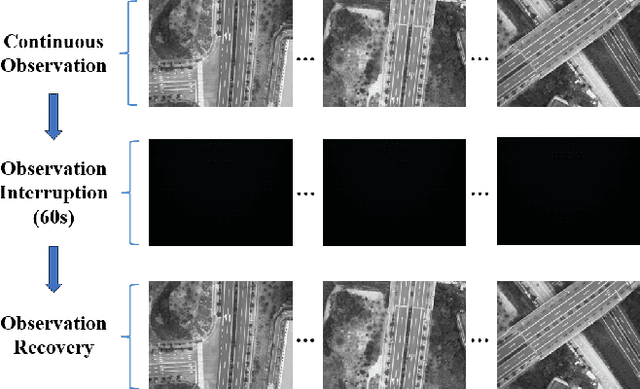
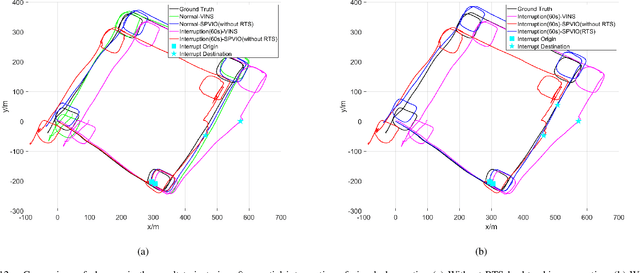
Due to the advantages of high computational efficiency and small memory requirements, filter-based visual inertial odometry (VIO) has a good application prospect in miniaturized and payload-constrained embedded systems. However, the filter-based method has the problem of insufficient accuracy. To this end, we propose the State transformation and Pose-only VIO (SP-VIO) by rebuilding the state and measurement models, and considering further visual deprived conditions. In detail, we first proposed a system model based on the double state transformation extended Kalman filter (DST-EKF), which has been proven to have better observability and consistency than the models based on extended Kalman filter (EKF) and state transformation extended Kalman filter (ST-EKF). Secondly, to reduce the influence of linearization error caused by inaccurate 3D reconstruction, we adopt the Pose-only (PO) theory to decouple the measurement model from 3D features. Moreover, to deal with visual deprived conditions, we propose a double state transformation Rauch-Tung-Striebel (DST-RTS) backtracking method to optimize motion trajectories during visual interruption. Experiments on public (EuRoC, Tum-VI, KITTI) and personal datasets show that SP-VIO has better accuracy and efficiency than state-of-the-art (SOTA) VIO algorithms, and has better robustness under visual deprived conditions.