 Add to Chrome
 Add to Firefox
 Add to Edge
Paradox of De-identification: A Critique of HIPAA Safe Harbour in the Age of LLMs
Feb 09, 2026
Privacy is a human right that sustains patient-provider trust. Clinical notes capture a patient's private vulnerability and individuality, which are used for care coordination and research. Under HIPAA Safe Harbor, these notes are de-identified to protect patient privacy. However, Safe Harbor was designed for an era of categorical tabular data, focusing on the removal of explicit identifiers while ignoring the latent information found in correlations between identity and quasi-identifiers, which can be captured by modern LLMs. We first formalize these correlations using a causal graph, then validate it empirically through individual re-identification of patients from scrubbed notes. The paradox of de-identification is further shown through a diagnosis ablation: even when all other information is removed, the model can predict the patient's neighborhood based on diagnosis alone. This position paper raises the question of how we can act as a community to uphold patient-provider trust when de-identification is inherently imperfect. We aim to raise awareness and discuss actionable recommendations.

Generalist Foundation Models Are Not Clinical Enough for Hospital Operations
Nov 17, 2025Hospitals and healthcare systems rely on operational decisions that determine patient flow, cost, and quality of care. Despite strong performance on medical knowledge and conversational benchmarks, foundation models trained on general text may lack the specialized knowledge required for these operational decisions. We introduce Lang1, a family of models (100M-7B parameters) pretrained on a specialized corpus blending 80B clinical tokens from NYU Langone Health's EHRs and 627B tokens from the internet. To rigorously evaluate Lang1 in real-world settings, we developed the REalistic Medical Evaluation (ReMedE), a benchmark derived from 668,331 EHR notes that evaluates five critical tasks: 30-day readmission prediction, 30-day mortality prediction, length of stay, comorbidity coding, and predicting insurance claims denial. In zero-shot settings, both general-purpose and specialized models underperform on four of five tasks (36.6%-71.7% AUROC), with mortality prediction being an exception. After finetuning, Lang1-1B outperforms finetuned generalist models up to 70x larger and zero-shot models up to 671x larger, improving AUROC by 3.64%-6.75% and 1.66%-23.66% respectively. We also observed cross-task scaling with joint finetuning on multiple tasks leading to improvement on other tasks. Lang1-1B effectively transfers to out-of-distribution settings, including other clinical tasks and an external health system. Our findings suggest that predictive capabilities for hospital operations require explicit supervised finetuning, and that this finetuning process is made more efficient by in-domain pretraining on EHR. Our findings support the emerging view that specialized LLMs can compete with generalist models in specialized tasks, and show that effective healthcare systems AI requires the combination of in-domain pretraining, supervised finetuning, and real-world evaluation beyond proxy benchmarks.
Language Model Classifier Aligns Better with Physician Word Sensitivity than XGBoost on Readmission Prediction
Nov 15, 2022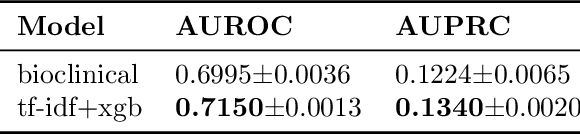
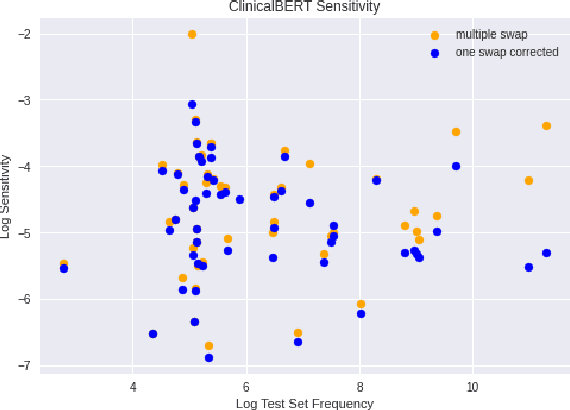
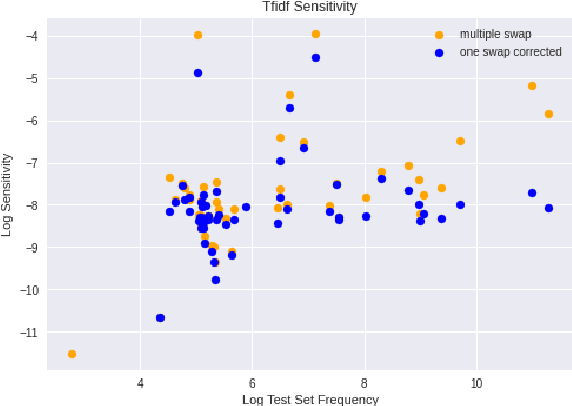
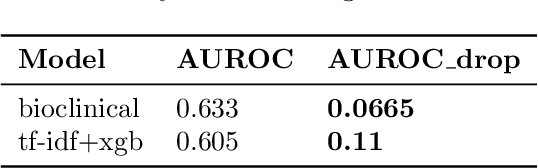
Traditional evaluation metrics for classification in natural language processing such as accuracy and area under the curve fail to differentiate between models with different predictive behaviors despite their similar performance metrics. We introduce sensitivity score, a metric that scrutinizes models' behaviors at the vocabulary level to provide insights into disparities in their decision-making logic. We assess the sensitivity score on a set of representative words in the test set using two classifiers trained for hospital readmission classification with similar performance statistics. Our experiments compare the decision-making logic of clinicians and classifiers based on rank correlations of sensitivity scores. The results indicate that the language model's sensitivity score aligns better with the professionals than the xgboost classifier on tf-idf embeddings, which suggests that xgboost uses some spurious features. Overall, this metric offers a novel perspective on assessing models' robustness by quantifying their discrepancy with professional opinions. Our code is available on GitHub (https://github.com/nyuolab/Model_Sensitivity).