 Add to Chrome
 Add to Firefox
 Add to Edge
From Score to Sound: An End-to-End MIDI-to-Motion Pipeline for Robotic Cello Performance
Jan 07, 2026
Robot musicians require precise control to obtain proper note accuracy, sound quality, and musical expression. Performance of string instruments, such as violin and cello, presents a significant challenge due to the precise control required over bow angle and pressure to produce the desired sound. While prior robotic cellists focus on accurate bowing trajectories, these works often rely on expensive motion capture techniques, and fail to sightread music in a human-like way. We propose a novel end-to-end MIDI score to robotic motion pipeline which converts musical input directly into collision-aware bowing motions for a UR5e robot cellist. Through use of Universal Robot Freedrive feature, our robotic musician can achieve human-like sound without the need for motion capture. Additionally, this work records live joint data via Real-Time Data Exchange (RTDE) as the robot plays, providing labeled robotic playing data from a collection of five standard pieces to the research community. To demonstrate the effectiveness of our method in comparison to human performers, we introduce the Musical Turing Test, in which a collection of 132 human participants evaluate our robot's performance against a human baseline. Human reference recordings are also released, enabling direct comparison for future studies. This evaluation technique establishes the first benchmark for robotic cello performance. Finally, we outline a residual reinforcement learning methodology to improve upon baseline robotic controls, highlighting future opportunities for improved string-crossing efficiency and sound quality.

Detecting Music Performance Errors with Transformers
Jan 03, 2025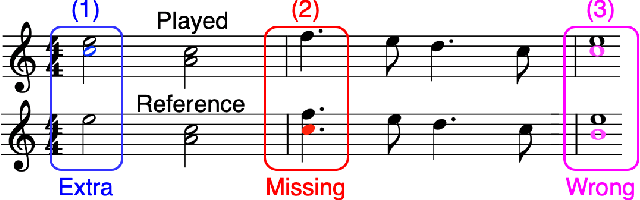
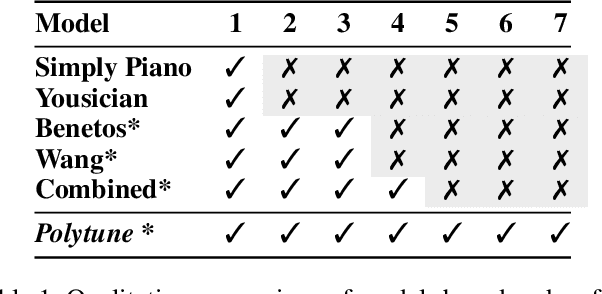
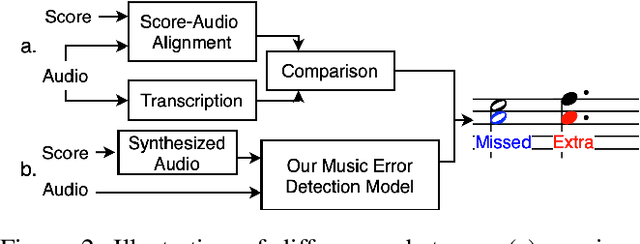
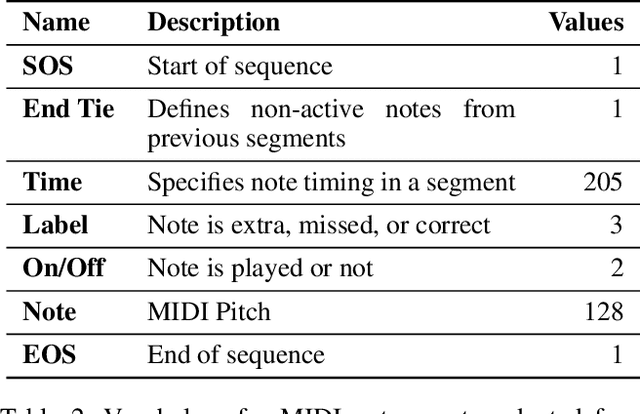
Beginner musicians often struggle to identify specific errors in their performances, such as playing incorrect notes or rhythms. There are two limitations in existing tools for music error detection: (1) Existing approaches rely on automatic alignment; therefore, they are prone to errors caused by small deviations between alignment targets.; (2) There is a lack of sufficient data to train music error detection models, resulting in over-reliance on heuristics. To address (1), we propose a novel transformer model, Polytune, that takes audio inputs and outputs annotated music scores. This model can be trained end-to-end to implicitly align and compare performance audio with music scores through latent space representations. To address (2), we present a novel data generation technique capable of creating large-scale synthetic music error datasets. Our approach achieves a 64.1% average Error Detection F1 score, improving upon prior work by 40 percentage points across 14 instruments. Additionally, compared with existing transcription methods repurposed for music error detection, our model can handle multiple instruments. Our source code and datasets are available at https://github.com/ben2002chou/Polytune.