 Add to Chrome
 Add to Firefox
 Add to Edge
Eliminating Hallucination in Diffusion-Augmented Interactive Text-to-Image Retrieval
Jan 28, 2026
Diffusion-Augmented Interactive Text-to-Image Retrieval (DAI-TIR) is a promising paradigm that improves retrieval performance by generating query images via diffusion models and using them as additional ``views'' of the user's intent. However, these generative views can be incorrect because diffusion generation may introduce hallucinated visual cues that conflict with the original query text. Indeed, we empirically demonstrate that these hallucinated cues can substantially degrade DAI-TIR performance. To address this, we propose Diffusion-aware Multi-view Contrastive Learning (DMCL), a hallucination-robust training framework that casts DAI-TIR as joint optimization over representations of query intent and the target image. DMCL introduces semantic-consistency and diffusion-aware contrastive objectives to align textual and diffusion-generated query views while suppressing hallucinated query signals. This yields an encoder that acts as a semantic filter, effectively mapping hallucinated cues into a null space, improving robustness to spurious cues and better representing the user's intent. Attention visualization and geometric embedding-space analyses corroborate this filtering behavior. Across five standard benchmarks, DMCL delivers consistent improvements in multi-round Hits@10, reaching as high as 7.37\% over prior fine-tuned and zero-shot baselines, which indicates it is a general and robust training framework for DAI-TIR.

Zero-Shot Interactive Text-to-Image Retrieval via Diffusion-Augmented Representations
Jan 26, 2025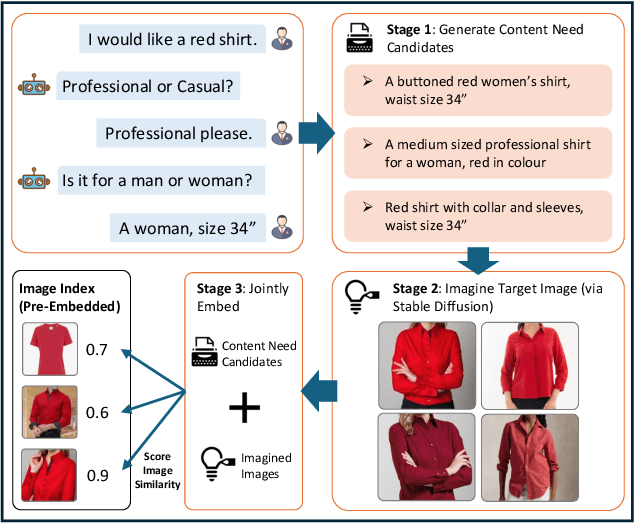
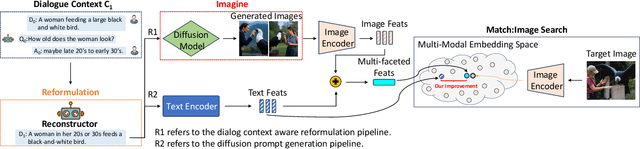
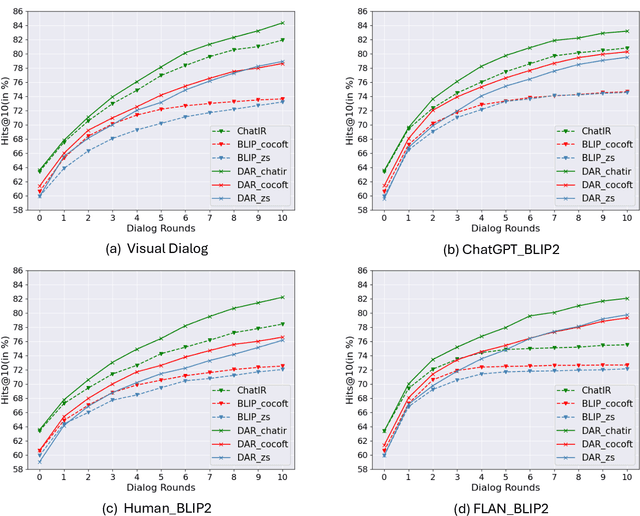
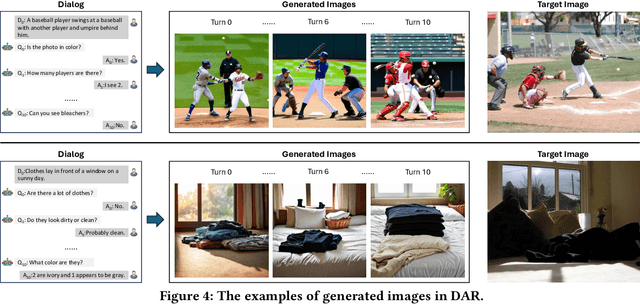
Interactive Text-to-Image Retrieval (I-TIR) has emerged as a transformative user-interactive tool for applications in domains such as e-commerce and education. Yet, current methodologies predominantly depend on finetuned Multimodal Large Language Models (MLLMs), which face two critical limitations: (1) Finetuning imposes prohibitive computational overhead and long-term maintenance costs. (2) Finetuning narrows the pretrained knowledge distribution of MLLMs, reducing their adaptability to novel scenarios. These issues are exacerbated by the inherently dynamic nature of real-world I-TIR systems, where queries and image databases evolve in complexity and diversity, often deviating from static training distributions. To overcome these constraints, we propose Diffusion Augmented Retrieval (DAR), a paradigm-shifting framework that bypasses MLLM finetuning entirely. DAR synergizes Large Language Model (LLM)-guided query refinement with Diffusion Model (DM)-based visual synthesis to create contextually enriched intermediate representations. This dual-modality approach deciphers nuanced user intent more holistically, enabling precise alignment between textual queries and visually relevant images. Rigorous evaluations across four benchmarks reveal DAR's dual strengths: (1) Matches state-of-the-art finetuned I-TIR models on straightforward queries without task-specific training. (2) Scalable Generalization: Surpasses finetuned baselines by 7.61% in Hits@10 (top-10 accuracy) under multi-turn conversational complexity, demonstrating robustness to intricate, distributionally shifted interactions. By eliminating finetuning dependencies and leveraging generative-augmented representations, DAR establishes a new trajectory for efficient, adaptive, and scalable cross-modal retrieval systems.