 Add to Chrome
 Add to Firefox
 Add to Edge
TxRay: Agentic Postmortem of Live Blockchain Attacks
Feb 01, 2026
Decentralized Finance (DeFi) has turned blockchains into financial infrastructure, allowing anyone to trade, lend, and build protocols without intermediaries, but this openness exposes pools of value controlled by code. Within five years, the DeFi ecosystem has lost over 15.75B USD to reported exploits. Many exploits arise from permissionless opportunities that any participant can trigger using only public state and standard interfaces, which we call Anyone-Can-Take (ACT) opportunities. Despite on-chain transparency, postmortem analysis remains slow and manual: investigations start from limited evidence, sometimes only a single transaction hash, and must reconstruct the exploit lifecycle by recovering related transactions, contract code, and state dependencies. We present TxRay, a Large Language Model (LLM) agentic postmortem system that uses tool calls to reconstruct live ACT attacks from limited evidence. Starting from one or more seed transactions, TxRay recovers the exploit lifecycle, derives an evidence-backed root cause, and generates a runnable, self-contained Proof of Concept (PoC) that deterministically reproduces the incident. TxRay self-checks postmortems by encoding incident-specific semantic oracles as executable assertions. To evaluate PoC correctness and quality, we develop PoCEvaluator, an independent agentic execution-and-review evaluator. On 114 incidents from DeFiHackLabs, TxRay produces an expert-aligned root cause and an executable PoC for 105 incidents, achieving 92.11% end-to-end reproduction. Under PoCEvaluator, 98.1% of TxRay PoCs avoid hard-coding attacker addresses, a +24.8pp lift over DeFiHackLabs. In a live deployment, TxRay delivers validated root causes in 40 minutes and PoCs in 59 minutes at median latency. TxRay's oracle-validated PoCs enable attack imitation, improving coverage by 15.6% and 65.5% over STING and APE.

Blockchain Large Language Models
Apr 29, 2023
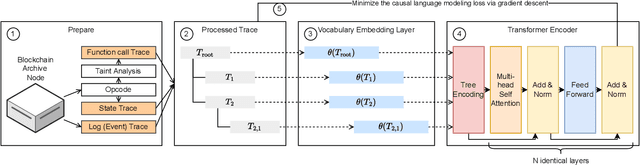

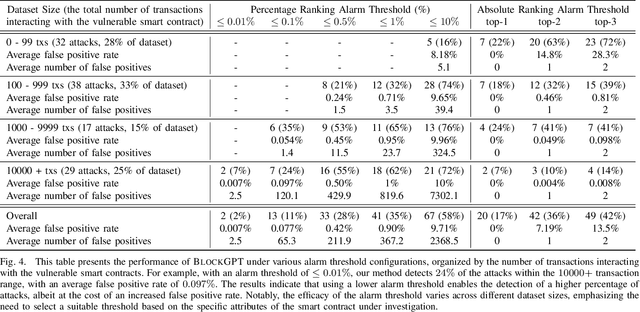
This paper presents a dynamic, real-time approach to detecting anomalous blockchain transactions. The proposed tool, BlockGPT, generates tracing representations of blockchain activity and trains from scratch a large language model to act as a real-time Intrusion Detection System. Unlike traditional methods, BlockGPT is designed to offer an unrestricted search space and does not rely on predefined rules or patterns, enabling it to detect a broader range of anomalies. We demonstrate the effectiveness of BlockGPT through its use as an anomaly detection tool for Ethereum transactions. In our experiments, it effectively identifies abnormal transactions among a dataset of 68M transactions and has a batched throughput of 2284 transactions per second on average. Our results show that, BlockGPT identifies abnormal transactions by ranking 49 out of 124 attacks among the top-3 most abnormal transactions interacting with their victim contracts. This work makes contributions to the field of blockchain transaction analysis by introducing a custom data encoding compatible with the transformer architecture, a domain-specific tokenization technique, and a tree encoding method specifically crafted for the Ethereum Virtual Machine (EVM) trace representation.