 Add to Chrome
 Add to Firefox
 Add to Edge
Communication-Avoiding Linear Algebraic Kernel K-Means on GPUs
Jan 23, 2026
Clustering is an important tool in data analysis, with K-means being popular for its simplicity and versatility. However, it cannot handle non-linearly separable clusters. Kernel K-means addresses this limitation but requires a large kernel matrix, making it computationally and memory intensive. Prior work has accelerated Kernel K-means by formulating it using sparse linear algebra primitives and implementing it on a single GPU. However, that approach cannot run on datasets with more than approximately 80,000 samples due to limited GPU memory. In this work, we address this issue by presenting a suite of distributed-memory parallel algorithms for large-scale Kernel K-means clustering on multi-GPU systems. Our approach maps the most computationally expensive components of Kernel K-means onto communication-efficient distributed linear algebra primitives uniquely tailored for Kernel K-means, enabling highly scalable implementations that efficiently cluster million-scale datasets. Central to our work is the design of partitioning schemes that enable communication-efficient composition of the linear algebra primitives that appear in Kernel K-means. Our 1.5D algorithm consistently achieves the highest performance, enabling Kernel K-means to scale to data one to two orders of magnitude larger than previously practical. On 256 GPUs, it achieves a geometric mean weak scaling efficiency of $79.7\%$ and a geometric mean strong scaling speedup of $4.2\times$. Compared to our 1D algorithm, the 1.5D approach achieves up to a $3.6\times$ speedup on 256 GPUs and reduces clustering time from over an hour to under two seconds relative to a single-GPU sliding window implementation. Our results show that distributed algorithms designed with application-specific linear algebraic formulations can achieve substantial performance improvement.

Tackling the Matrix Multiplication Micro-kernel Generation with Exo
Oct 27, 2023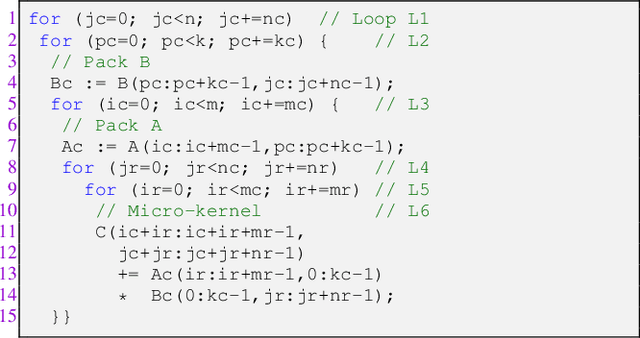
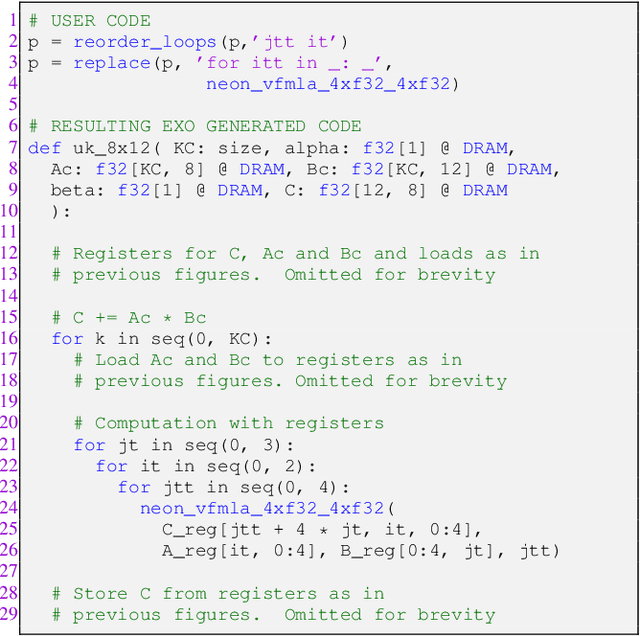
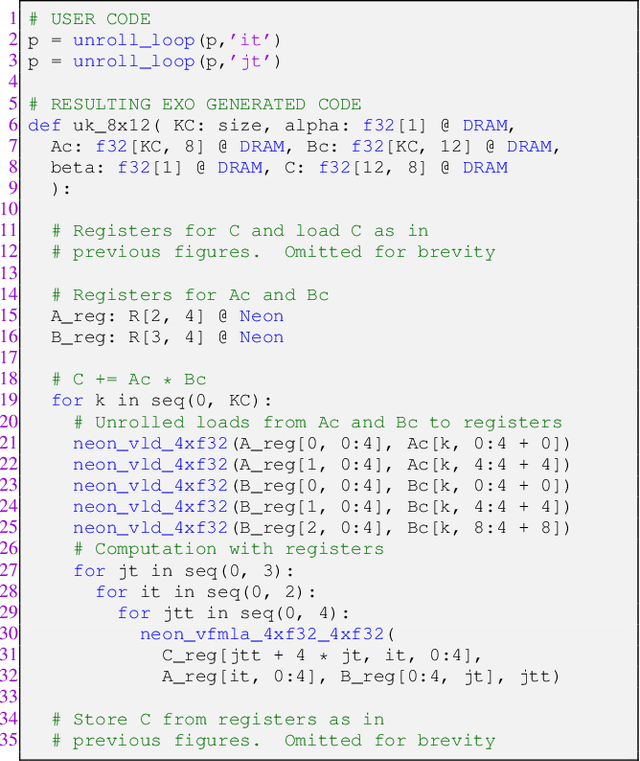
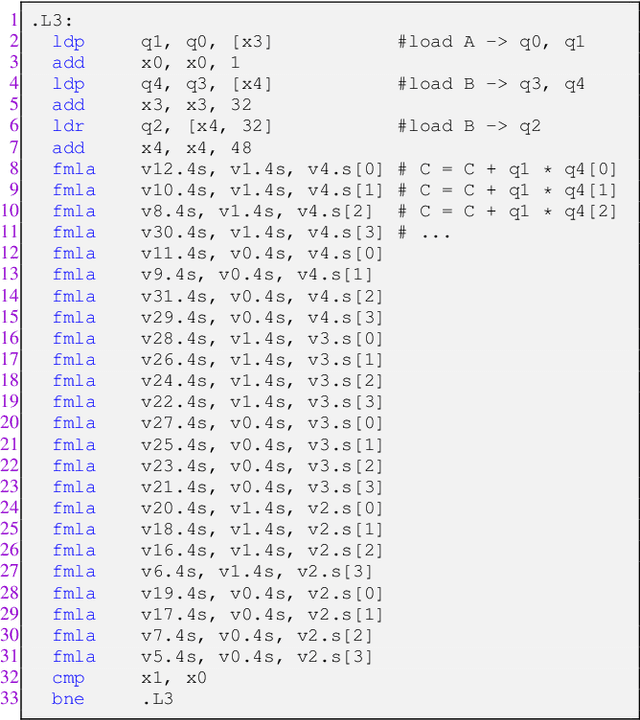
The optimization of the matrix multiplication (or GEMM) has been a need during the last decades. This operation is considered the flagship of current linear algebra libraries such as BLIS, OpenBLAS, or Intel OneAPI because of its widespread use in a large variety of scientific applications. The GEMM is usually implemented following the GotoBLAS philosophy, which tiles the GEMM operands and uses a series of nested loops for performance improvement. These approaches extract the maximum computational power of the architectures through small pieces of hardware-oriented, high-performance code called micro-kernel. However, this approach forces developers to generate, with a non-negligible effort, a dedicated micro-kernel for each new hardware. In this work, we present a step-by-step procedure for generating micro-kernels with the Exo compiler that performs close to (or even better than) manually developed microkernels written with intrinsic functions or assembly language. Our solution also improves the portability of the generated code, since a hardware target is fully specified by a concise library-based description of its instructions.