 Add to Chrome
 Add to Firefox
 Add to Edge
RoamScene3D: Immersive Text-to-3D Scene Generation via Adaptive Object-aware Roaming
Jan 27, 2026
Generating immersive 3D scenes from texts is a core task in computer vision, crucial for applications in virtual reality and game development. Despite the promise of leveraging 2D diffusion priors, existing methods suffer from spatial blindness and rely on predefined trajectories that fail to exploit the inner relationships among salient objects. Consequently, these approaches are unable to comprehend the semantic layout, preventing them from exploring the scene adaptively to infer occluded content. Moreover, current inpainting models operate in 2D image space, struggling to plausibly fill holes caused by camera motion. To address these limitations, we propose RoamScene3D, a novel framework that bridges the gap between semantic guidance and spatial generation. Our method reasons about the semantic relations among objects and produces consistent and photorealistic scenes. Specifically, we employ a vision-language model (VLM) to construct a scene graph that encodes object relations, guiding the camera to perceive salient object boundaries and plan an adaptive roaming trajectory. Furthermore, to mitigate the limitations of static 2D priors, we introduce a Motion-Injected Inpainting model that is fine-tuned on a synthetic panoramic dataset integrating authentic camera trajectories, making it adaptive to camera motion. Extensive experiments demonstrate that with semantic reasoning and geometric constraints, our method significantly outperforms state-of-the-art approaches in producing consistent and photorealistic scenes. Our code is available at https://github.com/JS-CHU/RoamScene3D.

Digging into Intrinsic Contextual Information for High-fidelity 3D Point Cloud Completion
Dec 11, 2024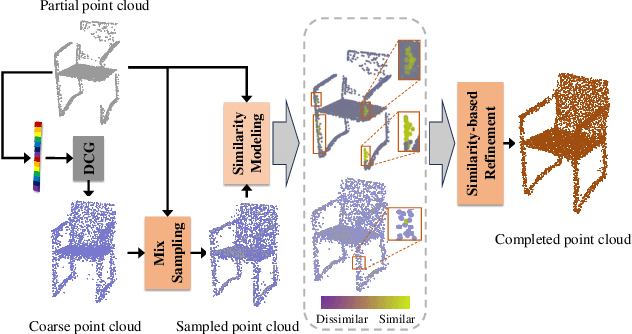
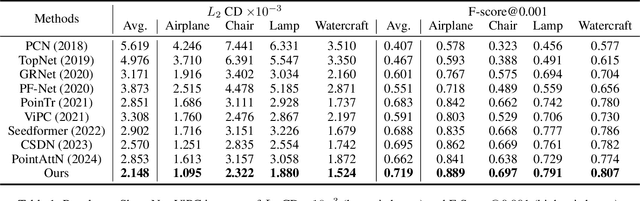

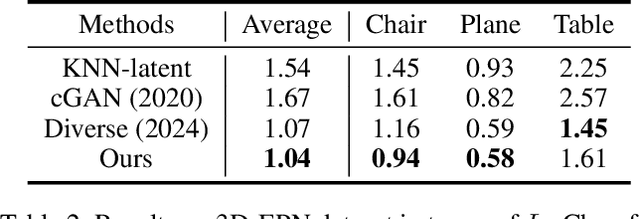
The common occurrence of occlusion-induced incompleteness in point clouds has made point cloud completion (PCC) a highly-concerned task in the field of geometric processing. Existing PCC methods typically produce complete point clouds from partial point clouds in a coarse-to-fine paradigm, with the coarse stage generating entire shapes and the fine stage improving texture details. Though diffusion models have demonstrated effectiveness in the coarse stage, the fine stage still faces challenges in producing high-fidelity results due to the ill-posed nature of PCC. The intrinsic contextual information for texture details in partial point clouds is the key to solving the challenge. In this paper, we propose a high-fidelity PCC method that digs into both short and long-range contextual information from the partial point cloud in the fine stage. Specifically, after generating the coarse point cloud via a diffusion-based coarse generator, a mixed sampling module introduces short-range contextual information from partial point clouds into the fine stage. A surface freezing modules safeguards points from noise-free partial point clouds against disruption. As for the long-range contextual information, we design a similarity modeling module to derive similarity with rigid transformation invariance between points, conducting effective matching of geometric manifold features globally. In this way, the high-quality components present in the partial point cloud serve as valuable references for refining the coarse point cloud with high fidelity. Extensive experiments have demonstrated the superiority of the proposed method over SOTA competitors. Our code is available at https://github.com/JS-CHU/ContextualCompletion.