 Add to Chrome
 Add to Firefox
 Add to Edge
Coverage First Next Best View for Inspection of Cluttered Pipe Networks Using Mobile Manipulators
Mar 17, 2026
Robotic inspection of radioactive areas enables operators to be removed from hazardous environments; however, planning and operating in confined, cluttered environments remain challenging. These systems must autonomously reconstruct the unknown environment and cover its surfaces, whilst estimating and avoiding collisions with objects in the environment. In this paper, we propose a new planning approach based on next-best-view that enables simultaneous exploration and exploitation of the environment by reformulating the coverage path planning problem in terms of information gain. To handle obstacle avoidance under uncertainty, we extend the vector-field-inequalities framework to explicitly account for stochastic measurements of geometric primitives in the environment via chance constraints in a constrained optimal control law. The stochastic constraints were evaluated experimentally alongside the planner on a mobile manipulator in a confined environment to inspect a pipe network. These experiments demonstrate that the system can autonomously plan and execute inspection and coverage paths to reconstruct and fully cover the simplified pipe network. Moreover, the system successfully estimated geometric primitives online and avoided collisions during motion between viewpoints.

Non-Invasive Diagnosis for Clubroot Using Terahertz Time-Domain Spectroscopy and Physics-Constrained Neural Networks
Jan 19, 2026Clubroot, a major soilborne disease affecting canola and other cruciferous crops, is characterized by the development of large galls on the roots of susceptible hosts. In this study, we present the first application of terahertz time-domain spectroscopy (THz-TDS) as a non-invasive diagnosis tool in plant pathology. Compared with conventional molecular, spectroscopic, and immunoassay-based methods, THz-TDS offers distinct advantages, including non-contact, non-destructive, and preparation-free measurement, enabling rapid in situ screening of plant and soil samples. Our results demonstrate that THz-TDS can differentiate between healthy and clubroot-infected tissues by detecting both structural and biochemical alterations. Specifically, infected roots exhibit a blue shift in the refractive index in the low-frequency THz range, along with distinct peaks-indicative of disruptions in water transport and altered metabolic activity in both roots and leaves. Interestingly, the characteristic root swelling observed in infected plants reflects internal tissue disorganization rather than an actual increase in water content. Furthermore, a physics-constrained neural network is proposed to extract the main feature in THz-TDS. A comprehensive evaluation, including time-domain signals, amplitude and phase images, refractive index and absorption coefficient maps, and principal component analysis, provides enhanced contrast and spatial resolution compared to raw time-domain or frequency signals. These findings suggest that THz-TDS holds significant potential for early, non-destructive detection of plant diseases and may serve as a valuable tool to limit their spread in agricultural systems.
JC5A: Service Delay Minimization for Aerial MEC-assisted Industrial Cyber-Physical Systems
Nov 07, 2024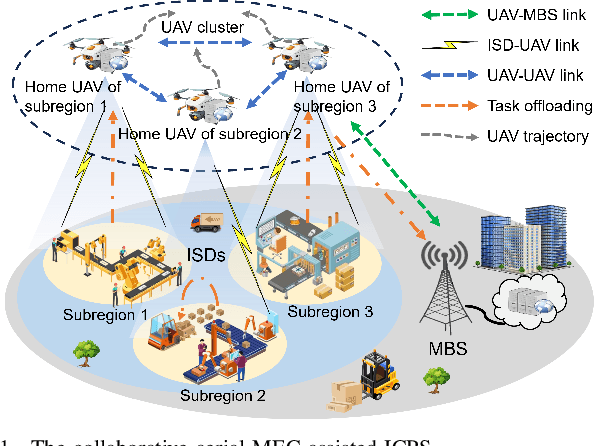
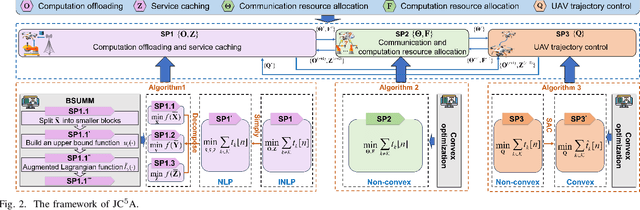
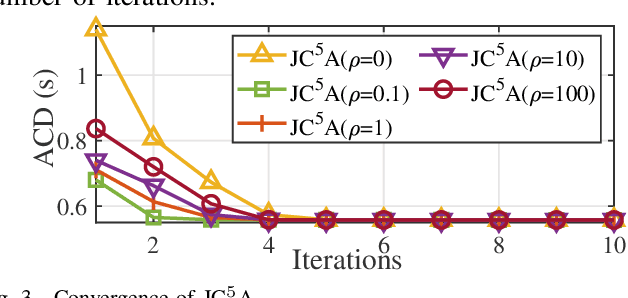
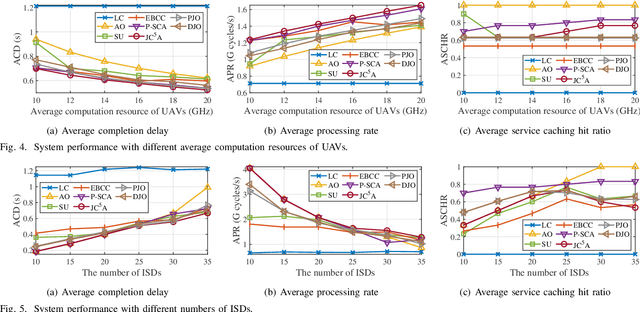
In the era of the sixth generation (6G) and industrial Internet of Things (IIoT), an industrial cyber-physical system (ICPS) drives the proliferation of sensor devices and computing-intensive tasks. To address the limited resources of IIoT sensor devices, unmanned aerial vehicle (UAV)-assisted mobile edge computing (MEC) has emerged as a promising solution, providing flexible and cost-effective services in close proximity of IIoT sensor devices (ISDs). However, leveraging aerial MEC to meet the delay-sensitive and computation-intensive requirements of the ISDs could face several challenges, including the limited communication, computation and caching (3C) resources, stringent offloading requirements for 3C services, and constrained on-board energy of UAVs. To address these issues, we first present a collaborative aerial MEC-assisted ICPS architecture by incorporating the computing capabilities of the macro base station (MBS) and UAVs. We then formulate a service delay minimization optimization problem (SDMOP). Since the SDMOP is proved to be an NP-hard problem, we propose a joint computation offloading, caching, communication resource allocation, computation resource allocation, and UAV trajectory control approach (JC5A). Specifically, JC5A consists of a block successive upper bound minimization method of multipliers (BSUMM) for computation offloading and service caching, a convex optimization-based method for communication and computation resource allocation, and a successive convex approximation (SCA)-based method for UAV trajectory control. Moreover, we theoretically prove the convergence and polynomial complexity of JC5A. Simulation results demonstrate that the proposed approach can achieve superior system performance compared to the benchmark approaches and algorithms.