 Add to Chrome
 Add to Firefox
 Add to Edge
TF-CoDiT: Conditional Time Series Synthesis with Diffusion Transformers for Treasury Futures
Jan 17, 2026
Diffusion Transformers (DiT) have achieved milestones in synthesizing financial time-series data, such as stock prices and order flows. However, their performance in synthesizing treasury futures data is still underexplored. This work emphasizes the characteristics of treasury futures data, including its low volume, market dependencies, and the grouped correlations among multivariables. To overcome these challenges, we propose TF-CoDiT, the first DiT framework for language-controlled treasury futures synthesis. To facilitate low-data learning, TF-CoDiT adapts the standard DiT by transforming multi-channel 1-D time series into Discrete Wavelet Transform (DWT) coefficient matrices. A U-shape VAE is proposed to encode cross-channel dependencies hierarchically into a latent variable and bridge the latent and DWT spaces through decoding, thereby enabling latent diffusion generation. To derive prompts that cover essential conditions, we introduce the Financial Market Attribute Protocol (FinMAP) - a multi-level description system that standardizes daily$/$periodical market dynamics by recognizing 17$/$23 economic indicators from 7/8 perspectives. In our experiments, we gather four types of treasury futures data covering the period from 2015 to 2025, and define data synthesis tasks with durations ranging from one week to four months. Extensive evaluations demonstrate that TF-CoDiT can produce highly authentic data with errors at most 0.433 (MSE) and 0.453 (MAE) to the ground-truth. Further studies evidence the robustness of TF-CoDiT across contracts and temporal horizons.

Global Context Compression with Interleaved Vision-Text Transformation
Jan 15, 2026Recent achievements of vision-language models in end-to-end OCR point to a new avenue for low-loss compression of textual information. This motivates earlier works that render the Transformer's input into images for prefilling, which effectively reduces the number of tokens through visual encoding, thereby alleviating the quadratically increased Attention computations. However, this partial compression fails to save computational or memory costs at token-by-token inference. In this paper, we investigate global context compression, which saves tokens at both prefilling and inference stages. Consequently, we propose VIST2, a novel Transformer that interleaves input text chunks alongside their visual encoding, while depending exclusively on visual tokens in the pre-context to predict the next text token distribution. Around this idea, we render text chunks into sketch images and train VIST2 in multiple stages, starting from curriculum-scheduled pretraining for optical language modeling, followed by modal-interleaved instruction tuning. We conduct extensive experiments using VIST2 families scaled from 0.6B to 8B to explore the training recipe and hyperparameters. With a 4$\times$ compression ratio, the resulting models demonstrate significant superiority over baselines on long writing tasks, achieving, on average, a 3$\times$ speedup in first-token generation, 77% reduction in memory usage, and 74% reduction in FLOPS. Our codes and datasets will be public to support further studies.
CPTuning: Contrastive Prompt Tuning for Generative Relation Extraction
Jan 04, 2025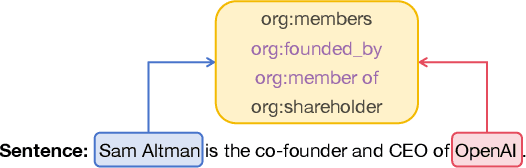

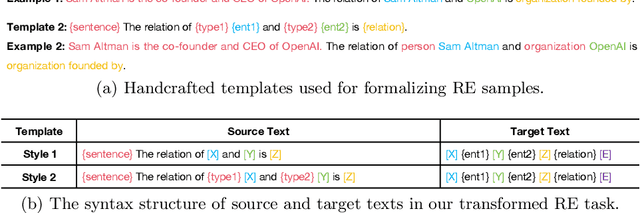
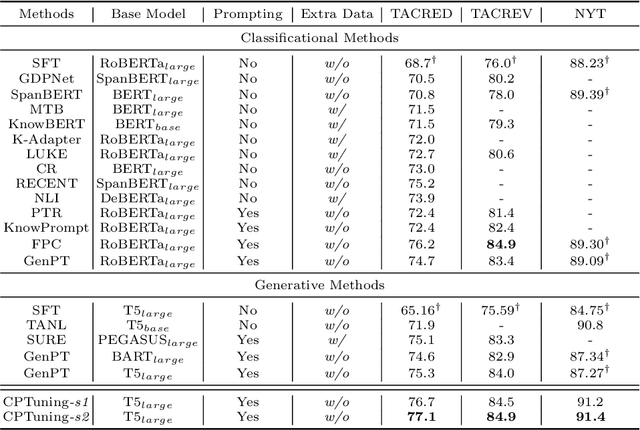
Generative relation extraction (RE) commonly involves first reformulating RE as a linguistic modeling problem easily tackled with pre-trained language models (PLM) and then fine-tuning a PLM with supervised cross-entropy loss. Although having achieved promising performance, existing approaches assume only one deterministic relation between each pair of entities without considering real scenarios where multiple relations may be valid, i.e., entity pair overlap, causing their limited applications. To address this problem, we introduce a novel contrastive prompt tuning method for RE, CPTuning, which learns to associate a candidate relation between two in-context entities with a probability mass above or below a threshold, corresponding to whether the relation exists. Beyond learning schema, CPTuning also organizes RE as a verbalized relation generation task and uses Trie-constrained decoding to ensure a model generates valid relations. It adaptively picks out the generated candidate relations with a high estimated likelihood in inference, thereby achieving multi-relation extraction. We conduct extensive experiments on four widely used datasets to validate our method. Results show that T5-large fine-tuned with CPTuning significantly outperforms previous methods, regardless of single or multiple relations extraction.