 Add to Chrome
 Add to Firefox
 Add to Edge
Rotate Your Character: Revisiting Video Diffusion Models for High-Quality 3D Character Generation
Jan 09, 2026
Generating high-quality 3D characters from single images remains a significant challenge in digital content creation, particularly due to complex body poses and self-occlusion. In this paper, we present RCM (Rotate your Character Model), an advanced image-to-video diffusion framework tailored for high-quality novel view synthesis (NVS) and 3D character generation. Compared to existing diffusion-based approaches, RCM offers several key advantages: (1) transferring characters with any complex poses into a canonical pose, enabling consistent novel view synthesis across the entire viewing orbit, (2) high-resolution orbital video generation at 1024x1024 resolution, (3) controllable observation positions given different initial camera poses, and (4) multi-view conditioning supporting up to 4 input images, accommodating diverse user scenarios. Extensive experiments demonstrate that RCM outperforms state-of-the-art methods in both novel view synthesis and 3D generation quality.

TAGRPO: Boosting GRPO on Image-to-Video Generation with Direct Trajectory Alignment
Jan 09, 2026Recent studies have demonstrated the efficacy of integrating Group Relative Policy Optimization (GRPO) into flow matching models, particularly for text-to-image and text-to-video generation. However, we find that directly applying these techniques to image-to-video (I2V) models often fails to yield consistent reward improvements. To address this limitation, we present TAGRPO, a robust post-training framework for I2V models inspired by contrastive learning. Our approach is grounded in the observation that rollout videos generated from identical initial noise provide superior guidance for optimization. Leveraging this insight, we propose a novel GRPO loss applied to intermediate latents, encouraging direct alignment with high-reward trajectories while maximizing distance from low-reward counterparts. Furthermore, we introduce a memory bank for rollout videos to enhance diversity and reduce computational overhead. Despite its simplicity, TAGRPO achieves significant improvements over DanceGRPO in I2V generation.
Hunyuan-Game: Industrial-grade Intelligent Game Creation Model
May 20, 2025Intelligent game creation represents a transformative advancement in game development, utilizing generative artificial intelligence to dynamically generate and enhance game content. Despite notable progress in generative models, the comprehensive synthesis of high-quality game assets, including both images and videos, remains a challenging frontier. To create high-fidelity game content that simultaneously aligns with player preferences and significantly boosts designer efficiency, we present Hunyuan-Game, an innovative project designed to revolutionize intelligent game production. Hunyuan-Game encompasses two primary branches: image generation and video generation. The image generation component is built upon a vast dataset comprising billions of game images, leading to the development of a group of customized image generation models tailored for game scenarios: (1) General Text-to-Image Generation. (2) Game Visual Effects Generation, involving text-to-effect and reference image-based game visual effect generation. (3) Transparent Image Generation for characters, scenes, and game visual effects. (4) Game Character Generation based on sketches, black-and-white images, and white models. The video generation component is built upon a comprehensive dataset of millions of game and anime videos, leading to the development of five core algorithmic models, each targeting critical pain points in game development and having robust adaptation to diverse game video scenarios: (1) Image-to-Video Generation. (2) 360 A/T Pose Avatar Video Synthesis. (3) Dynamic Illustration Generation. (4) Generative Video Super-Resolution. (5) Interactive Game Video Generation. These image and video generation models not only exhibit high-level aesthetic expression but also deeply integrate domain-specific knowledge, establishing a systematic understanding of diverse game and anime art styles.
Hunyuan-DiT: A Powerful Multi-Resolution Diffusion Transformer with Fine-Grained Chinese Understanding
May 14, 2024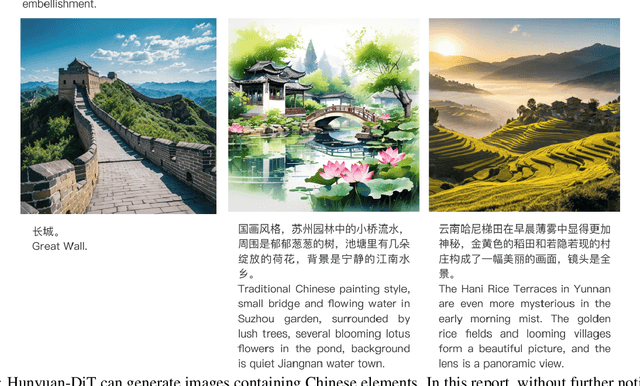
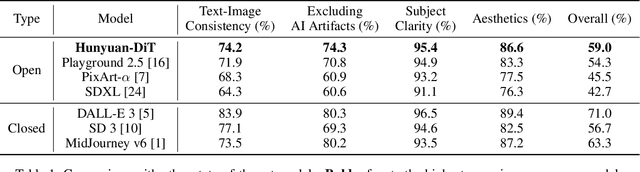

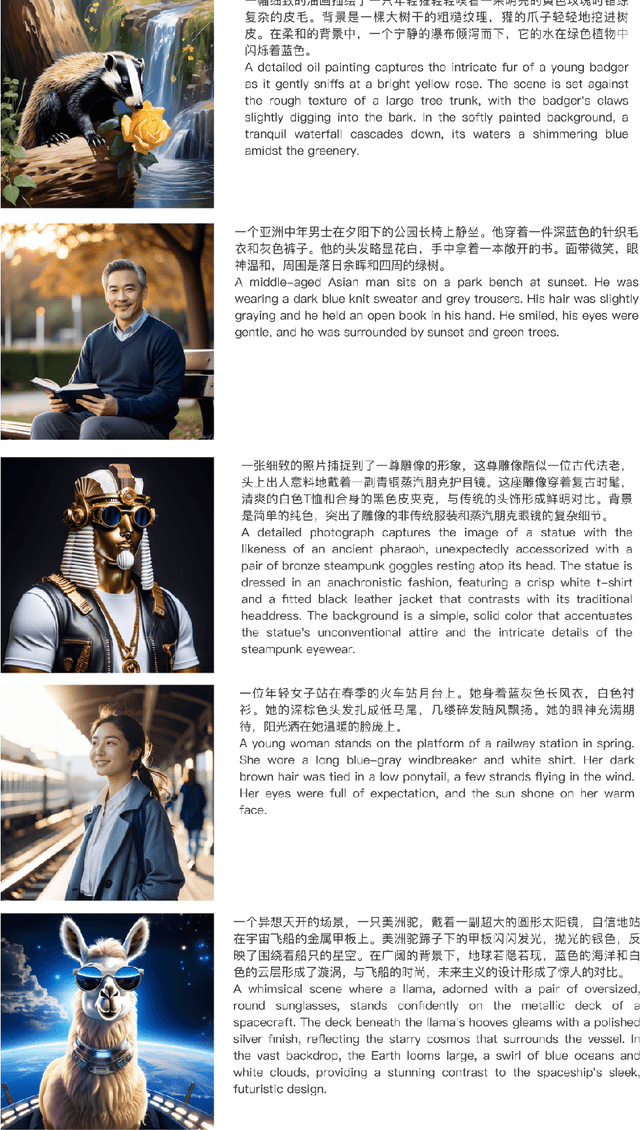
We present Hunyuan-DiT, a text-to-image diffusion transformer with fine-grained understanding of both English and Chinese. To construct Hunyuan-DiT, we carefully design the transformer structure, text encoder, and positional encoding. We also build from scratch a whole data pipeline to update and evaluate data for iterative model optimization. For fine-grained language understanding, we train a Multimodal Large Language Model to refine the captions of the images. Finally, Hunyuan-DiT can perform multi-turn multimodal dialogue with users, generating and refining images according to the context. Through our holistic human evaluation protocol with more than 50 professional human evaluators, Hunyuan-DiT sets a new state-of-the-art in Chinese-to-image generation compared with other open-source models. Code and pretrained models are publicly available at github.com/Tencent/HunyuanDiT
Object-Driven One-Shot Fine-tuning of Text-to-Image Diffusion with Prototypical Embedding
Jan 28, 2024As large-scale text-to-image generation models have made remarkable progress in the field of text-to-image generation, many fine-tuning methods have been proposed. However, these models often struggle with novel objects, especially with one-shot scenarios. Our proposed method aims to address the challenges of generalizability and fidelity in an object-driven way, using only a single input image and the object-specific regions of interest. To improve generalizability and mitigate overfitting, in our paradigm, a prototypical embedding is initialized based on the object's appearance and its class, before fine-tuning the diffusion model. And during fine-tuning, we propose a class-characterizing regularization to preserve prior knowledge of object classes. To further improve fidelity, we introduce object-specific loss, which can also use to implant multiple objects. Overall, our proposed object-driven method for implanting new objects can integrate seamlessly with existing concepts as well as with high fidelity and generalization. Our method outperforms several existing works. The code will be released.