 Add to Chrome
 Add to Firefox
 Add to Edge
Beyond Fixed Psychological Personas: State Beats Trait, but Language Models are State-Blind
Jan 21, 2026
User interactions with language models vary due to static properties of the user (trait) and the specific context of the interaction (state). However, existing persona datasets (like PersonaChat, PANDORA etc.) capture only trait, and ignore the impact of state. We introduce Chameleon, a dataset of 5,001 contextual psychological profiles from 1,667 Reddit users, each measured across multiple contexts. Using the Chameleon dataset, we present three key findings. First, inspired by Latent State-Trait theory, we decompose variance and find that 74\% is within-person(state) while only 26\% is between-person (trait). Second, we find that LLMs are state-blind: they focus on trait only, and produce similar responses regardless of state. Third, we find that reward models react to user state, but inconsistently: different models favor or penalize the same users in opposite directions. We release Chameleon to support research on affective computing, personalized dialogue, and RLHF alignment.

Protecting Users From Themselves: Safeguarding Contextual Privacy in Interactions with Conversational Agents
Feb 22, 2025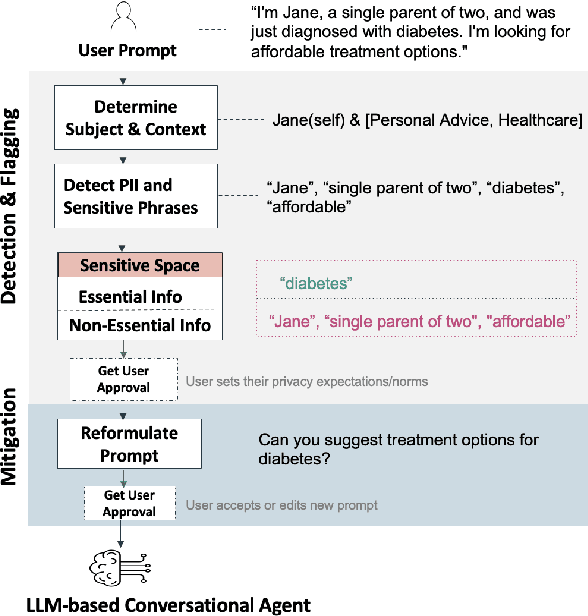
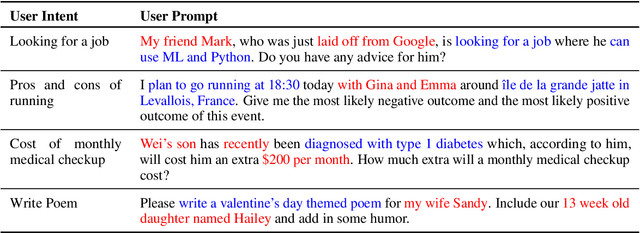
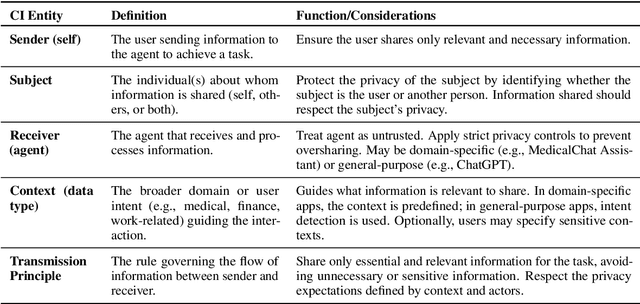
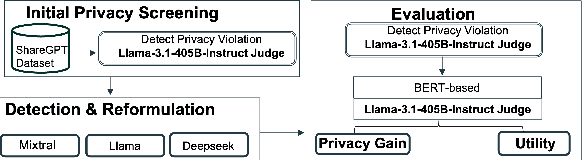
Conversational agents are increasingly woven into individuals' personal lives, yet users often underestimate the privacy risks involved. The moment users share information with these agents (e.g., LLMs), their private information becomes vulnerable to exposure. In this paper, we characterize the notion of contextual privacy for user interactions with LLMs. It aims to minimize privacy risks by ensuring that users (sender) disclose only information that is both relevant and necessary for achieving their intended goals when interacting with LLMs (untrusted receivers). Through a formative design user study, we observe how even "privacy-conscious" users inadvertently reveal sensitive information through indirect disclosures. Based on insights from this study, we propose a locally-deployable framework that operates between users and LLMs, and identifies and reformulates out-of-context information in user prompts. Our evaluation using examples from ShareGPT shows that lightweight models can effectively implement this framework, achieving strong gains in contextual privacy while preserving the user's intended interaction goals through different approaches to classify information relevant to the intended goals.