 Add to Chrome
 Add to Firefox
 Add to Edge
FrontierCS: Evolving Challenges for Evolving Intelligence
Dec 17, 2025


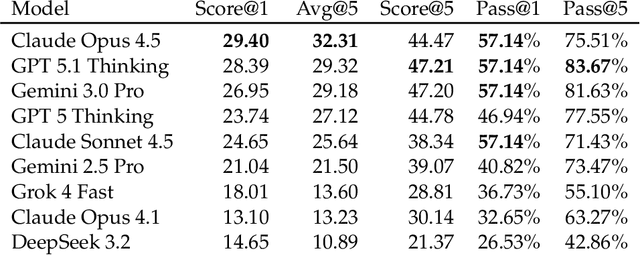
We introduce FrontierCS, a benchmark of 156 open-ended problems across diverse areas of computer science, designed and reviewed by experts, including CS PhDs and top-tier competitive programming participants and problem setters. Unlike existing benchmarks that focus on tasks with known optimal solutions, FrontierCS targets problems where the optimal solution is unknown, but the quality of a solution can be objectively evaluated. Models solve these tasks by implementing executable programs rather than outputting a direct answer. FrontierCS includes algorithmic problems, which are often NP-hard variants of competitive programming problems with objective partial scoring, and research problems with the same property. For each problem we provide an expert reference solution and an automatic evaluator. Combining open-ended design, measurable progress, and expert curation, FrontierCS provides a benchmark at the frontier of computer-science difficulty. Empirically, we find that frontier reasoning models still lag far behind human experts on both the algorithmic and research tracks, that increasing reasoning budgets alone does not close this gap, and that models often over-optimize for generating merely workable code instead of discovering high-quality algorithms and system designs.

The Danger of Overthinking: Examining the Reasoning-Action Dilemma in Agentic Tasks
Feb 12, 2025Large Reasoning Models (LRMs) represent a breakthrough in AI problem-solving capabilities, but their effectiveness in interactive environments can be limited. This paper introduces and analyzes overthinking in LRMs. A phenomenon where models favor extended internal reasoning chains over environmental interaction. Through experiments on software engineering tasks using SWE Bench Verified, we observe three recurring patterns: Analysis Paralysis, Rogue Actions, and Premature Disengagement. We propose a framework to study these behaviors, which correlates with human expert assessments, and analyze 4018 trajectories. We observe that higher overthinking scores correlate with decreased performance, with reasoning models exhibiting stronger tendencies toward overthinking compared to non-reasoning models. Our analysis reveals that simple efforts to mitigate overthinking in agentic environments, such as selecting the solution with the lower overthinking score, can improve model performance by almost 30% while reducing computational costs by 43%. These results suggest that mitigating overthinking has strong practical implications. We suggest that by leveraging native function-calling capabilities and selective reinforcement learning overthinking tendencies could be mitigated. We also open-source our evaluation framework and dataset to facilitate research in this direction at https://github.com/AlexCuadron/Overthinking.