 Add to Chrome
 Add to Firefox
 Add to Edge
SonoEdit: Null-Space Constrained Knowledge Editing for Pronunciation Correction in LLM-Based TTS
Jan 23, 2026
Neural text-to-speech (TTS) systems systematically mispronounce low-resource proper nouns, particularly non-English names, brands, and geographic locations, due to their underrepresentation in predominantly English training corpora. Existing solutions typically rely on expensive multilingual data collection, supervised finetuning, or manual phonetic annotation, which limits the deployment of TTS systems in linguistically diverse settings. We introduce SonoEdit, a model editing technique that surgically corrects pronunciation errors in pre-trained TTS models without retraining. Instead of costly finetuning or explicit phoneme injection, we propose a parsimonious alternative based on Null-Space Pronunciation Editing, which performs a single-shot parameter update to modify the pronunciation of specific words while provably preserving all other model behavior. We first adapt Acoustic Causal Tracing to identify the Transformer layers responsible for text-to-pronunciation mapping. We then apply Null-Space Constrained Editing to compute a closed-form weight update that corrects the target pronunciation while remaining mathematically orthogonal to the subspace governing general speech generation. This constrained update steers the model's acoustic output toward a desired pronunciation exemplar while guaranteeing zero first-order change on a preserved speech corpus.

DiffuseKronA: A Parameter Efficient Fine-tuning Method for Personalized Diffusion Models
Feb 28, 2024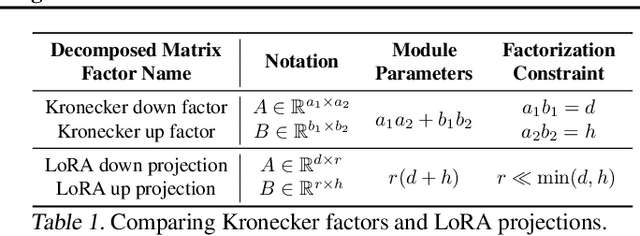
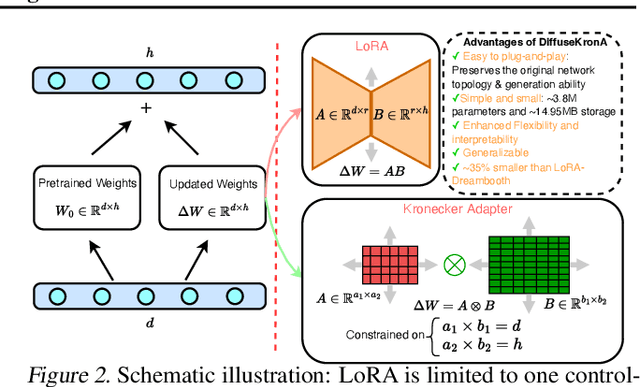
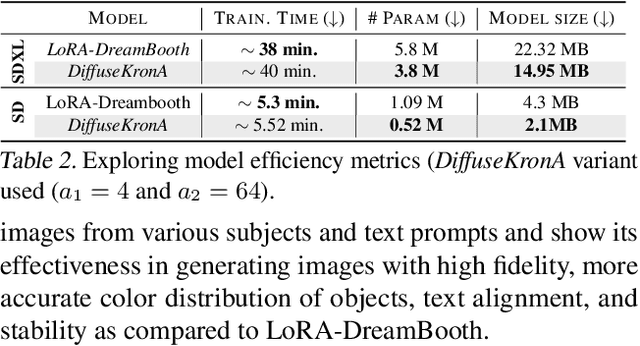
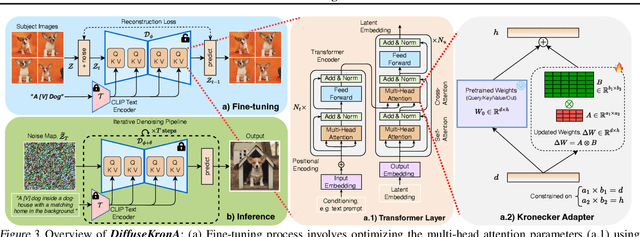
In the realm of subject-driven text-to-image (T2I) generative models, recent developments like DreamBooth and BLIP-Diffusion have led to impressive results yet encounter limitations due to their intensive fine-tuning demands and substantial parameter requirements. While the low-rank adaptation (LoRA) module within DreamBooth offers a reduction in trainable parameters, it introduces a pronounced sensitivity to hyperparameters, leading to a compromise between parameter efficiency and the quality of T2I personalized image synthesis. Addressing these constraints, we introduce \textbf{\textit{DiffuseKronA}}, a novel Kronecker product-based adaptation module that not only significantly reduces the parameter count by 35\% and 99.947\% compared to LoRA-DreamBooth and the original DreamBooth, respectively, but also enhances the quality of image synthesis. Crucially, \textit{DiffuseKronA} mitigates the issue of hyperparameter sensitivity, delivering consistent high-quality generations across a wide range of hyperparameters, thereby diminishing the necessity for extensive fine-tuning. Furthermore, a more controllable decomposition makes \textit{DiffuseKronA} more interpretable and even can achieve up to a 50\% reduction with results comparable to LoRA-Dreambooth. Evaluated against diverse and complex input images and text prompts, \textit{DiffuseKronA} consistently outperforms existing models, producing diverse images of higher quality with improved fidelity and a more accurate color distribution of objects, all the while upholding exceptional parameter efficiency, thus presenting a substantial advancement in the field of T2I generative modeling. Our project page, consisting of links to the code, and pre-trained checkpoints, is available at https://diffusekrona.github.io/.