 Add to Chrome
 Add to Firefox
 Add to Edge
Efficiently Estimating Data Efficiency for Language Model Fine-tuning
Dec 31, 2025
While large language models (LLMs) demonstrate reasonable zero-shot capability across many downstream tasks, fine-tuning is a common practice to improve their performance. However, a task's data efficiency--i.e., the number of fine-tuning examples needed to achieve a desired level of performance--is often unknown, resulting in costly cycles of incremental annotation and retraining. Indeed, we demonstrate across a curated set of 30 specialized tasks that performant LLMs may struggle zero-shot but can attain stronger performance after fine-tuning. This motivates the need for methods to predict a task's data efficiency without requiring incremental annotation. After introducing a concrete metric that quantifies a task's data efficiency, we propose using the gradient cosine similarity of low-confidence examples to predict data efficiency based on a small number of labeled samples. We validate our approach on a diverse set of tasks with varying data efficiencies, attaining 8.6% error in overall data efficiency prediction and typically eliminating hundreds of unnecessary annotations on each task. Our experiment results and implementation code are available on GitHub.

Constellation Dataset: Benchmarking High-Altitude Object Detection for an Urban Intersection
Apr 25, 2024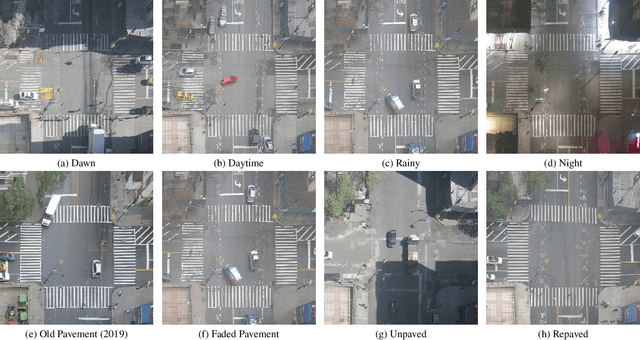
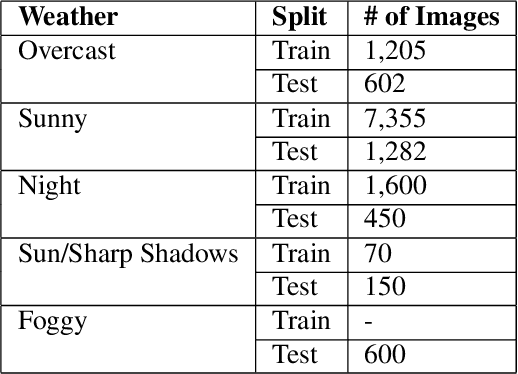
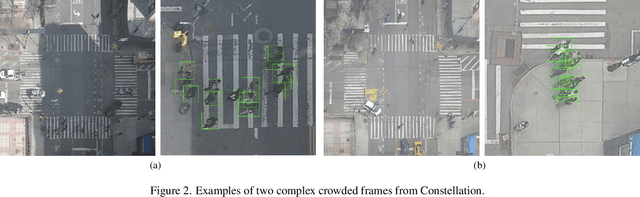
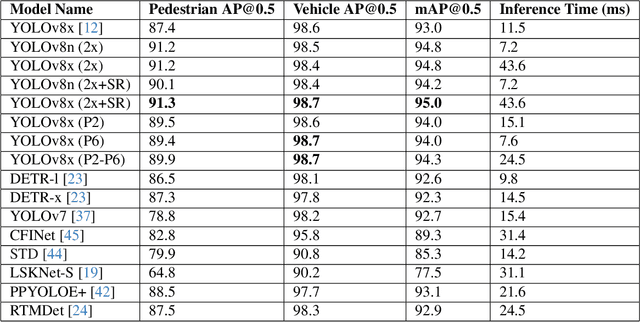
We introduce Constellation, a dataset of 13K images suitable for research on detection of objects in dense urban streetscapes observed from high-elevation cameras, collected for a variety of temporal conditions. The dataset addresses the need for curated data to explore problems in small object detection exemplified by the limited pixel footprint of pedestrians observed tens of meters from above. It enables the testing of object detection models for variations in lighting, building shadows, weather, and scene dynamics. We evaluate contemporary object detection architectures on the dataset, observing that state-of-the-art methods have lower performance in detecting small pedestrians compared to vehicles, corresponding to a 10% difference in average precision (AP). Using structurally similar datasets for pretraining the models results in an increase of 1.8% mean AP (mAP). We further find that incorporating domain-specific data augmentations helps improve model performance. Using pseudo-labeled data, obtained from inference outcomes of the best-performing models, improves the performance of the models. Finally, comparing the models trained using the data collected in two different time intervals, we find a performance drift in models due to the changes in intersection conditions over time. The best-performing model achieves a pedestrian AP of 92.0% with 11.5 ms inference time on NVIDIA A100 GPUs, and an mAP of 95.4%.