 Add to Chrome
 Add to Firefox
 Add to Edge
MedEinst: Benchmarking the Einstellung Effect in Medical LLMs through Counterfactual Differential Diagnosis
Jan 10, 2026
Despite achieving high accuracy on medical benchmarks, LLMs exhibit the Einstellung Effect in clinical diagnosis--relying on statistical shortcuts rather than patient-specific evidence, causing misdiagnosis in atypical cases. Existing benchmarks fail to detect this critical failure mode. We introduce MedEinst, a counterfactual benchmark with 5,383 paired clinical cases across 49 diseases. Each pair contains a control case and a "trap" case with altered discriminative evidence that flips the diagnosis. We measure susceptibility via Bias Trap Rate--probability of misdiagnosing traps despite correctly diagnosing controls. Extensive Evaluation of 17 LLMs shows frontier models achieve high baseline accuracy but severe bias trap rates. Thus, we propose ECR-Agent, aligning LLM reasoning with Evidence-Based Medicine standard via two components: (1) Dynamic Causal Inference (DCI) performs structured reasoning through dual-pathway perception, dynamic causal graph reasoning across three levels (association, intervention, counterfactual), and evidence audit for final diagnosis; (2) Critic-Driven Graph and Memory Evolution (CGME) iteratively refines the system by storing validated reasoning paths in an exemplar base and consolidating disease-specific knowledge into evolving illness graphs. Source code is to be released.

Medchain: Bridging the Gap Between LLM Agents and Clinical Practice through Interactive Sequential Benchmarking
Dec 02, 2024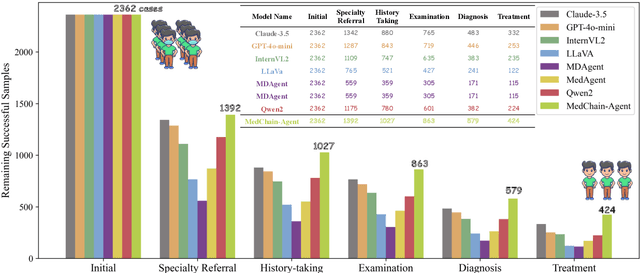
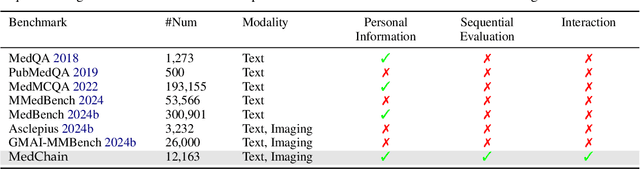
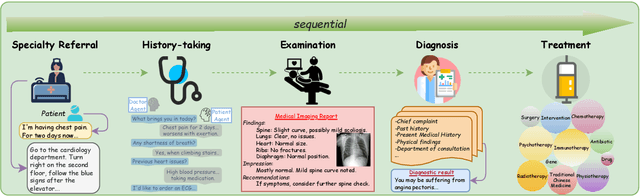
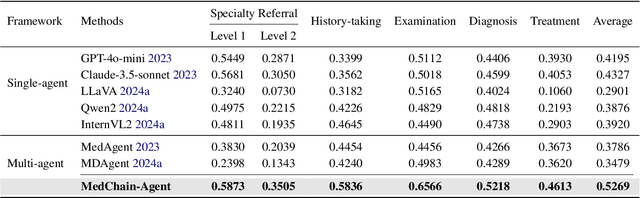
Clinical decision making (CDM) is a complex, dynamic process crucial to healthcare delivery, yet it remains a significant challenge for artificial intelligence systems. While Large Language Model (LLM)-based agents have been tested on general medical knowledge using licensing exams and knowledge question-answering tasks, their performance in the CDM in real-world scenarios is limited due to the lack of comprehensive testing datasets that mirror actual medical practice. To address this gap, we present MedChain, a dataset of 12,163 clinical cases that covers five key stages of clinical workflow. MedChain distinguishes itself from existing benchmarks with three key features of real-world clinical practice: personalization, interactivity, and sequentiality. Further, to tackle real-world CDM challenges, we also propose MedChain-Agent, an AI system that integrates a feedback mechanism and a MCase-RAG module to learn from previous cases and adapt its responses. MedChain-Agent demonstrates remarkable adaptability in gathering information dynamically and handling sequential clinical tasks, significantly outperforming existing approaches. The relevant dataset and code will be released upon acceptance of this paper.