 Add to Chrome
 Add to Firefox
 Add to Edge
Two-Stage Grid Optimization for Group-wise Quantization of LLMs
Feb 02, 2026
Group-wise quantization is an effective strategy for mitigating accuracy degradation in low-bit quantization of large language models (LLMs). Among existing methods, GPTQ has been widely adopted due to its efficiency; however, it neglects input statistics and inter-group correlations when determining group scales, leading to a mismatch with its goal of minimizing layer-wise reconstruction loss. In this work, we propose a two-stage optimization framework for group scales that explicitly minimizes the layer-wise reconstruction loss. In the first stage, performed prior to GPTQ, we initialize each group scale to minimize the group-wise reconstruction loss, thereby incorporating input statistics. In the second stage, we freeze the integer weights obtained via GPTQ and refine the group scales to minimize the layer-wise reconstruction loss. To this end, we employ the coordinate descent algorithm and derive a closed-form update rule, which enables efficient refinement without costly numerical optimization. Notably, our derivation incorporates the quantization errors from preceding layers to prevent error accumulation. Experimental results demonstrate that our method consistently enhances group-wise quantization, achieving higher accuracy with negligible overhead.

Improved Learning-Augmented Algorithms for the Multi-Option Ski Rental Problem via Best-Possible Competitive Analysis
Feb 14, 2023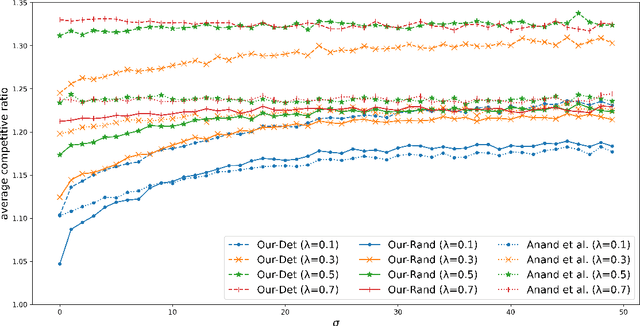
In this paper, we present improved learning-augmented algorithms for the multi-option ski rental problem. Learning-augmented algorithms take ML predictions as an added part of the input and incorporates these predictions in solving the given problem. Due to their unique strength that combines the power of ML predictions with rigorous performance guarantees, they have been extensively studied in the context of online optimization problems. Even though ski rental problems are one of the canonical problems in the field of online optimization, only deterministic algorithms were previously known for multi-option ski rental, with or without learning augmentation. We present the first randomized learning-augmented algorithm for this problem, surpassing previous performance guarantees given by deterministic algorithms. Our learning-augmented algorithm is based on a new, provably best-possible randomized competitive algorithm for the problem. Our results are further complemented by lower bounds for deterministic and randomized algorithms, and computational experiments evaluating our algorithms' performance improvements.