 Add to Chrome
 Add to Firefox
 Add to Edge
EventFlash: Towards Efficient MLLMs for Event-Based Vision
Feb 03, 2026
Event-based multimodal large language models (MLLMs) enable robust perception in high-speed and low-light scenarios, addressing key limitations of frame-based MLLMs. However, current event-based MLLMs often rely on dense image-like processing paradigms, overlooking the spatiotemporal sparsity of event streams and resulting in high computational cost. In this paper, we propose EventFlash, a novel and efficient MLLM to explore spatiotemporal token sparsification for reducing data redundancy and accelerating inference. Technically, we build EventMind, a large-scale and scene-diverse dataset with over 500k instruction sets, providing both short and long event stream sequences to support our curriculum training strategy. We then present an adaptive temporal window aggregation module for efficient temporal sampling, which adaptively compresses temporal tokens while retaining key temporal cues. Finally, a sparse density-guided attention module is designed to improve spatial token efficiency by selecting informative regions and suppressing empty or sparse areas. Experimental results show that EventFlash achieves a $12.4\times$ throughput improvement over the baseline (EventFlash-Zero) while maintaining comparable performance. It supports long-range event stream processing with up to 1,000 bins, significantly outperforming the 5-bin limit of EventGPT. We believe EventFlash serves as an efficient foundation model for event-based vision.

EventGPT: Event Stream Understanding with Multimodal Large Language Models
Dec 01, 2024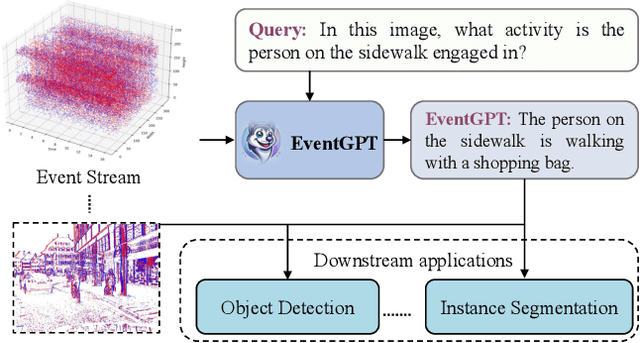
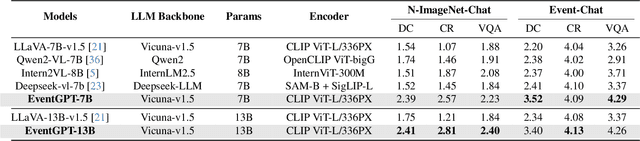
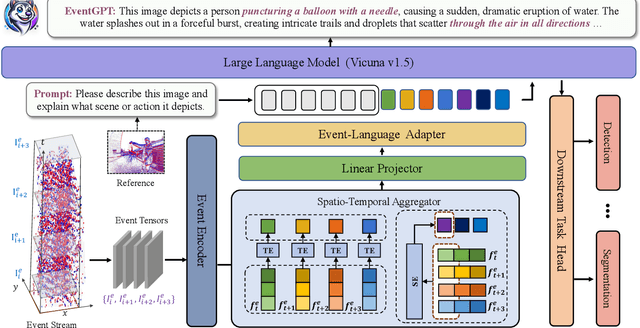
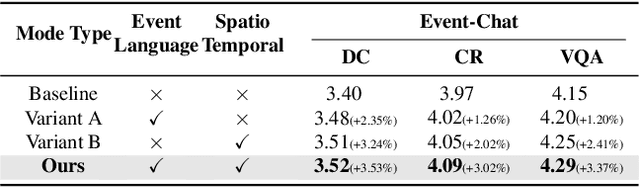
Event cameras record visual information as asynchronous pixel change streams, excelling at scene perception under unsatisfactory lighting or high-dynamic conditions. Existing multimodal large language models (MLLMs) concentrate on natural RGB images, failing in scenarios where event data fits better. In this paper, we introduce EventGPT, the first MLLM for event stream understanding, to the best of our knowledge, marking a pioneering attempt to integrate large language models (LLMs) with event stream comprehension. To mitigate the huge domain gaps, we develop a three-stage optimization paradigm to gradually equip a pre-trained LLM with the capability of understanding event-based scenes. Our EventGPT comprises an event encoder, followed by a spatio-temporal aggregator, a linear projector, an event-language adapter, and an LLM. Firstly, RGB image-text pairs generated by GPT are leveraged to warm up the linear projector, referring to LLaVA, as the gap between natural image and language modalities is relatively smaller. Secondly, we construct a synthetic yet large dataset, N-ImageNet-Chat, consisting of event frames and corresponding texts to enable the use of the spatio-temporal aggregator and to train the event-language adapter, thereby aligning event features more closely with the language space. Finally, we gather an instruction dataset, Event-Chat, which contains extensive real-world data to fine-tune the entire model, further enhancing its generalization ability. We construct a comprehensive benchmark, and experiments show that EventGPT surpasses previous state-of-the-art MLLMs in generation quality, descriptive accuracy, and reasoning capability.