 Add to Chrome
 Add to Firefox
 Add to Edge
Joint Fractional Delay and Doppler Frequency Estimator Under Spectrum Wrapping Phenomenon for LEO-ICAN AFDM Signals
Feb 04, 2026
With the rapid development of low earth orbit (LEO) satellites, the design of integrated communication and navigation (ICAN) signals has attracted increasing attention, especially in the field of vehicle-to-everything (V2X). As a new-generation waveform, Affine Frequency Division Multiplexing (AFDM) features high robustness against Doppler effects, a simple modulation structure, and low pilot overhead, making it a promising candidate for high-dynamic LEO satellite scenarios. However, LEO-ICAN AFDM signals face challenges in fractional delay and Doppler frequency estimation. Existing studies that ignore its inherent spectrum wrapping phenomenon may lead to deviations of varying degrees in model construction. This paper conducts an in-depth derivation of AFDM's input-output relationship under fractional cases, reveals the envelope characteristics of its equivalent channel, and proposes a joint estimation algorithm based on peak-to-sidelobe power ratio (PSPR) detection and early-late gate (ELG) to estimate fractional Doppler frequency and delay. Simulations show that the algorithm has low complexity, low guard interval overhead, and high precision compared with traditional methods.

Soft Multipath Information-Based UWB Tracking in Cluttered Scenarios: Preliminaries and Validations
May 29, 2024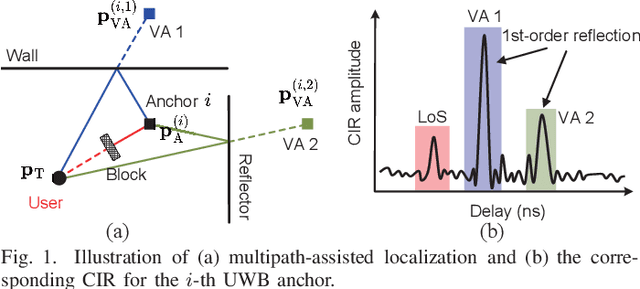
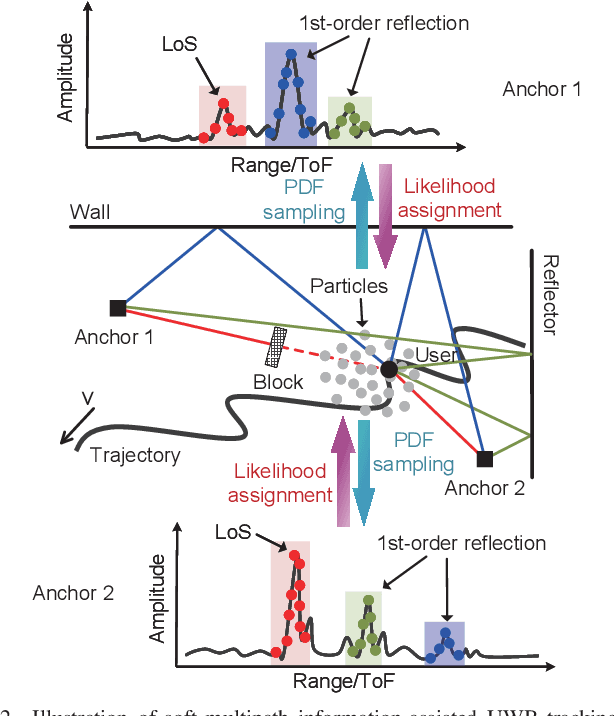
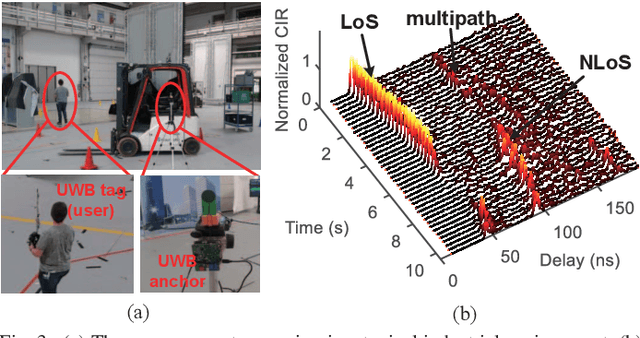
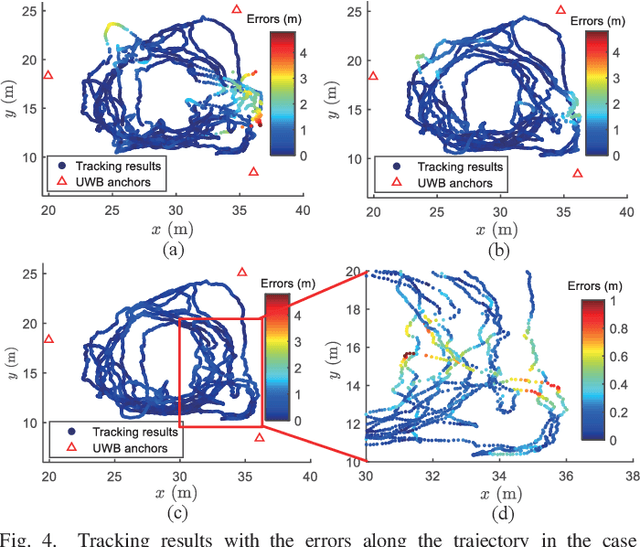
In this paper, we investigate ultra-wideband (UWB) localization and tracking in cluttered environments. Instead of mitigating the multipath, we exploit the specular reflections to enhance the localizability and improve the positioning accuracy. With the assistance of the multipath, it is also possible to achieve localization purposes using fewer anchors or when the line-of-sight propagations are blocked. Rather than using single-value distance, angle, or Doppler estimates for the localization, we model the likelihoods of both the line-of-sight and specular multipath components, namely soft multipath information, and propose the multipath-assisted probabilistic UWB tracking algorithm. Experimental results in a cluttered industrial scenario show that the proposed algorithm achieves 46.4 cm and 33.1 cm 90th percentile errors in the cases of 3 and 4 anchors, respectively, which outperforms conventional methods with more than 61.8% improvement given fewer anchors and strong multipath effect.