 Add to Chrome
 Add to Firefox
 Add to Edge
Statistical Foundations of DIME: Risk Estimation for Practical Index Selection
Jan 09, 2026
High-dimensional dense embeddings have become central to modern Information Retrieval, but many dimensions are noisy or redundant. Recently proposed DIME (Dimension IMportance Estimation), provides query-dependent scores to identify informative components of embeddings. DIME relies on a costly grid search to select a priori a dimensionality for all the query corpus's embeddings. Our work provides a statistically grounded criterion that directly identifies the optimal set of dimensions for each query at inference time. Experiments confirm achieving parity of effectiveness and reduces embedding size by an average of $\sim50\%$ across different models and datasets at inference time.

ECLIPSE: Contrastive Dimension Importance Estimation with Pseudo-Irrelevance Feedback for Dense Retrieval
Dec 19, 2024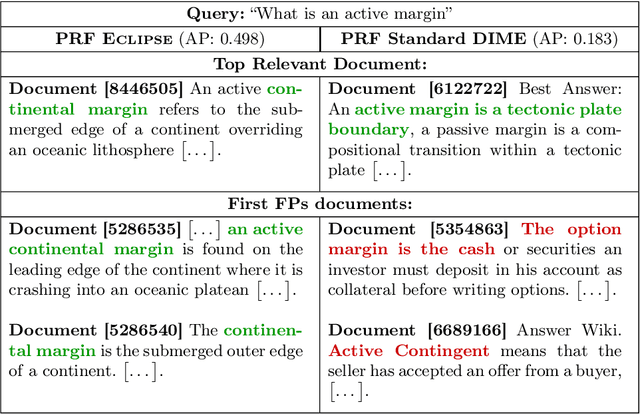
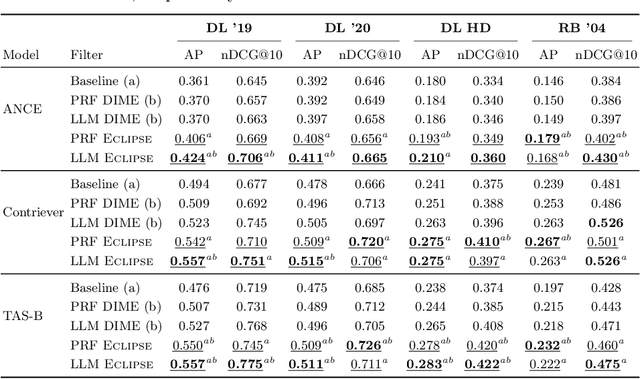
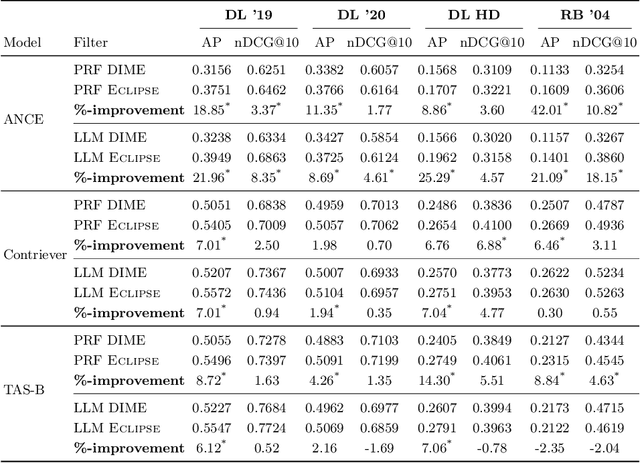
Recent advances in Information Retrieval have leveraged high-dimensional embedding spaces to improve the retrieval of relevant documents. Moreover, the Manifold Clustering Hypothesis suggests that despite these high-dimensional representations, documents relevant to a query reside on a lower-dimensional, query-dependent manifold. While this hypothesis has inspired new retrieval methods, existing approaches still face challenges in effectively separating non-relevant information from relevant signals. We propose a novel methodology that addresses these limitations by leveraging information from both relevant and non-relevant documents. Our method, ECLIPSE, computes a centroid based on irrelevant documents as a reference to estimate noisy dimensions present in relevant ones, enhancing retrieval performance. Extensive experiments on three in-domain and one out-of-domain benchmarks demonstrate an average improvement of up to 19.50% (resp. 22.35%) in mAP(AP) and 11.42% (resp. 13.10%) in nDCG@10 w.r.t. the DIME-based baseline (resp. the baseline using all dimensions). Our results pave the way for more robust, pseudo-irrelevance-based retrieval systems in future IR research.