 Add to Chrome
 Add to Firefox
 Add to Edge
DeepLeak: Privacy Enhancing Hardening of Model Explanations Against Membership Leakage
Jan 06, 2026
Machine learning (ML) explainability is central to algorithmic transparency in high-stakes settings such as predictive diagnostics and loan approval. However, these same domains require rigorous privacy guaranties, creating tension between interpretability and privacy. Although prior work has shown that explanation methods can leak membership information, practitioners still lack systematic guidance on selecting or deploying explanation techniques that balance transparency with privacy. We present DeepLeak, a system to audit and mitigate privacy risks in post-hoc explanation methods. DeepLeak advances the state-of-the-art in three ways: (1) comprehensive leakage profiling: we develop a stronger explanation-aware membership inference attack (MIA) to quantify how much representative explanation methods leak membership information under default configurations; (2) lightweight hardening strategies: we introduce practical, model-agnostic mitigations, including sensitivity-calibrated noise, attribution clipping, and masking, that substantially reduce membership leakage while preserving explanation utility; and (3) root-cause analysis: through controlled experiments, we pinpoint algorithmic properties (e.g., attribution sparsity and sensitivity) that drive leakage. Evaluating 15 explanation techniques across four families on image benchmarks, DeepLeak shows that default settings can leak up to 74.9% more membership information than previously reported. Our mitigations cut leakage by up to 95% (minimum 46.5%) with only <=3.3% utility loss on average. DeepLeak offers a systematic, reproducible path to safer explainability in privacy-sensitive ML.

DeepProv: Behavioral Characterization and Repair of Neural Networks via Inference Provenance Graph Analysis
Sep 30, 2025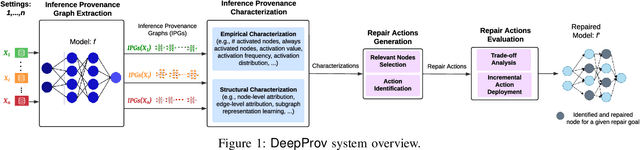

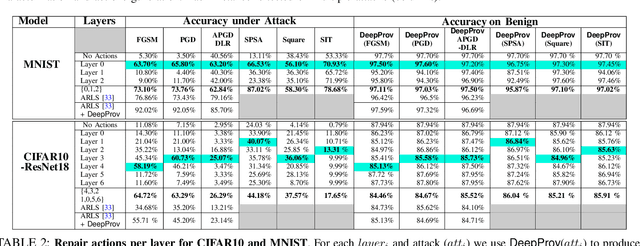

Deep neural networks (DNNs) are increasingly being deployed in high-stakes applications, from self-driving cars to biometric authentication. However, their unpredictable and unreliable behaviors in real-world settings require new approaches to characterize and ensure their reliability. This paper introduces DeepProv, a novel and customizable system designed to capture and characterize the runtime behavior of DNNs during inference by using their underlying graph structure. Inspired by system audit provenance graphs, DeepProv models the computational information flow of a DNN's inference process through Inference Provenance Graphs (IPGs). These graphs provide a detailed structural representation of the behavior of DNN, allowing both empirical and structural analysis. DeepProv uses these insights to systematically repair DNNs for specific objectives, such as improving robustness, privacy, or fairness. We instantiate DeepProv with adversarial robustness as the goal of model repair and conduct extensive case studies to evaluate its effectiveness. Our results demonstrate its effectiveness and scalability across diverse classification tasks, attack scenarios, and model complexities. DeepProv automatically identifies repair actions at the node and edge-level within IPGs, significantly enhancing the robustness of the model. In particular, applying DeepProv repair strategies to just a single layer of a DNN yields an average 55% improvement in adversarial accuracy. Moreover, DeepProv complements existing defenses, achieving substantial gains in adversarial robustness. Beyond robustness, we demonstrate the broader potential of DeepProv as an adaptable system to characterize DNN behavior in other critical areas, such as privacy auditing and fairness analysis.
SPGNN-API: A Transferable Graph Neural Network for Attack Paths Identification and Autonomous Mitigation
May 31, 2023Attack paths are the potential chain of malicious activities an attacker performs to compromise network assets and acquire privileges through exploiting network vulnerabilities. Attack path analysis helps organizations to identify new/unknown chains of attack vectors that reach critical assets within the network, as opposed to individual attack vectors in signature-based attack analysis. Timely identification of attack paths enables proactive mitigation of threats. Nevertheless, manual analysis of complex network configurations, vulnerabilities, and security events to identify attack paths is rarely feasible. This work proposes a novel transferable graph neural network-based model for shortest path identification. The proposed shortest path detection approach, integrated with a novel holistic and comprehensive model for identifying potential network vulnerabilities interactions, is then utilized to detect network attack paths. Our framework automates the risk assessment of attack paths indicating the propensity of the paths to enable the compromise of highly-critical assets (e.g., databases) given the network configuration, assets' criticality, and the severity of the vulnerabilities in-path to the asset. The proposed framework, named SPGNN-API, incorporates automated threat mitigation through a proactive timely tuning of the network firewall rules and zero-trust policies to break critical attack paths and bolster cyber defenses. Our evaluation process is twofold; evaluating the performance of the shortest path identification and assessing the attack path detection accuracy. Our results show that SPGNN-API largely outperforms the baseline model for shortest path identification with an average accuracy >= 95% and successfully detects 100% of the potentially compromised assets, outperforming the attack graph baseline by 47%.