 Add to Chrome
 Add to Firefox
 Add to Edge
Robust Intervention Learning from Emergency Stop Interventions
Feb 03, 2026
Human interventions are a common source of data in autonomous systems during testing. These interventions provide an important signal about where the current policy needs improvement, but are often noisy and incomplete. We define Robust Intervention Learning (RIL) as the problem of learning from intervention data while remaining robust to the quality and informativeness of the intervention signal. In the best case, interventions are precise and avoiding them is sufficient to solve the task, but in many realistic settings avoiding interventions is necessary but not sufficient for achieving good performance. We study robust intervention learning in the context of emergency stop interventions and propose Residual Intervention Fine-Tuning (RIFT), a residual fine-tuning algorithm that treats intervention feedback as an incomplete learning signal and explicitly combines it with a prior policy. By framing intervention learning as a fine-tuning problem, our approach leverages structure encoded in the prior policy to resolve ambiguity when intervention signals under-specify the task. We provide theoretical analysis characterizing conditions under which this formulation yields principled policy improvement, and identify regimes where intervention learning is expected to fail. Our experiments reveal that residual fine-tuning enables robust and consistent policy improvement across a range of intervention strategies and prior policy qualities, and highlight robust intervention learning as a promising direction for future work.

Linear Memory SE(2) Invariant Attention
Jul 24, 2025Processing spatial data is a key component in many learning tasks for autonomous driving such as motion forecasting, multi-agent simulation, and planning. Prior works have demonstrated the value in using SE(2) invariant network architectures that consider only the relative poses between objects (e.g. other agents, scene features such as traffic lanes). However, these methods compute the relative poses for all pairs of objects explicitly, requiring quadratic memory. In this work, we propose a mechanism for SE(2) invariant scaled dot-product attention that requires linear memory relative to the number of objects in the scene. Our SE(2) invariant transformer architecture enjoys the same scaling properties that have benefited large language models in recent years. We demonstrate experimentally that our approach is practical to implement and improves performance compared to comparable non-invariant architectures.
Scenario Diffusion: Controllable Driving Scenario Generation With Diffusion
Nov 16, 2023
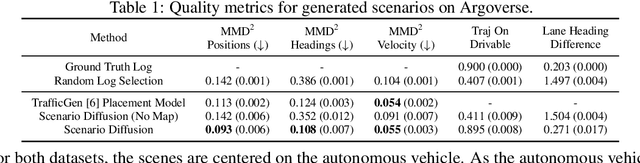
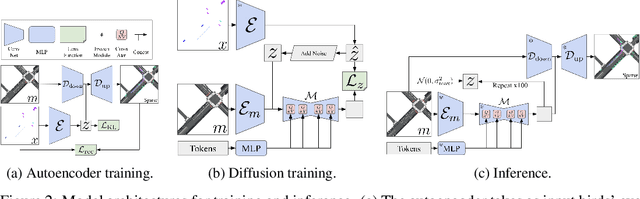

Automated creation of synthetic traffic scenarios is a key part of validating the safety of autonomous vehicles (AVs). In this paper, we propose Scenario Diffusion, a novel diffusion-based architecture for generating traffic scenarios that enables controllable scenario generation. We combine latent diffusion, object detection and trajectory regression to generate distributions of synthetic agent poses, orientations and trajectories simultaneously. To provide additional control over the generated scenario, this distribution is conditioned on a map and sets of tokens describing the desired scenario. We show that our approach has sufficient expressive capacity to model diverse traffic patterns and generalizes to different geographical regions.
Generating Driving Scenes with Diffusion
May 29, 2023In this paper we describe a learned method of traffic scene generation designed to simulate the output of the perception system of a self-driving car. In our "Scene Diffusion" system, inspired by latent diffusion, we use a novel combination of diffusion and object detection to directly create realistic and physically plausible arrangements of discrete bounding boxes for agents. We show that our scene generation model is able to adapt to different regions in the US, producing scenarios that capture the intricacies of each region.