 Add to Chrome
 Add to Firefox
 Add to Edge
Curriculum-Based Strategies for Efficient Cross-Domain Action Recognition
Jan 20, 2026
Despite significant progress in human action recognition, generalizing to diverse viewpoints remains a challenge. Most existing datasets are captured from ground-level perspectives, and models trained on them often struggle to transfer to drastically different domains such as aerial views. This paper examines how curriculum-based training strategies can improve generalization to unseen real aerial-view data without using any real aerial data during training. We explore curriculum learning for cross-view action recognition using two out-of-domain sources: synthetic aerial-view data and real ground-view data. Our results on the evaluation on order of training (fine-tuning on synthetic aerial data vs. real ground data) shows that fine-tuning on real ground data but differ in how they transition from synthetic to real. The first uses a two-stage curriculum with direct fine-tuning, while the second applies a progressive curriculum that expands the dataset in multiple stages before fine-tuning. We evaluate both methods on the REMAG dataset using SlowFast (CNN-based) and MViTv2 (Transformer-based) architectures. Results show that combining the two out-of-domain datasets clearly outperforms training on a single domain, whether real ground-view or synthetic aerial-view. Both curriculum strategies match the top-1 accuracy of simple dataset combination while offering efficiency gains. With the two-step fine-tuning method, SlowFast achieves up to a 37% reduction in iterations and MViTv2 up to a 30% reduction compared to simple combination. The multi-step progressive approach further reduces iterations, by up to 9% for SlowFast and 30% for MViTv2, relative to the two-step method. These findings demonstrate that curriculum-based training can maintain comparable performance (top-1 accuracy within 3% range) while improving training efficiency in cross-view action recognition.

Texture- and Shape-based Adversarial Attacks for Vehicle Detection in Synthetic Overhead Imagery
Dec 20, 2024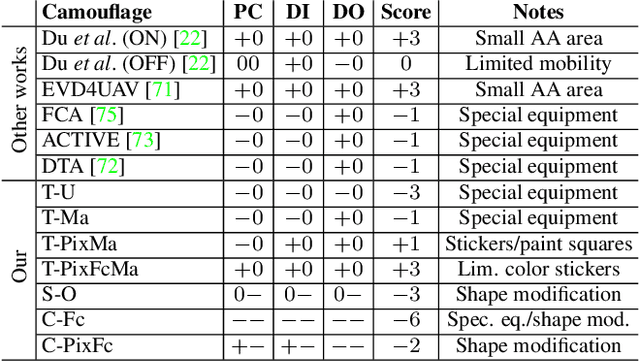
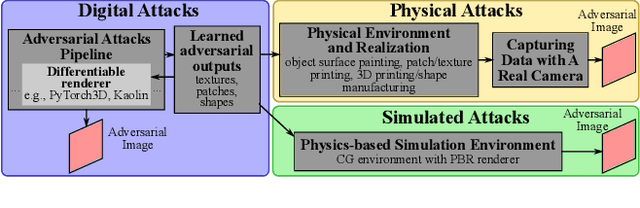
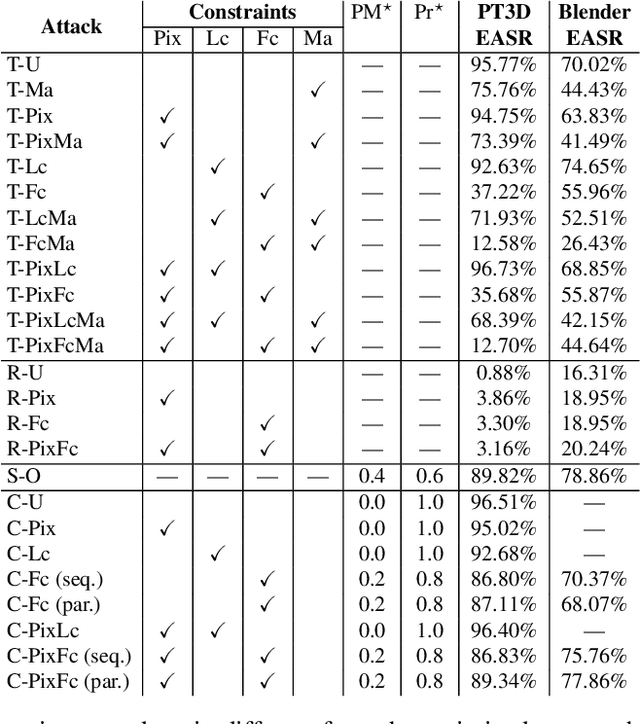
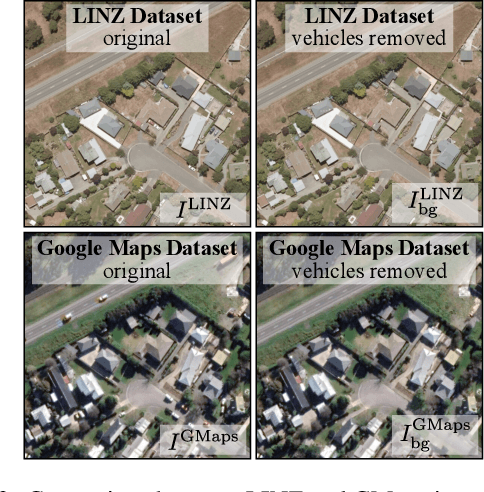
Detecting vehicles in aerial images can be very challenging due to complex backgrounds, small resolution, shadows, and occlusions. Despite the effectiveness of SOTA detectors such as YOLO, they remain vulnerable to adversarial attacks (AAs), compromising their reliability. Traditional AA strategies often overlook the practical constraints of physical implementation, focusing solely on attack performance. Our work addresses this issue by proposing practical implementation constraints for AA in texture and/or shape. These constraints include pixelation, masking, limiting the color palette of the textures, and constraining the shape modifications. We evaluated the proposed constraints through extensive experiments using three widely used object detector architectures, and compared them to previous works. The results demonstrate the effectiveness of our solutions and reveal a trade-off between practicality and performance. Additionally, we introduce a labeled dataset of overhead images featuring vehicles of various categories. We will make the code/dataset public upon paper acceptance.