 Add to Chrome
 Add to Firefox
 Add to Edge
Implicit bias as a Gauge correction: Theory and Inverse Design
Jan 10, 2026
A central problem in machine learning theory is to characterize how learning dynamics select particular solutions among the many compatible with the training objective, a phenomenon, called implicit bias, which remains only partially characterized. In the present work, we identify a general mechanism, in terms of an explicit geometric correction of the learning dynamics, for the emergence of implicit biases, arising from the interaction between continuous symmetries in the model's parametrization and stochasticity in the optimization process. Our viewpoint is constructive in two complementary directions: given model symmetries, one can derive the implicit bias they induce; conversely, one can inverse-design a wide class of different implicit biases by computing specific redundant parameterizations. More precisely, we show that, when the dynamics is expressed in the quotient space obtained by factoring out the symmetry group of the parameterization, the resulting stochastic differential equation gains a closed form geometric correction in the stationary distribution of the optimizer dynamics favoring orbits with small local volume. We compute the resulting symmetry induced bias for a range of architectures, showing how several well known results fit into a single unified framework. The approach also provides a practical methodology for deriving implicit biases in new settings, and it yields concrete, testable predictions that we confirm by numerical simulations on toy models trained on synthetic data, leaving more complex scenarios for future work. Finally, we test the implicit bias inverse-design procedure in notable cases, including biases toward sparsity in linear features or in spectral properties of the model parameters.

Emergent representations in networks trained with the Forward-Forward algorithm
May 26, 2023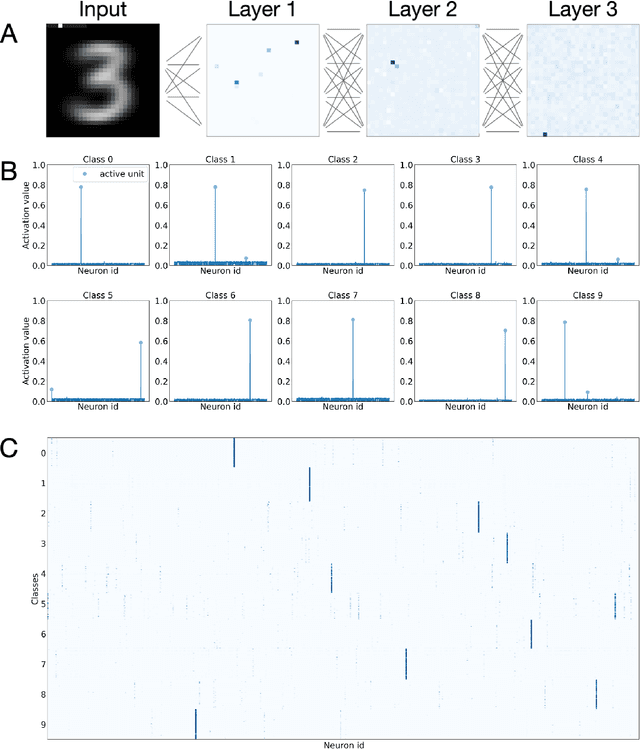

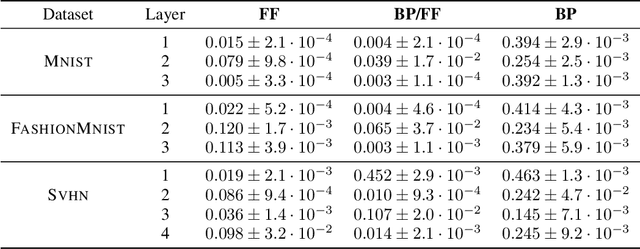
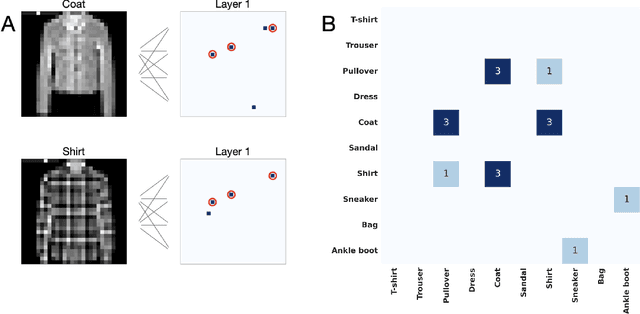
The Backpropagation algorithm, widely used to train neural networks, has often been criticised for its lack of biological realism. In an attempt to find a more biologically plausible alternative, and avoid to back-propagate gradients in favour of using local learning rules, the recently introduced Forward-Forward algorithm replaces the traditional forward and backward passes of Backpropagation with two forward passes. In this work, we show that internal representations obtained with the Forward-Forward algorithm organize into robust, category-specific ensembles, composed by an extremely low number of active units (high sparsity). This is remarkably similar to what is observed in cortical representations during sensory processing. While not found in models trained with standard Backpropagation, sparsity emerges also in networks optimized by Backpropagation, on the same training objective of Forward-Forward. These results suggest that the learning procedure proposed by Forward-Forward may be superior to Backpropagation in modelling learning in the cortex, even when a backward pass is used.