 Add to Chrome
 Add to Firefox
 Add to Edge
FlowSymm: Physics Aware, Symmetry Preserving Graph Attention for Network Flow Completion
Jan 29, 2026
Recovering missing flows on the edges of a network, while exactly respecting local conservation laws, is a fundamental inverse problem that arises in many systems such as transportation, energy, and mobility. We introduce FlowSymm, a novel architecture that combines (i) a group-action on divergence-free flows, (ii) a graph-attention encoder to learn feature-conditioned weights over these symmetry-preserving actions, and (iii) a lightweight Tikhonov refinement solved via implicit bilevel optimization. The method first anchors the given observation on a minimum-norm divergence-free completion. We then compute an orthonormal basis for all admissible group actions that leave the observed flows invariant and parameterize the valid solution subspace, which shows an Abelian group structure under vector addition. A stack of GATv2 layers then encodes the graph and its edge features into per-edge embeddings, which are pooled over the missing edges and produce per-basis attention weights. This attention-guided process selects a set of physics-aware group actions that preserve the observed flows. Finally, a scalar Tikhonov penalty refines the missing entries via a convex least-squares solver, with gradients propagated implicitly through Cholesky factorization. Across three real-world flow benchmarks (traffic, power, bike), FlowSymm outperforms state-of-the-art baselines in RMSE, MAE and correlation metrics.

#Secim2023: First Public Dataset for Studying Turkish General Election
Nov 22, 2022
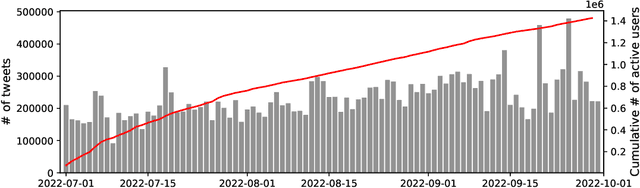
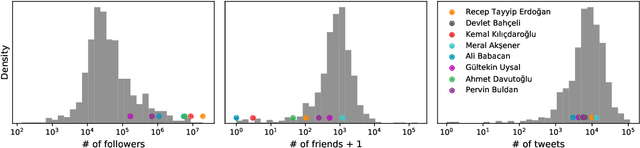
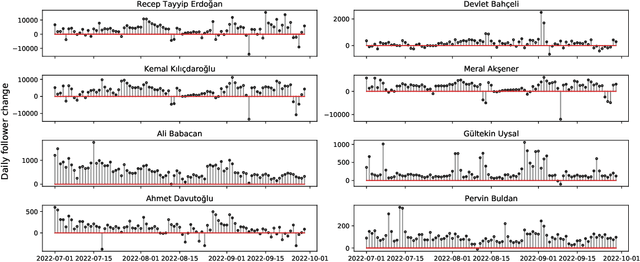
In the context of Turkey's upcoming parliamentary and presidential elections ("se\c{c}im" in Turkish), social media is playing an important role in shaping public debate. The increasing engagement of citizens on social media platforms has led to the growing use of social media by political actors. It is of utmost importance to capture the upcoming Turkish elections, as social media is becoming an essential component of election propaganda, political debates, smear campaigns, and election manipulation by domestic and international actors. We provide a comprehensive dataset for social media researchers to study the upcoming election, develop tools to prevent online manipulation, and gather novel information to inform the public. We are committed to continually improving the data collection and updating it regularly leading up to the election. Using the Secim2023 dataset, researchers can examine the social and communication networks between political actors, track current trends, and investigate emerging threats to election integrity. Our dataset is available at: https://github.com/ViralLab/Secim2023_Dataset