 Add to Chrome
 Add to Firefox
 Add to Edge
WADEPre: A Wavelet-based Decomposition Model for Extreme Precipitation Nowcasting with Multi-Scale Learning
Feb 02, 2026
The heavy-tailed nature of precipitation intensity impedes precise precipitation nowcasting. Standard models that optimize pixel-wise losses are prone to regression-to-the-mean bias, which blurs extreme values. Existing Fourier-based methods also lack the spatial localization needed to resolve transient convective cells. To overcome these intrinsic limitations, we propose WADEPre, a wavelet-based decomposition model for extreme precipitation that transitions the modeling into the wavelet domain. By leveraging the Discrete Wavelet Transform for explicit decomposition, WADEPre employs a dual-branch architecture: an Approximation Network to model stable, low-frequency advection, isolating deterministic trends from statistical bias, and a spatially localized Detail Network to capture high-frequency stochastic convection, resolving transient singularities and preserving sharp boundaries. A subsequent Refiner module then dynamically reconstructs these decoupled multi-scale components into the final high-fidelity forecast. To address optimization instability, we introduce a multi-scale curriculum learning strategy that progressively shifts supervision from coarse scales to fine-grained details. Extensive experiments on the SEVIR and Shanghai Radar datasets demonstrate that WADEPre achieves state-of-the-art performance, yielding significant improvements in capturing extreme thresholds and maintaining structural fidelity. Our code is available at https://github.com/sonderlau/WADEPre.

TLSAN: Time-aware Long- and Short-term Attention Network for Next-item Recommendation
Mar 16, 2021
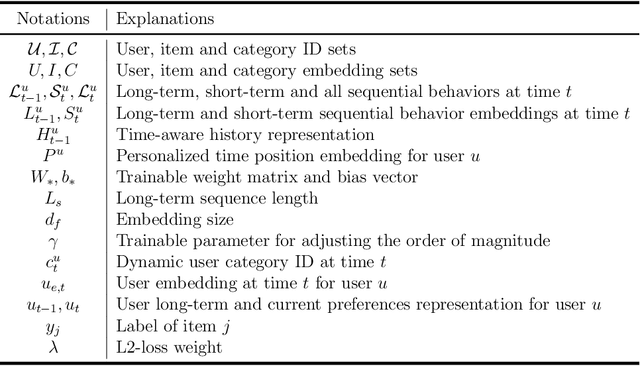

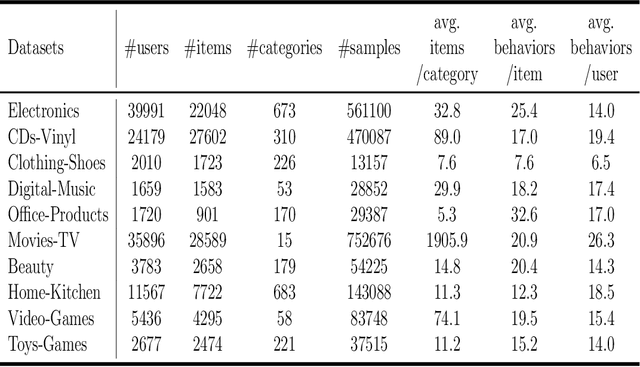
Recently, deep neural networks are widely applied in recommender systems for their effectiveness in capturing/modeling users' preferences. Especially, the attention mechanism in deep learning enables recommender systems to incorporate various features in an adaptive way. Specifically, as for the next item recommendation task, we have the following three observations: 1) users' sequential behavior records aggregate at time positions ("time-aggregation"), 2) users have personalized taste that is related to the "time-aggregation" phenomenon ("personalized time-aggregation"), and 3) users' short-term interests play an important role in the next item prediction/recommendation. In this paper, we propose a new Time-aware Long- and Short-term Attention Network (TLSAN) to address those observations mentioned above. Specifically, TLSAN consists of two main components. Firstly, TLSAN models "personalized time-aggregation" and learn user-specific temporal taste via trainable personalized time position embeddings with category-aware correlations in long-term behaviors. Secondly, long- and short-term feature-wise attention layers are proposed to effectively capture users' long- and short-term preferences for accurate recommendation. Especially, the attention mechanism enables TLSAN to utilize users' preferences in an adaptive way, and its usage in long- and short-term layers enhances TLSAN's ability of dealing with sparse interaction data. Extensive experiments are conducted on Amazon datasets from different fields (also with different size), and the results show that TLSAN outperforms state-of-the-art baselines in both capturing users' preferences and performing time-sensitive next-item recommendation.