 Add to Chrome
 Add to Firefox
 Add to Edge
The Effectiveness of Style Vectors for Steering Large Language Models: A Human Evaluation
Jan 29, 2026
Controlling the behavior of large language models (LLMs) at inference time is essential for aligning outputs with human abilities and safety requirements. \emph{Activation steering} provides a lightweight alternative to prompt engineering and fine-tuning by directly modifying internal activations to guide generation. This research advances the literature in three significant directions. First, while previous work demonstrated the technical feasibility of steering emotional tone using automated classifiers, this paper presents the first human evaluation of activation steering concerning the emotional tone of LLM outputs, collecting over 7,000 crowd-sourced ratings from 190 participants via Prolific ($n=190$). These ratings assess both perceived emotional intensity and overall text quality. Second, we find strong alignment between human and model-based quality ratings (mean $r=0.776$, range $0.157$--$0.985$), indicating automatic scoring can proxy perceived quality. Moderate steering strengths ($λ\approx 0.15$) reliably amplify target emotions while preserving comprehensibility, with the strongest effects for disgust ($η_p^2 = 0.616$) and fear ($η_p^2 = 0.540$), and minimal effects for surprise ($η_p^2 = 0.042$). Finally, upgrading from Alpaca to LlaMA-3 yielded more consistent steering with significant effects across emotions and strengths (all $p < 0.001$). Inter-rater reliability was high (ICC $= 0.71$--$0.87$), underscoring the robustness of the findings. These findings support activation-based control as a scalable method for steering LLM behavior across affective dimensions.

Style Vectors for Steering Generative Large Language Model
Feb 02, 2024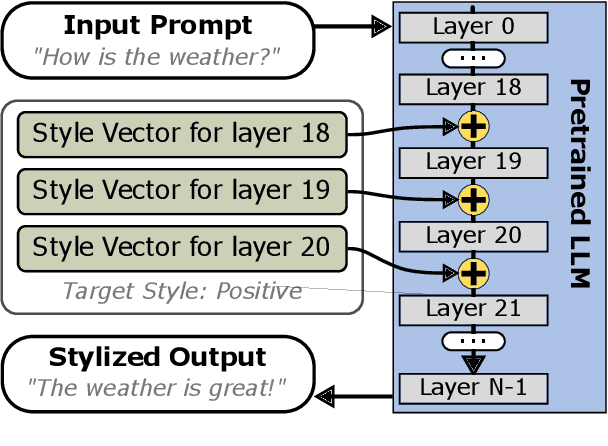
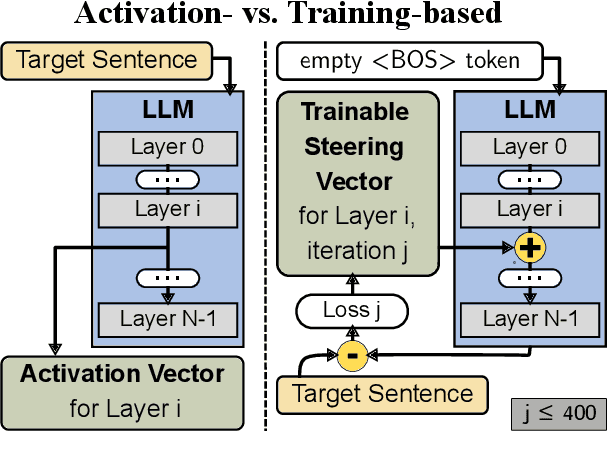
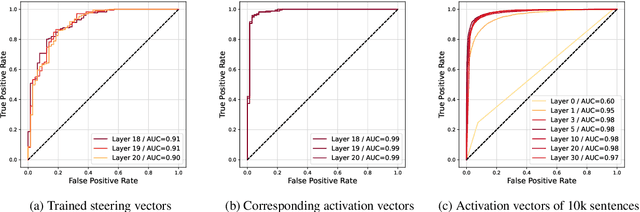
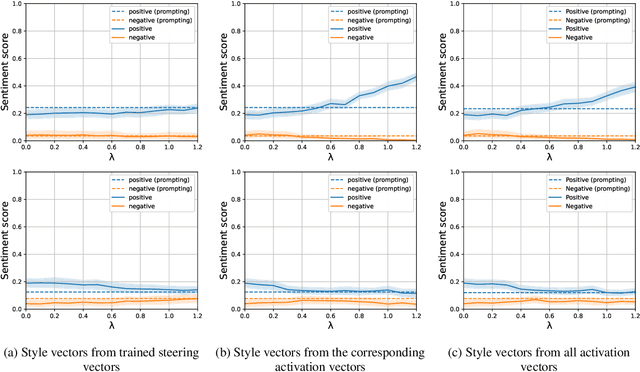
This research explores strategies for steering the output of large language models (LLMs) towards specific styles, such as sentiment, emotion, or writing style, by adding style vectors to the activations of hidden layers during text generation. We show that style vectors can be simply computed from recorded layer activations for input texts in a specific style in contrast to more complex training-based approaches. Through a series of experiments, we demonstrate the effectiveness of activation engineering using such style vectors to influence the style of generated text in a nuanced and parameterisable way, distinguishing it from prompt engineering. The presented research constitutes a significant step towards developing more adaptive and effective AI-empowered interactive systems.