 Add to Chrome
 Add to Firefox
 Add to Edge
Diagnosing Causal Reasoning in Vision-Language Models via Structured Relevance Graphs
Feb 24, 2026
Large Vision-Language Models (LVLMs) achieve strong performance on visual question answering benchmarks, yet often rely on spurious correlations rather than genuine causal reasoning. Existing evaluations primarily assess the correctness of the answers, making it unclear whether failures arise from limited reasoning capability or from misidentifying causally relevant information. We introduce Vision-Language Causal Graphs (VLCGs), a structured, query-conditioned representation that explicitly encodes causally relevant objects, attributes, relations, and scene-grounded assumptions. Building on this representation, we present ViLCaR, a diagnostic benchmark comprising tasks for Causal Attribution, Causal Inference, and Question Answering, along with graph-aligned evaluation metrics that assess relevance identification beyond final answer accuracy. Experiments in state-of-the-art LVLMs show that injecting structured relevance information significantly improves attribution and inference consistency compared to zero-shot and standard in-context learning. These findings suggest that current limitations in LVLM causal reasoning stem primarily from insufficient structural guidance rather than a lack of reasoning capacity.

Utilizing Sequential Information of General Lab-test Results and Diagnoses History for Differential Diagnosis of Dementia
Feb 21, 2025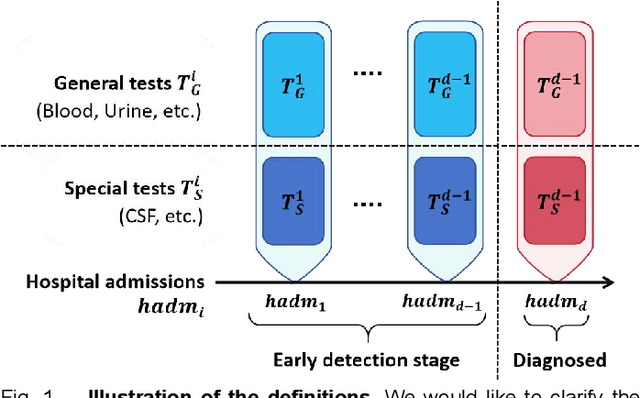
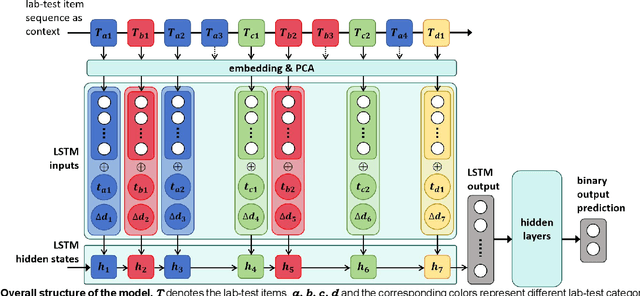
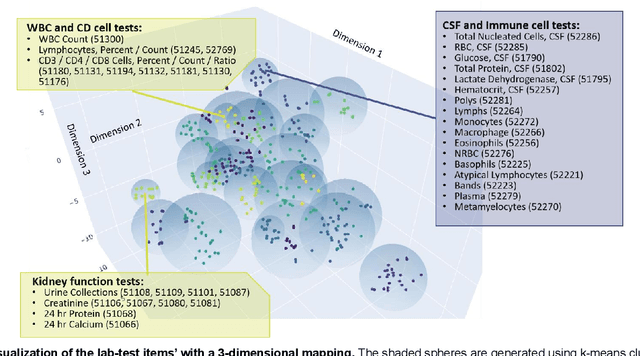
Early diagnosis of Alzheimer's Disease (AD) faces multiple data-related challenges, including high variability in patient data, limited access to specialized diagnostic tests, and overreliance on single-type indicators. These challenges are exacerbated by the progressive nature of AD, where subtle pathophysiological changes often precede clinical symptoms by decades. To address these limitations, this study proposes a novel approach that takes advantage of routinely collected general laboratory test histories for the early detection and differential diagnosis of AD. By modeling lab test sequences as "sentences", we apply word embedding techniques to capture latent relationships between tests and employ deep time series models, including long-short-term memory (LSTM) and Transformer networks, to model temporal patterns in patient records. Experimental results demonstrate that our approach improves diagnostic accuracy and enables scalable and costeffective AD screening in diverse clinical settings.