 Add to Chrome
 Add to Firefox
 Add to Edge
Do LLM hallucination detectors suffer from low-resource effect?
Jan 23, 2026
LLMs, while outperforming humans in a wide range of tasks, can still fail in unanticipated ways. We focus on two pervasive failure modes: (i) hallucinations, where models produce incorrect information about the world, and (ii) the low-resource effect, where the models show impressive performance in high-resource languages like English but the performance degrades significantly in low-resource languages like Bengali. We study the intersection of these issues and ask: do hallucination detectors suffer from the low-resource effect? We conduct experiments on five tasks across three domains (factual recall, STEM, and Humanities). Experiments with four LLMs and three hallucination detectors reveal a curious finding: As expected, the task accuracies in low-resource languages experience large drops (compared to English). However, the drop in detectors' accuracy is often several times smaller than the drop in task accuracy. Our findings suggest that even in low-resource languages, the internal mechanisms of LLMs might encode signals about their uncertainty. Further, the detectors are robust within language (even for non-English) and in multilingual setups, but not in cross-lingual settings without in-language supervision.

MILDSum: A Novel Benchmark Dataset for Multilingual Summarization of Indian Legal Case Judgments
Oct 28, 2023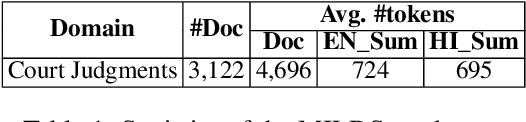
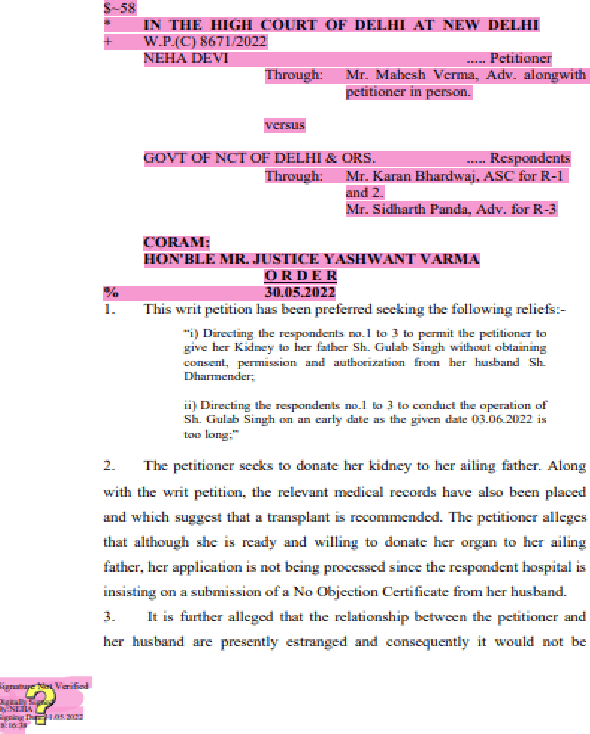
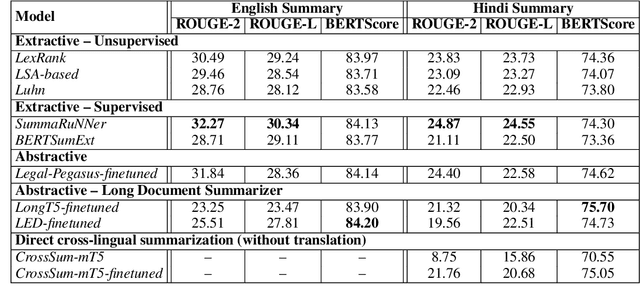
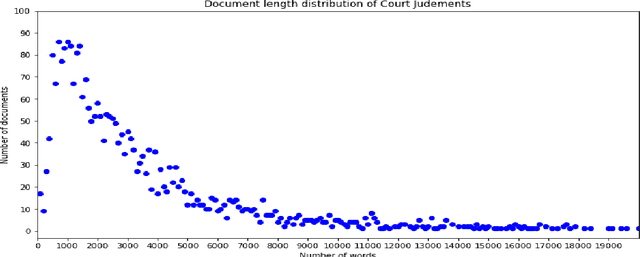
Automatic summarization of legal case judgments is a practically important problem that has attracted substantial research efforts in many countries. In the context of the Indian judiciary, there is an additional complexity -- Indian legal case judgments are mostly written in complex English, but a significant portion of India's population lacks command of the English language. Hence, it is crucial to summarize the legal documents in Indian languages to ensure equitable access to justice. While prior research primarily focuses on summarizing legal case judgments in their source languages, this study presents a pioneering effort toward cross-lingual summarization of English legal documents into Hindi, the most frequently spoken Indian language. We construct the first high-quality legal corpus comprising of 3,122 case judgments from prominent Indian courts in English, along with their summaries in both English and Hindi, drafted by legal practitioners. We benchmark the performance of several diverse summarization approaches on our corpus and demonstrate the need for further research in cross-lingual summarization in the legal domain.
Improving Access to Justice for the Indian Population: A Benchmark for Evaluating Translation of Legal Text to Indian Languages
Oct 15, 2023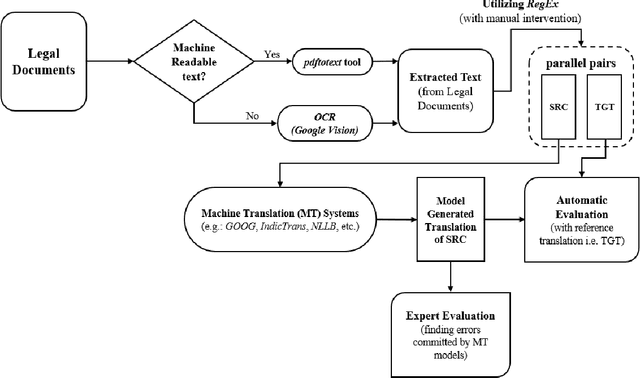
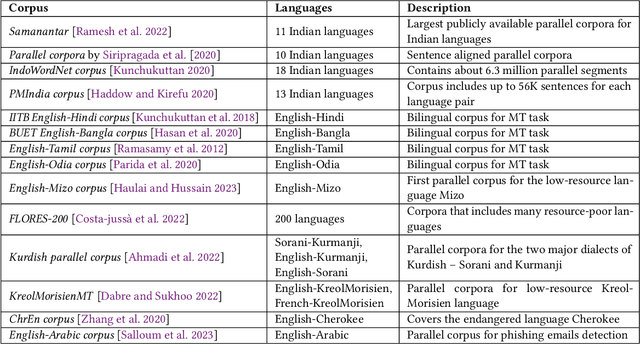
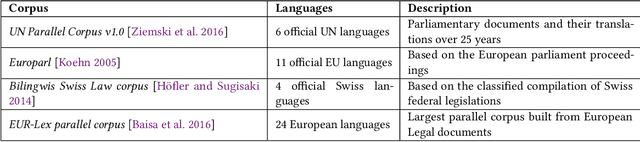
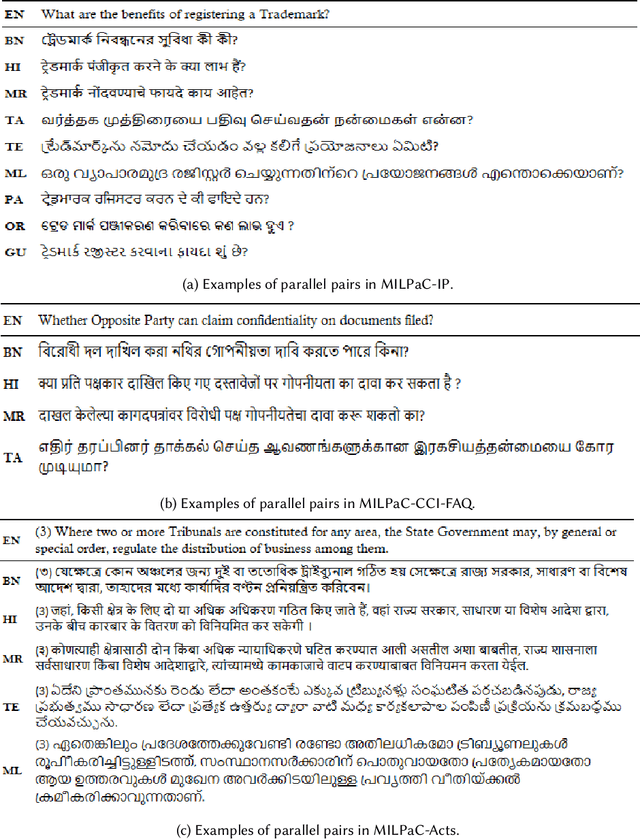
Most legal text in the Indian judiciary is written in complex English due to historical reasons. However, only about 10% of the Indian population is comfortable in reading English. Hence legal text needs to be made available in various Indian languages, possibly by translating the available legal text from English. Though there has been a lot of research on translation to and between Indian languages, to our knowledge, there has not been much prior work on such translation in the legal domain. In this work, we construct the first high-quality legal parallel corpus containing aligned text units in English and nine Indian languages, that includes several low-resource languages. We also benchmark the performance of a wide variety of Machine Translation (MT) systems over this corpus, including commercial MT systems, open-source MT systems and Large Language Models. Through a comprehensive survey by Law practitioners, we check how satisfied they are with the translations by some of these MT systems, and how well automatic MT evaluation metrics agree with the opinions of Law practitioners.