 Add to Chrome
 Add to Firefox
 Add to Edge
Attribution-Guided Distillation of Matryoshka Sparse Autoencoders
Dec 31, 2025
Sparse autoencoders (SAEs) aim to disentangle model activations into monosemantic, human-interpretable features. In practice, learned features are often redundant and vary across training runs and sparsity levels, which makes interpretations difficult to transfer and reuse. We introduce Distilled Matryoshka Sparse Autoencoders (DMSAEs), a training pipeline that distills a compact core of consistently useful features and reuses it to train new SAEs. DMSAEs run an iterative distillation cycle: train a Matryoshka SAE with a shared core, use gradient X activation to measure each feature's contribution to next-token loss in the most nested reconstruction, and keep only the smallest subset that explains a fixed fraction of the attribution. Only the core encoder weight vectors are transferred across cycles; the core decoder and all non-core latents are reinitialized each time. On Gemma-2-2B layer 12 residual stream activations, seven cycles of distillation (500M tokens, 65k width) yielded a distilled core of 197 features that were repeatedly selected. Training using this distilled core improves several SAEBench metrics and demonstrates that consistent sets of latent features can be transferred across sparsity levels

Nonlinear dimensionality reduction then and now: AIMs for dissipative PDEs in the ML era
Oct 24, 2023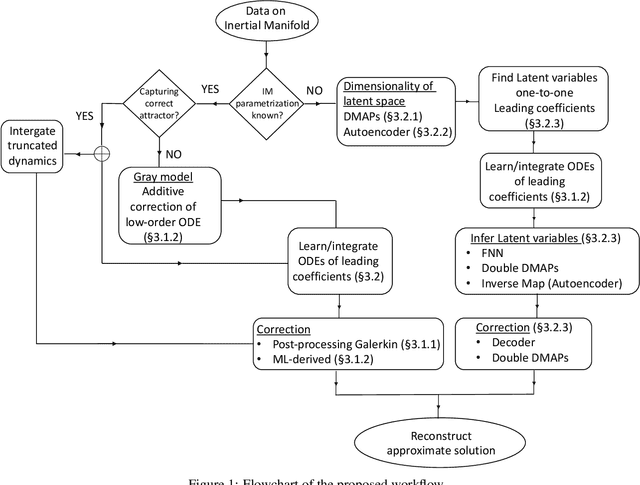
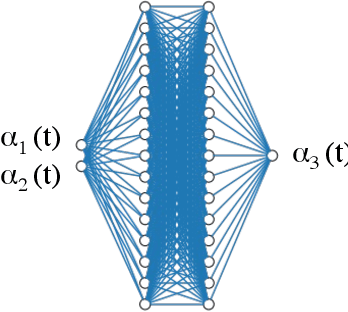
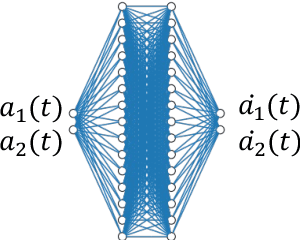
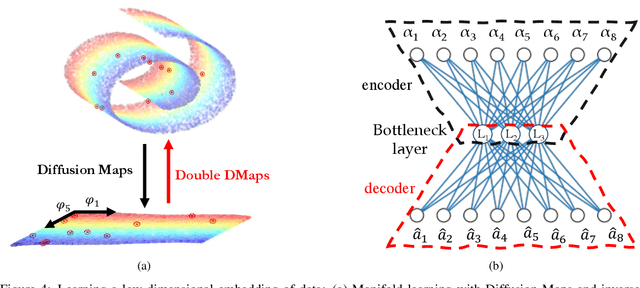
This study presents a collection of purely data-driven workflows for constructing reduced-order models (ROMs) for distributed dynamical systems. The ROMs we focus on, are data-assisted models inspired by, and templated upon, the theory of Approximate Inertial Manifolds (AIMs); the particular motivation is the so-called post-processing Galerkin method of Garcia-Archilla, Novo and Titi. Its applicability can be extended: the need for accurate truncated Galerkin projections and for deriving closed-formed corrections can be circumvented using machine learning tools. When the right latent variables are not a priori known, we illustrate how autoencoders as well as Diffusion Maps (a manifold learning scheme) can be used to discover good sets of latent variables and test their explainability. The proposed methodology can express the ROMs in terms of (a) theoretical (Fourier coefficients), (b) linear data-driven (POD modes) and/or (c) nonlinear data-driven (Diffusion Maps) coordinates. Both Black-Box and (theoretically-informed and data-corrected) Gray-Box models are described; the necessity for the latter arises when truncated Galerkin projections are so inaccurate as to not be amenable to post-processing. We use the Chafee-Infante reaction-diffusion and the Kuramoto-Sivashinsky dissipative partial differential equations to illustrate and successfully test the overall framework.
Tasks Makyth Models: Machine Learning Assisted Surrogates for Tipping Points
Sep 25, 2023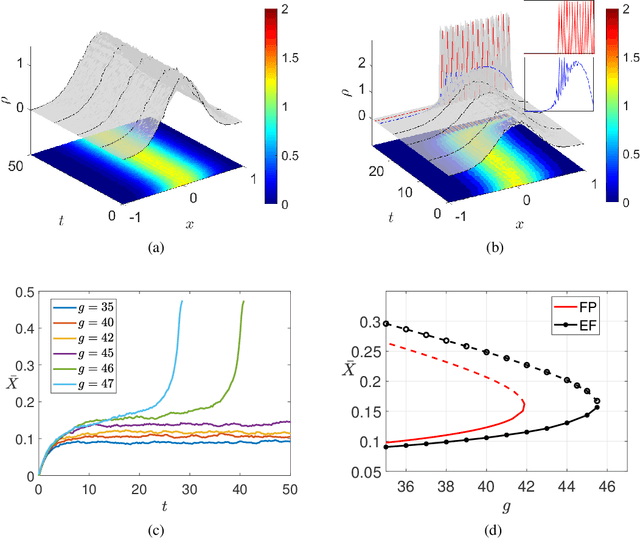

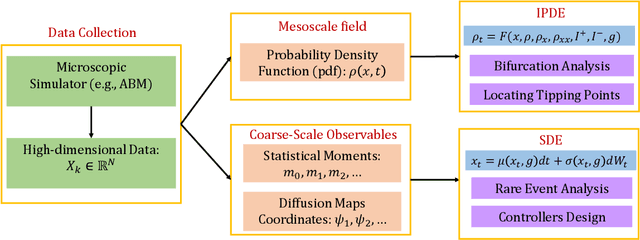

We present a machine learning (ML)-assisted framework bridging manifold learning, neural networks, Gaussian processes, and Equation-Free multiscale modeling, for (a) detecting tipping points in the emergent behavior of complex systems, and (b) characterizing probabilities of rare events (here, catastrophic shifts) near them. Our illustrative example is an event-driven, stochastic agent-based model (ABM) describing the mimetic behavior of traders in a simple financial market. Given high-dimensional spatiotemporal data -- generated by the stochastic ABM -- we construct reduced-order models for the emergent dynamics at different scales: (a) mesoscopic Integro-Partial Differential Equations (IPDEs); and (b) mean-field-type Stochastic Differential Equations (SDEs) embedded in a low-dimensional latent space, targeted to the neighborhood of the tipping point. We contrast the uses of the different models and the effort involved in learning them.