 Add to Chrome
 Add to Firefox
 Add to Edge
ASBA: A-line State Space Model and B-line Attention for Sparse Optical Doppler Tomography Reconstruction
Jan 20, 2026
Optical Doppler Tomography (ODT) is an emerging blood flow analysis technique. A 2D ODT image (B-scan) is generated by sequentially acquiring 1D depth-resolved raw A-scans (A-line) along the lateral axis (B-line), followed by Doppler phase-subtraction analysis. To ensure high-fidelity B-scan images, current practices rely on dense sampling, which prolongs scanning time, increases storage demands, and limits the capture of rapid blood flow dynamics. Recent studies have explored sparse sampling of raw A-scans to alleviate these limitations, but their effectiveness is hindered by the conservative sampling rates and the uniform modeling of flow and background signals. In this study, we introduce a novel blood flow-aware network, named ASBA (A-line ROI State space model and B-line phase Attention), to reconstruct ODT images from highly sparsely sampled raw A-scans. Specifically, we propose an A-line ROI state space model to extract sparsely distributed flow features along the A-line, and a B-line phase attention to capture long-range flow signals along each B-line based on phase difference. Moreover, we introduce a flow-aware weighted loss function that encourages the network to prioritize the accurate reconstruction of flow signals. Extensive experiments on real animal data demonstrate that the proposed approach clearly outperforms existing state-of-the-art reconstruction methods.

Sparse Reconstruction of Optical Doppler Tomography Based on State Space Model
Apr 26, 2024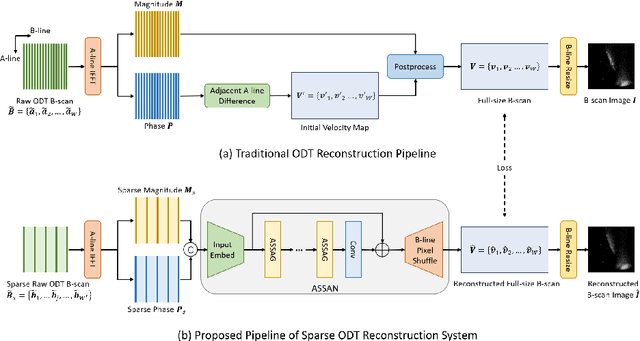
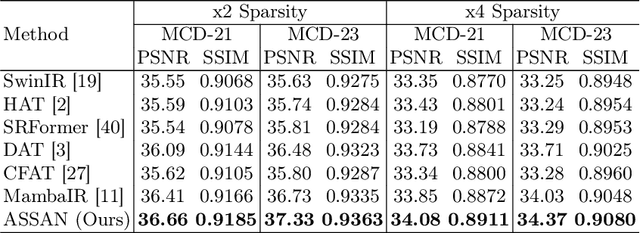
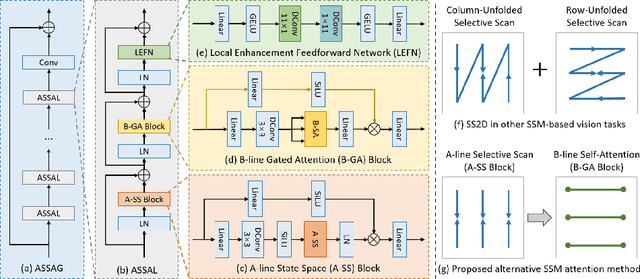
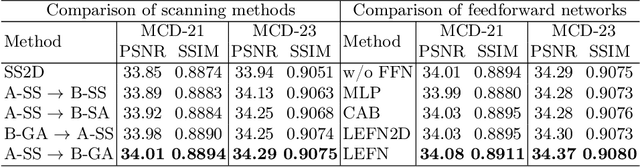
Optical Doppler Tomography (ODT) is a blood flow imaging technique popularly used in bioengineering applications. The fundamental unit of ODT is the 1D frequency response along the A-line (depth), named raw A-scan. A 2D ODT image (B-scan) is obtained by first sensing raw A-scans along the B-line (width), and then constructing the B-scan from these raw A-scans via magnitude-phase analysis and post-processing. To obtain a high-resolution B-scan with a precise flow map, densely sampled A-scans are required in current methods, causing both computational and storage burdens. To address this issue, in this paper we propose a novel sparse reconstruction framework with four main sequential steps: 1) early magnitude-phase fusion that encourages rich interaction of the complementary information in magnitude and phase, 2) State Space Model (SSM)-based representation learning, inspired by recent successes in Mamba and VMamba, to naturally capture both the intra-A-scan sequential information and between-A-scan interactions, 3) an Inception-based Feedforward Network module (IncFFN) to further boost the SSM-module, and 4) a B-line Pixel Shuffle (BPS) layer to effectively reconstruct the final results. In the experiments on real-world animal data, our method shows clear effectiveness in reconstruction accuracy. As the first application of SSM for image reconstruction tasks, we expect our work to inspire related explorations in not only efficient ODT imaging techniques but also generic image enhancement.