 Add to Chrome
 Add to Firefox
 Add to Edge
Backdoor Sentinel: Detecting and Detoxifying Backdoors in Diffusion Models via Temporal Noise Consistency
Feb 02, 2026
Diffusion models have been widely deployed in AIGC services; however, their reliance on opaque training data and procedures exposes a broad attack surface for backdoor injection. In practical auditing scenarios, due to the protection of intellectual property and commercial confidentiality, auditors are typically unable to access model parameters, rendering existing white-box or query-intensive detection methods impractical. More importantly, even after the backdoor is detected, existing detoxification approaches are often trapped in a dilemma between detoxification effectiveness and generation quality. In this work, we identify a previously unreported phenomenon called temporal noise unconsistency, where the noise predictions between adjacent diffusion timesteps is disrupted in specific temporal segments when the input is triggered, while remaining stable under clean inputs. Leveraging this finding, we propose Temporal Noise Consistency Defense (TNC-Defense), a unified framework for backdoor detection and detoxification. The framework first uses the adjacent timestep noise consistency to design a gray-box detection module, for identifying and locating anomalous diffusion timesteps. Furthermore, the framework uses the identified anomalous timesteps to construct a trigger-agnostic, timestep-aware detoxification module, which directly corrects the backdoor generation path. This effectively suppresses backdoor behavior while significantly reducing detoxification costs. We evaluate the proposed method under five representative backdoor attack scenarios and compare it with state-of-the-art defenses. The results show that TNC-Defense improves the average detection accuracy by $11\%$ with negligible additional overhead, and invalidates an average of $98.5\%$ of triggered samples with only a mild degradation in generation quality.

DPR: Diffusion Preference-based Reward for Offline Reinforcement Learning
Mar 03, 2025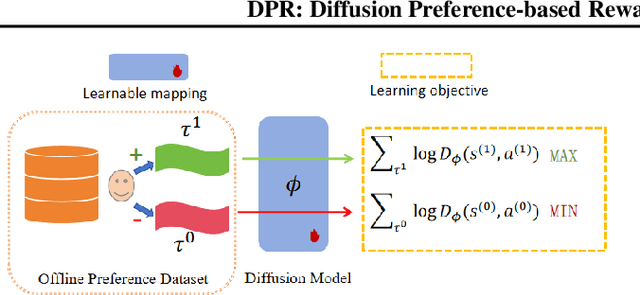
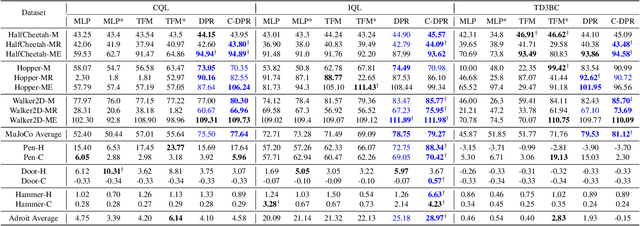
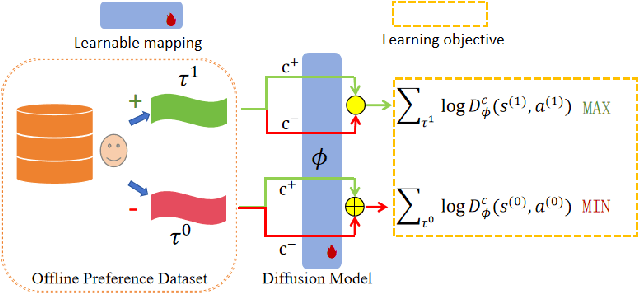
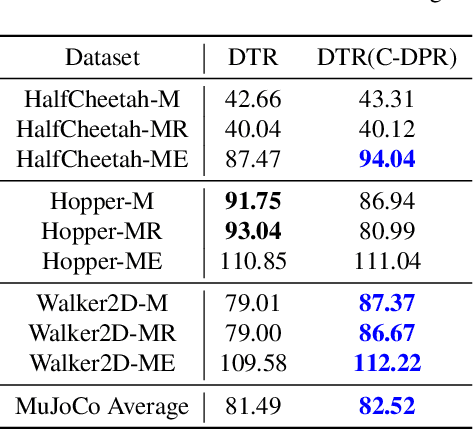
Offline preference-based reinforcement learning (PbRL) mitigates the need for reward definition, aligning with human preferences via preference-driven reward feedback without interacting with the environment. However, the effectiveness of preference-driven reward functions depends on the modeling ability of the learning model, which current MLP-based and Transformer-based methods may fail to adequately provide. To alleviate the failure of the reward function caused by insufficient modeling, we propose a novel preference-based reward acquisition method: Diffusion Preference-based Reward (DPR). Unlike previous methods using Bradley-Terry models for trajectory preferences, we use diffusion models to directly model preference distributions for state-action pairs, allowing rewards to be discriminatively obtained from these distributions. In addition, considering the particularity of preference data that only know the internal relationships of paired trajectories, we further propose Conditional Diffusion Preference-based Reward (C-DPR), which leverages relative preference information to enhance the construction of the diffusion model. We apply the above methods to existing offline reinforcement learning algorithms and a series of experiment results demonstrate that the diffusion-based reward acquisition approach outperforms previous MLP-based and Transformer-based methods.
Towards Macro-AUC oriented Imbalanced Multi-Label Continual Learning
Dec 24, 2024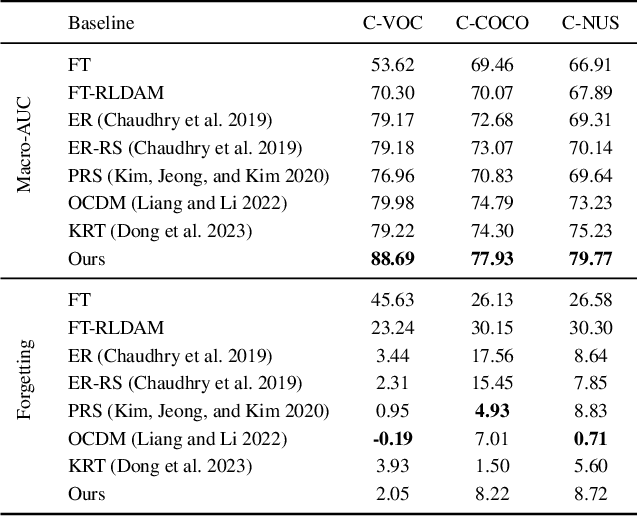
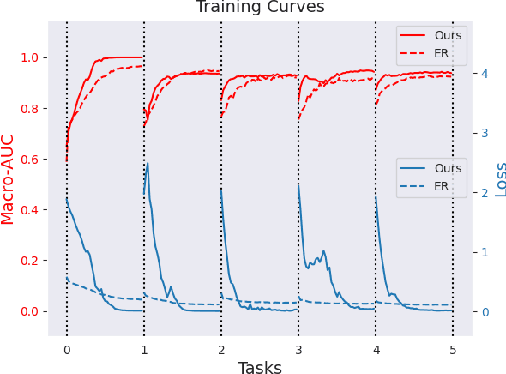
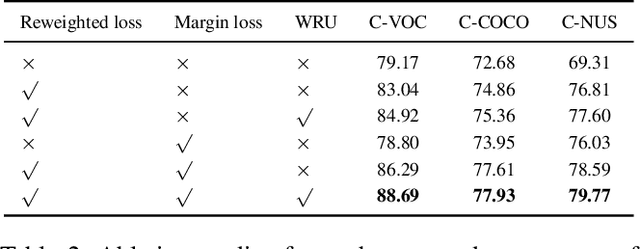
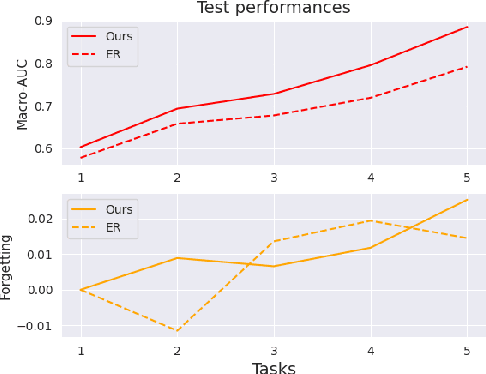
In Continual Learning (CL), while existing work primarily focuses on the multi-class classification task, there has been limited research on Multi-Label Learning (MLL). In practice, MLL datasets are often class-imbalanced, making it inherently challenging, a problem that is even more acute in CL. Due to its sensitivity to imbalance, Macro-AUC is an appropriate and widely used measure in MLL. However, there is no research to optimize Macro-AUC in MLCL specifically. To fill this gap, in this paper, we propose a new memory replay-based method to tackle the imbalance issue for Macro-AUC-oriented MLCL. Specifically, inspired by recent theory work, we propose a new Reweighted Label-Distribution-Aware Margin (RLDAM) loss. Furthermore, to be compatible with the RLDAM loss, a new memory-updating strategy named Weight Retain Updating (WRU) is proposed to maintain the numbers of positive and negative instances of the original dataset in memory. Theoretically, we provide superior generalization analyses of the RLDAM-based algorithm in terms of Macro-AUC, separately in batch MLL and MLCL settings. This is the first work to offer theoretical generalization analyses in MLCL to our knowledge. Finally, a series of experimental results illustrate the effectiveness of our method over several baselines. Our codes are available at https://github.com/ML-Group-SDU/Macro-AUC-CL.
DiffAIL: Diffusion Adversarial Imitation Learning
Dec 12, 2023Imitation learning aims to solve the problem of defining reward functions in real-world decision-making tasks. The current popular approach is the Adversarial Imitation Learning (AIL) framework, which matches expert state-action occupancy measures to obtain a surrogate reward for forward reinforcement learning. However, the traditional discriminator is a simple binary classifier and doesn't learn an accurate distribution, which may result in failing to identify expert-level state-action pairs induced by the policy interacting with the environment. To address this issue, we propose a method named diffusion adversarial imitation learning (DiffAIL), which introduces the diffusion model into the AIL framework. Specifically, DiffAIL models the state-action pairs as unconditional diffusion models and uses diffusion loss as part of the discriminator's learning objective, which enables the discriminator to capture better expert demonstrations and improve generalization. Experimentally, the results show that our method achieves state-of-the-art performance and significantly surpasses expert demonstration on two benchmark tasks, including the standard state-action setting and state-only settings. Our code can be available at the link https://github.com/ML-Group-SDU/DiffAIL.