 Add to Chrome
 Add to Firefox
 Add to Edge
GraphAllocBench: A Flexible Benchmark for Preference-Conditioned Multi-Objective Policy Learning
Jan 28, 2026
Preference-Conditioned Policy Learning (PCPL) in Multi-Objective Reinforcement Learning (MORL) aims to approximate diverse Pareto-optimal solutions by conditioning policies on user-specified preferences over objectives. This enables a single model to flexibly adapt to arbitrary trade-offs at run-time by producing a policy on or near the Pareto front. However, existing benchmarks for PCPL are largely restricted to toy tasks and fixed environments, limiting their realism and scalability. To address this gap, we introduce GraphAllocBench, a flexible benchmark built on a novel graph-based resource allocation sandbox environment inspired by city management, which we call CityPlannerEnv. GraphAllocBench provides a rich suite of problems with diverse objective functions, varying preference conditions, and high-dimensional scalability. We also propose two new evaluation metrics -- Proportion of Non-Dominated Solutions (PNDS) and Ordering Score (OS) -- that directly capture preference consistency while complementing the widely used hypervolume metric. Through experiments with Multi-Layer Perceptrons (MLPs) and graph-aware models, we show that GraphAllocBench exposes the limitations of existing MORL approaches and paves the way for using graph-based methods such as Graph Neural Networks in complex, high-dimensional combinatorial allocation tasks. Beyond its predefined problem set, GraphAllocBench enables users to flexibly vary objectives, preferences, and allocation rules, establishing it as a versatile and extensible benchmark for advancing PCPL. Code: https://anonymous.4open.science/r/GraphAllocBench

Scalable Interactive Machine Learning for Future Command and Control
Feb 09, 2024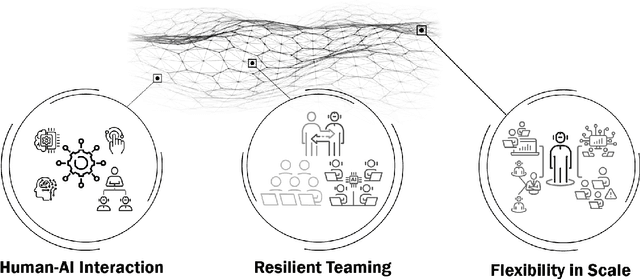
Future warfare will require Command and Control (C2) personnel to make decisions at shrinking timescales in complex and potentially ill-defined situations. Given the need for robust decision-making processes and decision-support tools, integration of artificial and human intelligence holds the potential to revolutionize the C2 operations process to ensure adaptability and efficiency in rapidly changing operational environments. We propose to leverage recent promising breakthroughs in interactive machine learning, in which humans can cooperate with machine learning algorithms to guide machine learning algorithm behavior. This paper identifies several gaps in state-of-the-art science and technology that future work should address to extend these approaches to function in complex C2 contexts. In particular, we describe three research focus areas that together, aim to enable scalable interactive machine learning (SIML): 1) developing human-AI interaction algorithms to enable planning in complex, dynamic situations; 2) fostering resilient human-AI teams through optimizing roles, configurations, and trust; and 3) scaling algorithms and human-AI teams for flexibility across a range of potential contexts and situations.