 Add to Chrome
 Add to Firefox
 Add to Edge
Semi-Automated Data Annotation in Multisensor Datasets for Autonomous Vehicle Testing
Dec 31, 2025
This report presents the design and implementation of a semi-automated data annotation pipeline developed within the DARTS project, whose goal is to create a large-scale, multimodal dataset of driving scenarios recorded in Polish conditions. Manual annotation of such heterogeneous data is both costly and time-consuming. To address this challenge, the proposed solution adopts a human-in-the-loop approach that combines artificial intelligence with human expertise to reduce annotation cost and duration. The system automatically generates initial annotations, enables iterative model retraining, and incorporates data anonymization and domain adaptation techniques. At its core, the tool relies on 3D object detection algorithms to produce preliminary annotations. Overall, the developed tools and methodology result in substantial time savings while ensuring consistent, high-quality annotations across different sensor modalities. The solution directly supports the DARTS project by accelerating the preparation of large annotated dataset in the project's standardized format, strengthening the technological base for autonomous vehicle research in Poland.

Semi-Supervised Diversity-Aware Domain Adaptation for 3D Object detection
Dec 31, 20253D object detectors are fundamental components of perception systems in autonomous vehicles. While these detectors achieve remarkable performance on standard autonomous driving benchmarks, they often struggle to generalize across different domains - for instance, a model trained in the U.S. may perform poorly in regions like Asia or Europe. This paper presents a novel lidar domain adaptation method based on neuron activation patterns, demonstrating that state-of-the-art performance can be achieved by annotating only a small, representative, and diverse subset of samples from the target domain if they are correctly selected. The proposed approach requires very small annotation budget and, when combined with post-training techniques inspired by continual learning prevent weight drift from the original model. Empirical evaluation shows that the proposed domain adaptation approach outperforms both linear probing and state-of-the-art domain adaptation techniques.
Detecting Out-of-distribution Objects Using Neuron Activation Patterns
Jul 31, 2023Object detection is essential to many perception algorithms used in modern robotics applications. Unfortunately, the existing models share a tendency to assign high confidence scores for out-of-distribution (OOD) samples. Although OOD detection has been extensively studied in recent years by the computer vision (CV) community, most proposed solutions apply only to the image recognition task. Real-world applications such as perception in autonomous vehicles struggle with far more complex challenges than classification. In our work, we focus on the prevalent field of object detection, introducing Neuron Activation PaTteRns for out-of-distribution samples detection in Object detectioN (NAPTRON). Performed experiments show that our approach outperforms state-of-the-art methods, without the need to affect in-distribution (ID) performance. By evaluating the methods in two distinct OOD scenarios and three types of object detectors we have created the largest open-source benchmark for OOD object detection.
Combating noisy labels in object detection datasets
Nov 25, 2022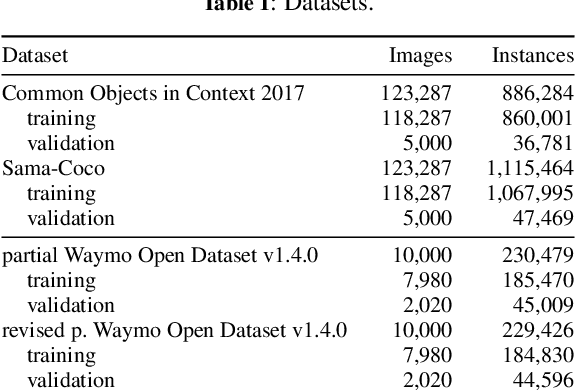
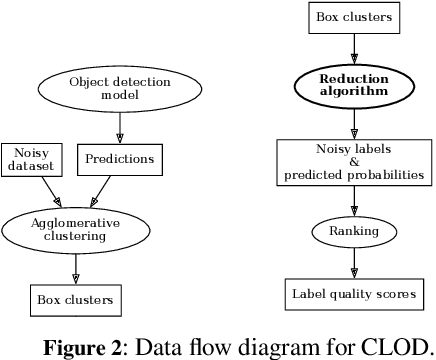
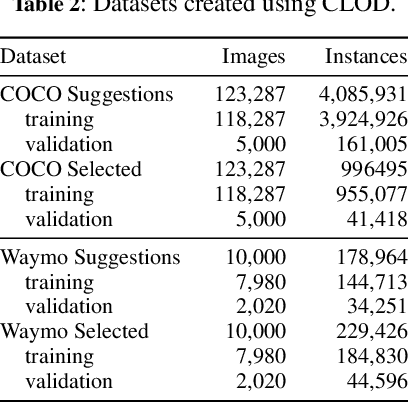
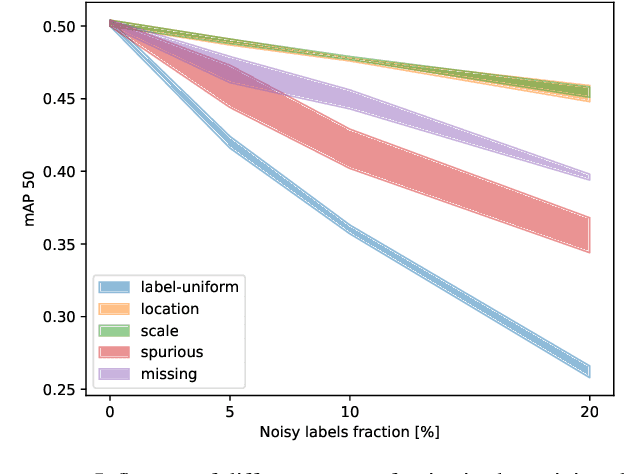
The quality of training datasets for deep neural networks is a key factor contributing to the accuracy of resulting models. This is even more important in difficult tasks such as object detection. Dealing with errors in these datasets was in the past limited to accepting that some fraction of examples is incorrect or predicting their confidence and assigning appropriate weights during training. In this work, we propose a different approach. For the first time, we extended the confident learning algorithm to the object detection task. By focusing on finding incorrect labels in the original training datasets, we can eliminate erroneous examples in their root. Suspicious bounding boxes can be re-annotated in order to improve the quality of the dataset itself, thus leading to better models without complicating their already complex architectures. We can effectively point out 99\% of artificially disturbed bounding boxes with FPR below 0.3. We see this method as a promising path to correcting well-known object detection datasets.