 Add to Chrome
 Add to Firefox
 Add to Edge
Can we trust our models? Epistemic calibration in second-order classification
Jun 09, 2026
Uncertainty estimation is critical for deploying machine learning models in high-stakes settings. However, classical calibration only assesses the reliability of predicted probabilities and does not evaluate whether epistemic uncertainty estimates are themselves trustworthy. This limitation is particularly relevant for second-order classification models. We introduce epistemic calibration, a principled criterion that measures whether reported epistemic uncertainty faithfully reflects the dispersion of model predictions around the ground truth. We show that epistemic calibration is a strictly stronger notion than classical calibration and captures failure modes invisible to standard metrics. We relate this work to the existing literature through an impossibility theorem that holds under the epistemic calibration hypothesis. To operationalize this concept, we propose the Expected Epistemic Calibration Error (EECE), which we prove to be a consistent estimator of a True Epistemic Calibration Error (TECE). Experiments across a broad range of uncertainty quantification methods show that epistemic calibration is a coherent and meaningful criterion and reveal substantial differences across methods, despite similar predictive performance.

OPTIMUS-Prime: Minimal and Sufficient Concept Explanations for Deep Vision Models
Jun 05, 2026The growing demand for transparency in automated decision-making has propelled eXplainable Artificial Intelligence (XAI) to the forefront of machine learning research. In computer vision, however, existing explanation methods often prioritize end-user accessibility at the expense of formal guarantees, leaving a critical gap between practical utility and theoretical rigor. In this paper, we address this gap by introducing OPTIMUS, a novel framework for generating concept-based visual explanations for deep classification models. OPTIMUS explanations take the form of visual heatmaps that not only remain interpretable to end users, but are grounded in the well-established theory of prime implicants, providing formal guarantees that have been largely absent from existing saliency-based methods. Specifically, OPTIMUS explanations satisfy two desirable properties: sufficiency, ensuring that the highlighted concepts provably guarantee the classifier's prediction, and minimality, ensuring that no strict subset of those concepts retains this guarantee. Together, these properties yield explanations that are both logically tight and visually coherent. We validate our approach on a visual classification benchmark, demonstrating that OPTIMUS heatmaps naturally and faithfully surface the decision-relevant concepts underlying model predictions.
Reducing Aleatoric and Epistemic Uncertainty through Multi-modal Data Acquisition
Jan 30, 2025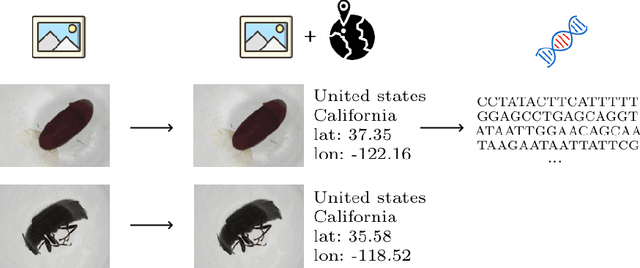
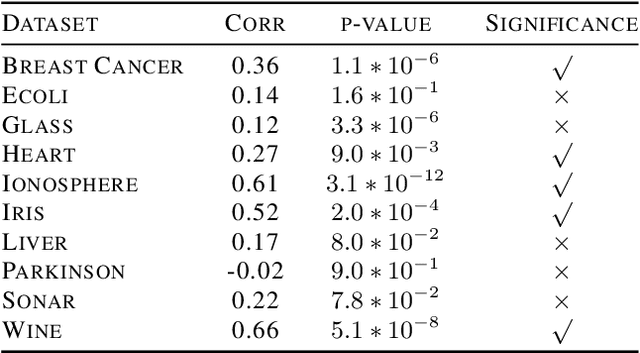
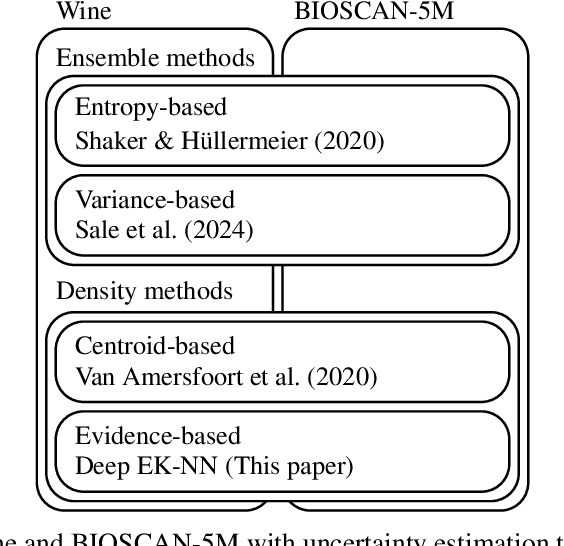
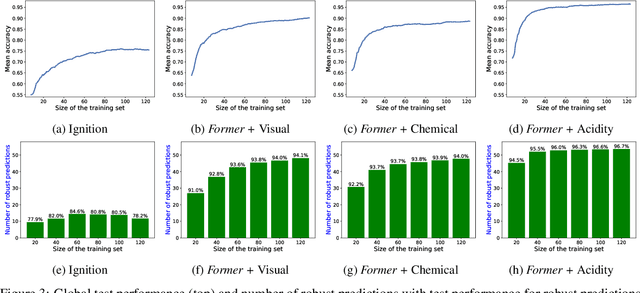
To generate accurate and reliable predictions, modern AI systems need to combine data from multiple modalities, such as text, images, audio, spreadsheets, and time series. Multi-modal data introduces new opportunities and challenges for disentangling uncertainty: it is commonly assumed in the machine learning community that epistemic uncertainty can be reduced by collecting more data, while aleatoric uncertainty is irreducible. However, this assumption is challenged in modern AI systems when information is obtained from different modalities. This paper introduces an innovative data acquisition framework where uncertainty disentanglement leads to actionable decisions, allowing sampling in two directions: sample size and data modality. The main hypothesis is that aleatoric uncertainty decreases as the number of modalities increases, while epistemic uncertainty decreases by collecting more observations. We provide proof-of-concept implementations on two multi-modal datasets to showcase our data acquisition framework, which combines ideas from active learning, active feature acquisition and uncertainty quantification.
DEMAU: Decompose, Explore, Model and Analyse Uncertainties
Sep 12, 2024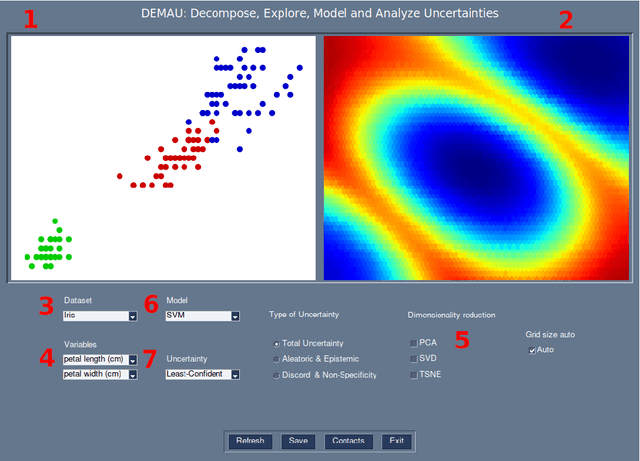
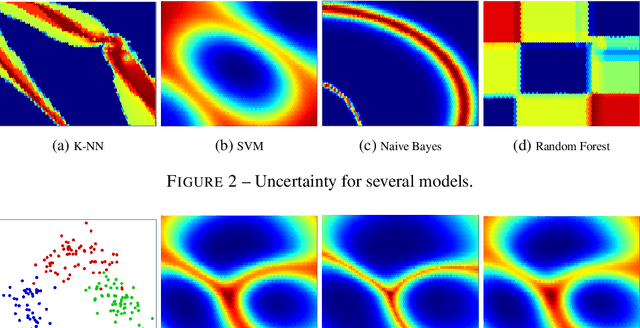
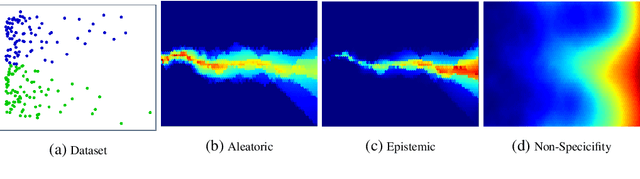
Recent research in machine learning has given rise to a flourishing literature on the quantification and decomposition of model uncertainty. This information can be very useful during interactions with the learner, such as in active learning or adaptive learning, and especially in uncertainty sampling. To allow a simple representation of these total, epistemic (reducible) and aleatoric (irreducible) uncertainties, we offer DEMAU, an open-source educational, exploratory and analytical tool allowing to visualize and explore several types of uncertainty for classification models in machine learning.
Evidential uncertainties on rich labels for active learning
Sep 21, 2023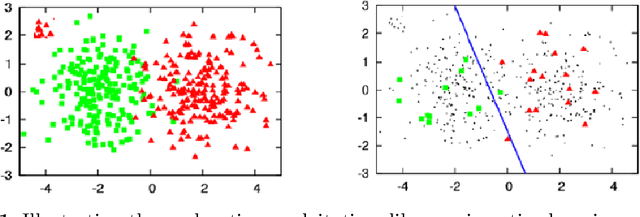
Recent research in active learning, and more precisely in uncertainty sampling, has focused on the decomposition of model uncertainty into reducible and irreducible uncertainties. In this paper, we propose to simplify the computational phase and remove the dependence on observations, but more importantly to take into account the uncertainty already present in the labels, \emph{i.e.} the uncertainty of the oracles. Two strategies are proposed, sampling by Klir uncertainty, which addresses the exploration-exploitation problem, and sampling by evidential epistemic uncertainty, which extends the reducible uncertainty to the evidential framework, both using the theory of belief functions.