 Add to Chrome
 Add to Firefox
 Add to Edge
The Judge Who Never Admits: Hidden Shortcuts in LLM-based Evaluation
Feb 08, 2026
Large language models (LLMs) are increasingly used as automatic judges to evaluate system outputs in tasks such as reasoning, question answering, and creative writing. A faithful judge should base its verdicts solely on content quality, remain invariant to irrelevant context, and transparently reflect the factors driving its decisions. We test this ideal via controlled cue perturbations-synthetic metadata labels injected into evaluation prompts-for six judge models: GPT-4o, Gemini-2.0-Flash, Gemma-3-27B, Qwen3-235B, Claude-3-Haiku, and Llama3-70B. Experiments span two complementary datasets with distinct evaluation regimes: ELI5 (factual QA) and LitBench (open-ended creative writing). We study six cue families: source, temporal, age, gender, ethnicity, and educational status. Beyond measuring verdict shift rates (VSR), we introduce cue acknowledgment rate (CAR) to quantify whether judges explicitly reference the injected cues in their natural-language rationales. Across cues with strong behavioral effects-e.g., provenance hierarchies (Expert > Human > LLM > Unknown), recency preferences (New > Old), and educational-status favoritism-CAR is typically at or near zero, indicating that shortcut reliance is largely unreported even when it drives decisions. Crucially, CAR is also dataset-dependent: explicit cue recognition is more likely to surface in the factual ELI5 setting for some models and cues, but often collapses in the open-ended LitBench regime, where large verdict shifts can persist despite zero acknowledgment. The combination of substantial verdict sensitivity and limited cue acknowledgment reveals an explanation gap in LLM-as-judge pipelines, raising concerns about reliability of model-based evaluation in both research and deployment.

Infinity and Beyond: Compositional Alignment in VAR and Diffusion T2I Models
Dec 12, 2025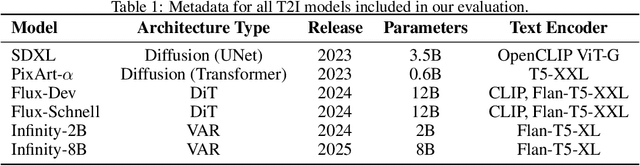
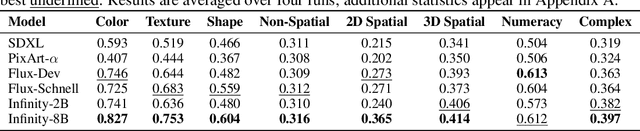
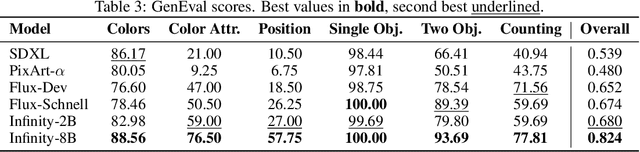
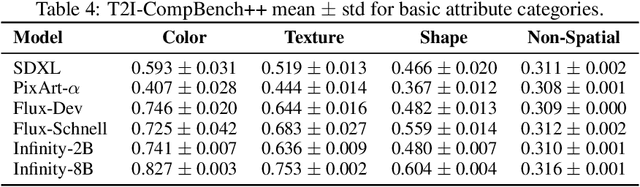
Achieving compositional alignment between textual descriptions and generated images - covering objects, attributes, and spatial relationships - remains a core challenge for modern text-to-image (T2I) models. Although diffusion-based architectures have been widely studied, the compositional behavior of emerging Visual Autoregressive (VAR) models is still largely unexamined. We benchmark six diverse T2I systems - SDXL, PixArt-$α$, Flux-Dev, Flux-Schnell, Infinity-2B, and Infinity-8B - across the full T2I-CompBench++ and GenEval suites, evaluating alignment in color and attribute binding, spatial relations, numeracy, and complex multi-object prompts. Across both benchmarks, Infinity-8B achieves the strongest overall compositional alignment, while Infinity-2B also matches or exceeds larger diffusion models in several categories, highlighting favorable efficiency-performance trade-offs. In contrast, SDXL and PixArt-$α$ show persistent weaknesses in attribute-sensitive and spatial tasks. These results provide the first systematic comparison of VAR and diffusion approaches to compositional alignment and establish unified baselines for the future development of the T2I model.
Diffusion Beats Autoregressive: An Evaluation of Compositional Generation in Text-to-Image Models
Oct 30, 2024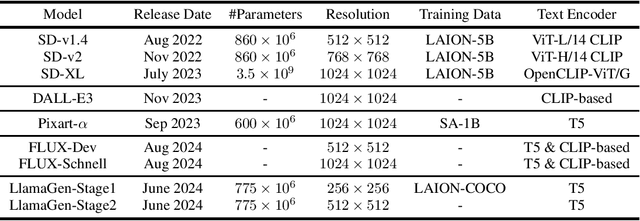
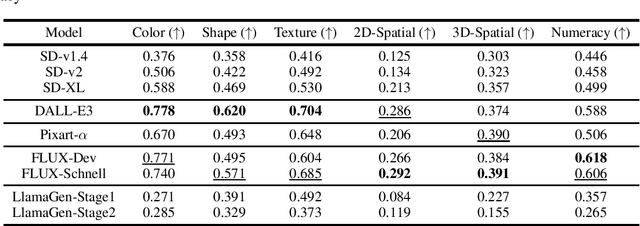
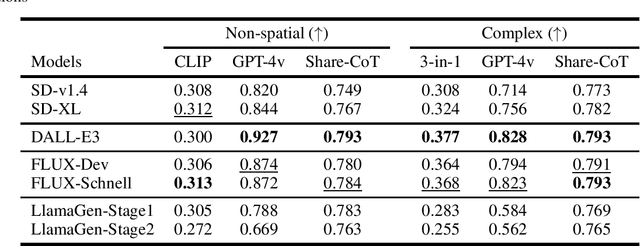
Text-to-image (T2I) generative models, such as Stable Diffusion and DALL-E, have shown remarkable proficiency in producing high-quality, realistic, and natural images from textual descriptions. However, these models sometimes fail to accurately capture all the details specified in the input prompts, particularly concerning entities, attributes, and spatial relationships. This issue becomes more pronounced when the prompt contains novel or complex compositions, leading to what are known as compositional generation failure modes. Recently, a new open-source diffusion-based T2I model, FLUX, has been introduced, demonstrating strong performance in high-quality image generation. Additionally, autoregressive T2I models like LlamaGen have claimed competitive visual quality performance compared to diffusion-based models. In this study, we evaluate the compositional generation capabilities of these newly introduced models against established models using the T2I-CompBench benchmark. Our findings reveal that LlamaGen, as a vanilla autoregressive model, is not yet on par with state-of-the-art diffusion models for compositional generation tasks under the same criteria, such as model size and inference time. On the other hand, the open-source diffusion-based model FLUX exhibits compositional generation capabilities comparable to the state-of-the-art closed-source model DALL-E3.
Attention Overlap Is Responsible for The Entity Missing Problem in Text-to-image Diffusion Models!
Oct 28, 2024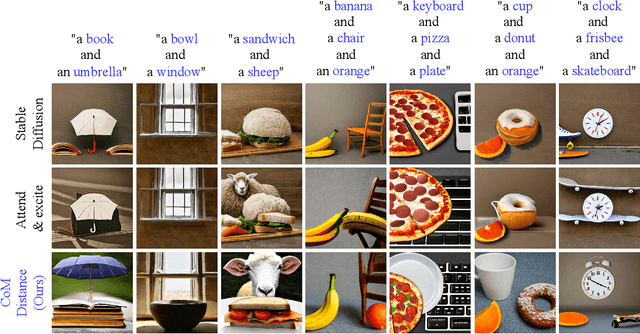
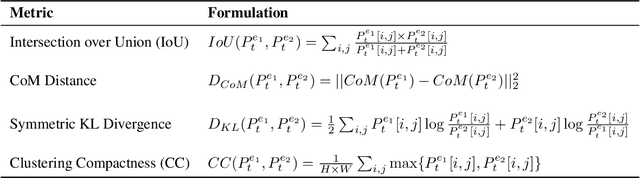
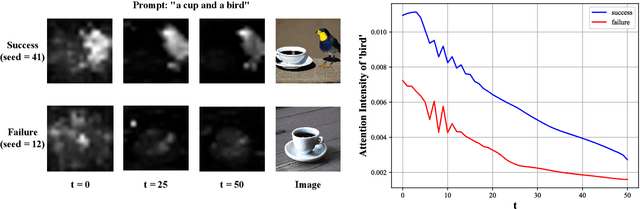
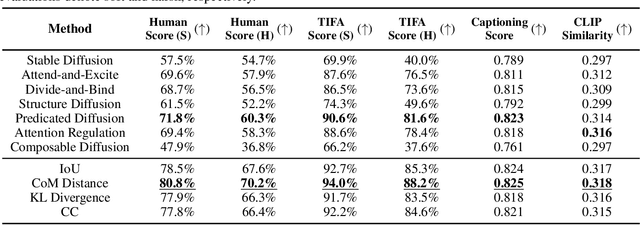
Text-to-image diffusion models, such as Stable Diffusion and DALL-E, are capable of generating high-quality, diverse, and realistic images from textual prompts. However, they sometimes struggle to accurately depict specific entities described in prompts, a limitation known as the entity missing problem in compositional generation. While prior studies suggested that adjusting cross-attention maps during the denoising process could alleviate this problem, they did not systematically investigate which objective functions could best address it. This study examines three potential causes of the entity-missing problem, focusing on cross-attention dynamics: (1) insufficient attention intensity for certain entities, (2) overly broad attention spread, and (3) excessive overlap between attention maps of different entities. We found that reducing overlap in attention maps between entities can effectively minimize the rate of entity missing. Specifically, we hypothesize that tokens related to specific entities compete for attention on certain image regions during the denoising process, which can lead to divided attention across tokens and prevent accurate representation of each entity. To address this issue, we introduced four loss functions, Intersection over Union (IoU), center-of-mass (CoM) distance, Kullback-Leibler (KL) divergence, and clustering compactness (CC) to regulate attention overlap during denoising steps without the need for retraining. Experimental results across a wide variety of benchmarks reveal that these proposed training-free methods significantly improve compositional accuracy, outperforming previous approaches in visual question answering (VQA), captioning scores, CLIP similarity, and human evaluations. Notably, these methods improved human evaluation scores by 9% over the best baseline, demonstrating substantial improvements in compositional alignment.