 Add to Chrome
 Add to Firefox
 Add to Edge
MAUGen: A Unified Diffusion Approach for Multi-Identity Facial Expression and AU Label Generation
Jan 31, 2026
The lack of large-scale, demographically diverse face images with precise Action Unit (AU) occurrence and intensity annotations has long been recognized as a fundamental bottleneck in developing generalizable AU recognition systems. In this paper, we propose MAUGen, a diffusion-based multi-modal framework that jointly generates a large collection of photorealistic facial expressions and anatomically consistent AU labels, including both occurrence and intensity, conditioned on a single descriptive text prompt. Our MAUGen involves two key modules: (1) a Multi-modal Representation Learning (MRL) module that captures the relationships among the paired textual description, facial identity, expression image, and AU activations within a unified latent space; and (2) a Diffusion-based Image label Generator (DIG) that decodes the joint representation into aligned facial image-label pairs across diverse identities. Under this framework, we introduce Multi-Identity Facial Action (MIFA), a large-scale multimodal synthetic dataset featuring comprehensive AU annotations and identity variations. Extensive experiments demonstrate that MAUGen outperforms existing methods in synthesizing photorealistic, demographically diverse facial images along with semantically aligned AU labels.

EasySplat: View-Adaptive Learning makes 3D Gaussian Splatting Easy
Jan 02, 2025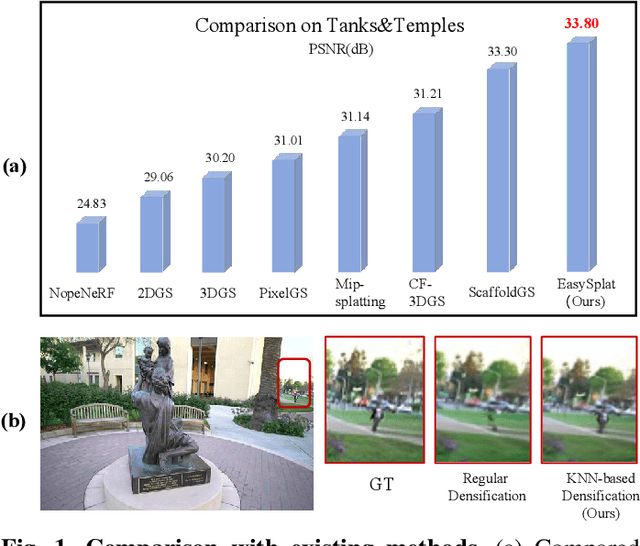
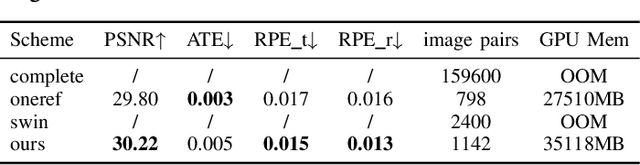
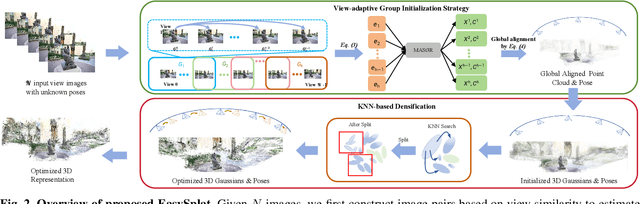
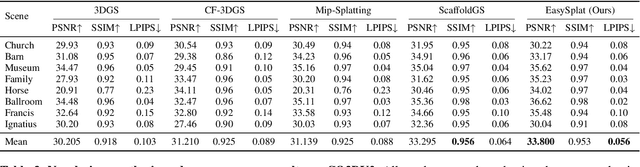
3D Gaussian Splatting (3DGS) techniques have achieved satisfactory 3D scene representation. Despite their impressive performance, they confront challenges due to the limitation of structure-from-motion (SfM) methods on acquiring accurate scene initialization, or the inefficiency of densification strategy. In this paper, we introduce a novel framework EasySplat to achieve high-quality 3DGS modeling. Instead of using SfM for scene initialization, we employ a novel method to release the power of large-scale pointmap approaches. Specifically, we propose an efficient grouping strategy based on view similarity, and use robust pointmap priors to obtain high-quality point clouds and camera poses for 3D scene initialization. After obtaining a reliable scene structure, we propose a novel densification approach that adaptively splits Gaussian primitives based on the average shape of neighboring Gaussian ellipsoids, utilizing KNN scheme. In this way, the proposed method tackles the limitation on initialization and optimization, leading to an efficient and accurate 3DGS modeling. Extensive experiments demonstrate that EasySplat outperforms the current state-of-the-art (SOTA) in handling novel view synthesis.