 Add to Chrome
 Add to Firefox
 Add to Edge
MiAD: Mirage Atom Diffusion for De Novo Crystal Generation
Nov 18, 2025

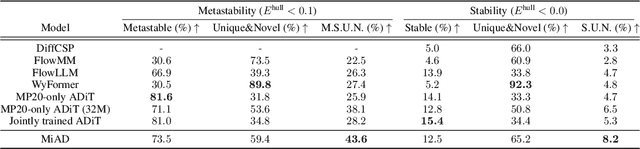
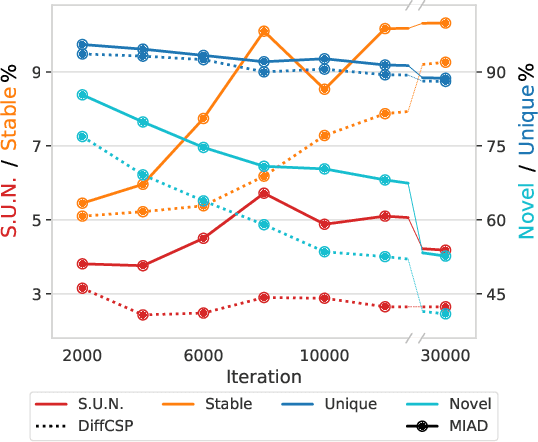
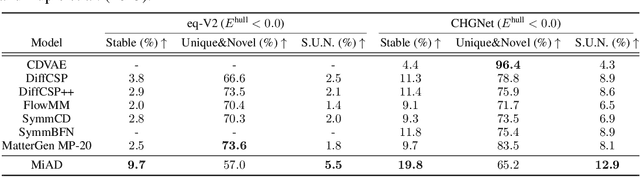
In recent years, diffusion-based models have demonstrated exceptional performance in searching for simultaneously stable, unique, and novel (S.U.N.) crystalline materials. However, most of these models don't have the ability to change the number of atoms in the crystal during the generation process, which limits the variability of model sampling trajectories. In this paper, we demonstrate the severity of this restriction and introduce a simple yet powerful technique, mirage infusion, which enables diffusion models to change the state of the atoms that make up the crystal from existent to non-existent (mirage) and vice versa. We show that this technique improves model quality by up to $\times2.5$ compared to the same model without this modification. The resulting model, Mirage Atom Diffusion (MiAD), is an equivariant joint diffusion model for de novo crystal generation that is capable of altering the number of atoms during the generation process. MiAD achieves an $8.2\%$ S.U.N. rate on the MP-20 dataset, which substantially exceeds existing state-of-the-art approaches. The source code can be found at \href{https://github.com/andrey-okhotin/miad.git}{\texttt{github.com/andrey-okhotin/miad}}.

Star-Shaped Denoising Diffusion Probabilistic Models
Feb 10, 2023Methods based on Denoising Diffusion Probabilistic Models (DDPM) became a ubiquitous tool in generative modeling. However, they are mostly limited to Gaussian and discrete diffusion processes. We propose Star-Shaped Denoising Diffusion Probabilistic Models (SS-DDPM), a model with a non-Markovian diffusion-like noising process. In the case of Gaussian distributions, this model is equivalent to Markovian DDPMs. However, it can be defined and applied with arbitrary noising distributions, and admits efficient training and sampling algorithms for a wide range of distributions that lie in the exponential family. We provide a simple recipe for designing diffusion-like models with distributions like Beta, von Mises--Fisher, Dirichlet, Wishart and others, which can be especially useful when data lies on a constrained manifold such as the unit sphere, the space of positive semi-definite matrices, the probabilistic simplex, etc. We evaluate the model in different settings and find it competitive even on image data, where Beta SS-DDPM achieves results comparable to a Gaussian DDPM.