 Add to Chrome
 Add to Firefox
 Add to Edge
POCI-Diff: Position Objects Consistently and Interactively with 3D-Layout Guided Diffusion
Jan 20, 2026
We propose a diffusion-based approach for Text-to-Image (T2I) generation with consistent and interactive 3D layout control and editing. While prior methods improve spatial adherence using 2D cues or iterative copy-warp-paste strategies, they often distort object geometry and fail to preserve consistency across edits. To address these limitations, we introduce a framework for Positioning Objects Consistently and Interactively (POCI-Diff), a novel formulation for jointly enforcing 3D geometric constraints and instance-level semantic binding within a unified diffusion process. Our method enables explicit per-object semantic control by binding individual text descriptions to specific 3D bounding boxes through Blended Latent Diffusion, allowing one-shot synthesis of complex multi-object scenes. We further propose a warping-free generative editing pipeline that supports object insertion, removal, and transformation via regeneration rather than pixel deformation. To preserve object identity and consistency across edits, we condition the diffusion process on reference images using IP-Adapter, enabling coherent object appearance throughout interactive 3D editing while maintaining global scene coherence. Experimental results demonstrate that POCI-Diff produces high-quality images consistent with the specified 3D layouts and edits, outperforming state-of-the-art methods in both visual fidelity and layout adherence while eliminating warping-induced geometric artifacts.

ESPLoRA: Enhanced Spatial Precision with Low-Rank Adaption in Text-to-Image Diffusion Models for High-Definition Synthesis
Apr 18, 2025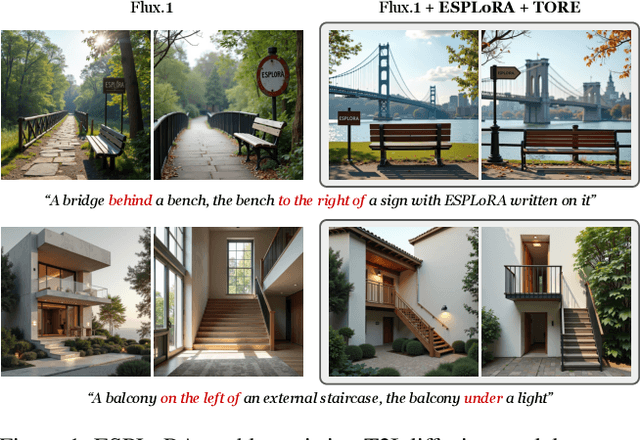
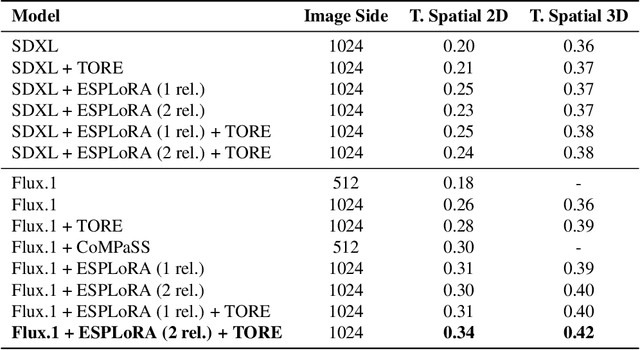
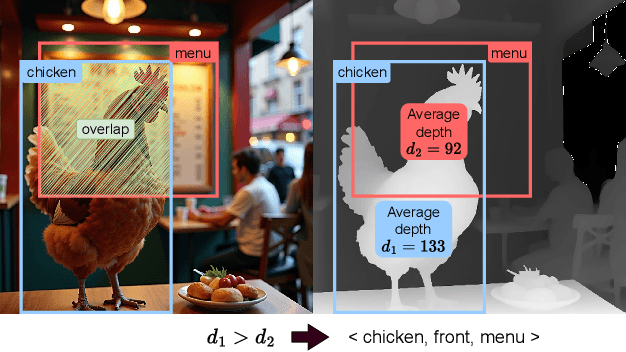
Diffusion models have revolutionized text-to-image (T2I) synthesis, producing high-quality, photorealistic images. However, they still struggle to properly render the spatial relationships described in text prompts. To address the lack of spatial information in T2I generations, existing methods typically use external network conditioning and predefined layouts, resulting in higher computational costs and reduced flexibility. Our approach builds upon a curated dataset of spatially explicit prompts, meticulously extracted and synthesized from LAION-400M to ensure precise alignment between textual descriptions and spatial layouts. Alongside this dataset, we present ESPLoRA, a flexible fine-tuning framework based on Low-Rank Adaptation, specifically designed to enhance spatial consistency in generative models without increasing generation time or compromising the quality of the outputs. In addition to ESPLoRA, we propose refined evaluation metrics grounded in geometric constraints, capturing 3D spatial relations such as \textit{in front of} or \textit{behind}. These metrics also expose spatial biases in T2I models which, even when not fully mitigated, can be strategically exploited by our TORE algorithm to further improve the spatial consistency of generated images. Our method outperforms the current state-of-the-art framework, CoMPaSS, by 13.33% on established spatial consistency benchmarks.