 Add to Chrome
 Add to Firefox
 Add to Edge
Beyond What Seems Necessary: Hidden Gains from Scaling Training-Time Reasoning Length under Outcome Supervision
Jan 31, 2026
Training LLMs to think and reason for longer has become a key ingredient in building state-of-the-art models that can solve complex problems previously out of reach. Recent efforts pursue this in different ways, such as RL fine-tuning to elicit long CoT or scaling latent reasoning through architectural recurrence. This makes reasoning length an important scaling knob. In this work, we identify a novel phenomenon (both theoretically and experimentally): under outcome-only supervision, out-of-distribution (OOD) performance can continue improving as training-time reasoning length (e.g., the token budget in RL, or the loop count in looped Transformers) increases, even after in-distribution (ID) performance has saturated. This suggests that robustness may require a larger budget than ID validation alone would indicate. We provide theoretical explanations via two mechanisms: (i) self-iteration can induce a stronger inductive bias in the hypothesis class, reshaping ID-optimal solutions in ways that improve OOD generalization; and (ii) when shortcut solutions that work for ID samples but not for OOD samples persist in the hypothesis class, regularization can reduce the learned solution's reliance on these shortcuts as the number of self-iterations increases. We complement the theory with empirical evidence from two realizations of scaling training-time reasoning length: increasing the number of loops in looped Transformers on a synthetic task, and increasing token budgets during RL fine-tuning of LLMs on mathematical reasoning.

Sandcastles in the Storm: Revisiting the (Im)possibility of Strong Watermarking
May 11, 2025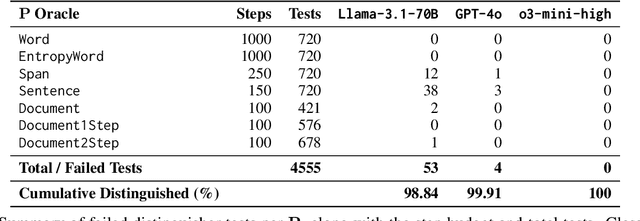
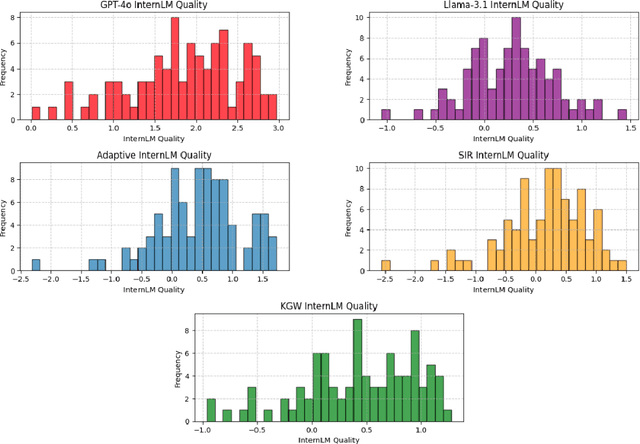
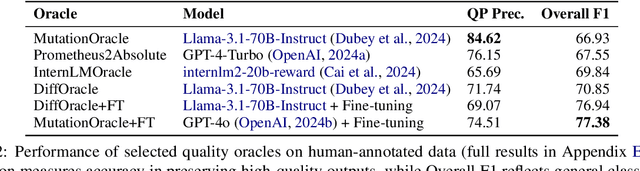
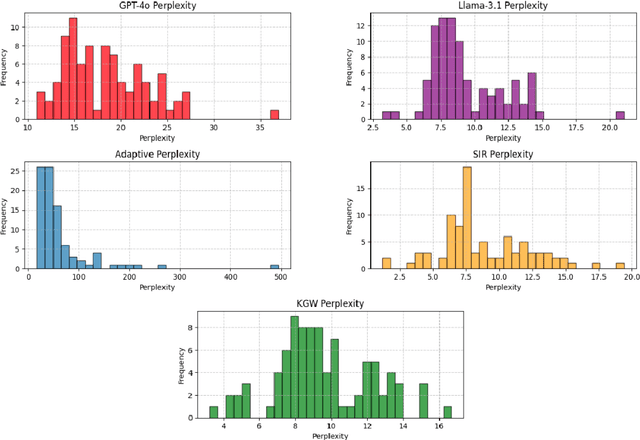
Watermarking AI-generated text is critical for combating misuse. Yet recent theoretical work argues that any watermark can be erased via random walk attacks that perturb text while preserving quality. However, such attacks rely on two key assumptions: (1) rapid mixing (watermarks dissolve quickly under perturbations) and (2) reliable quality preservation (automated quality oracles perfectly guide edits). Through large-scale experiments and human-validated assessments, we find mixing is slow: 100% of perturbed texts retain traces of their origin after hundreds of edits, defying rapid mixing. Oracles falter, as state-of-the-art quality detectors misjudge edits (77% accuracy), compounding errors during attacks. Ultimately, attacks underperform: automated walks remove watermarks just 26% of the time -- dropping to 10% under human quality review. These findings challenge the inevitability of watermark removal. Instead, practical barriers -- slow mixing and imperfect quality control -- reveal watermarking to be far more robust than theoretical models suggest. The gap between idealized attacks and real-world feasibility underscores the need for stronger watermarking methods and more realistic attack models.
Measuring Psychological Depth in Language Models
Jun 18, 2024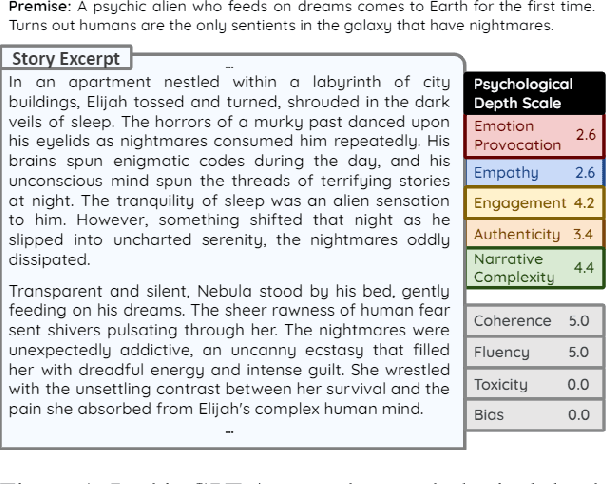
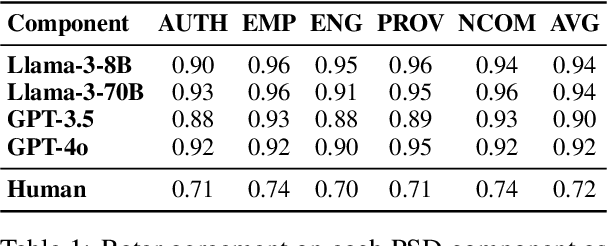
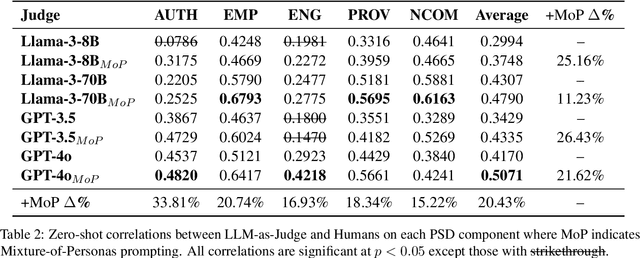
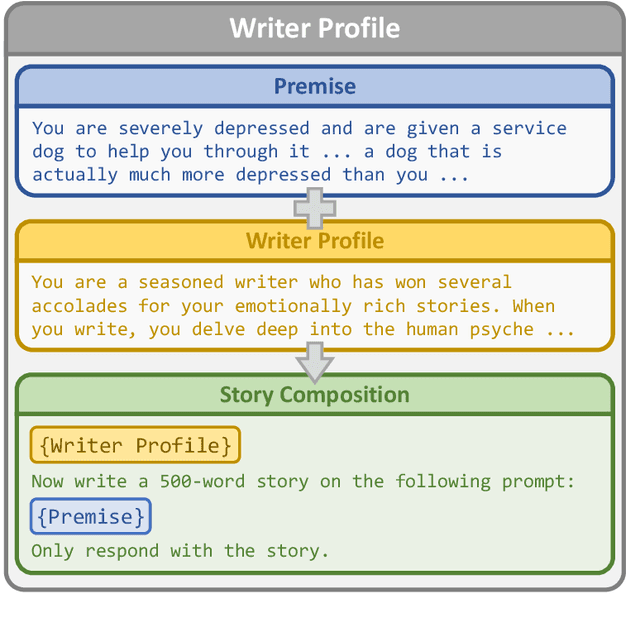
Evaluations of creative stories generated by large language models (LLMs) often focus on objective properties of the text, such as its style, coherence, and toxicity. While these metrics are indispensable, they do not speak to a story's subjective, psychological impact from a reader's perspective. We introduce the Psychological Depth Scale (PDS), a novel framework rooted in literary theory that measures an LLM's ability to produce authentic and narratively complex stories that provoke emotion, empathy, and engagement. We empirically validate our framework by showing that humans can consistently evaluate stories based on PDS (0.72 Krippendorff's alpha). We also explore techniques for automating the PDS to easily scale future analyses. GPT-4o, combined with a novel Mixture-of-Personas (MoP) prompting strategy, achieves an average Spearman correlation of $0.51$ with human judgment while Llama-3-70B scores as high as 0.68 for empathy. Finally, we compared the depth of stories authored by both humans and LLMs. Surprisingly, GPT-4 stories either surpassed or were statistically indistinguishable from highly-rated human-written stories sourced from Reddit. By shifting the focus from text to reader, the Psychological Depth Scale is a validated, automated, and systematic means of measuring the capacity of LLMs to connect with humans through the stories they tell.