 Add to Chrome
 Add to Firefox
 Add to Edge
AnyTask: an Automated Task and Data Generation Framework for Advancing Sim-to-Real Policy Learning
Dec 19, 2025
Generalist robot learning remains constrained by data: large-scale, diverse, and high-quality interaction data are expensive to collect in the real world. While simulation has become a promising way for scaling up data collection, the related tasks, including simulation task design, task-aware scene generation, expert demonstration synthesis, and sim-to-real transfer, still demand substantial human effort. We present AnyTask, an automated framework that pairs massively parallel GPU simulation with foundation models to design diverse manipulation tasks and synthesize robot data. We introduce three AnyTask agents for generating expert demonstrations aiming to solve as many tasks as possible: 1) ViPR, a novel task and motion planning agent with VLM-in-the-loop Parallel Refinement; 2) ViPR-Eureka, a reinforcement learning agent with generated dense rewards and LLM-guided contact sampling; 3) ViPR-RL, a hybrid planning and learning approach that jointly produces high-quality demonstrations with only sparse rewards. We train behavior cloning policies on generated data, validate them in simulation, and deploy them directly on real robot hardware. The policies generalize to novel object poses, achieving 44% average success across a suite of real-world pick-and-place, drawer opening, contact-rich pushing, and long-horizon manipulation tasks. Our project website is at https://anytask.rai-inst.com .

GraphRAG-Causal: A novel graph-augmented framework for causal reasoning and annotation in news
Jun 13, 2025GraphRAG-Causal introduces an innovative framework that combines graph-based retrieval with large language models to enhance causal reasoning in news analysis. Traditional NLP approaches often struggle with identifying complex, implicit causal links, especially in low-data scenarios. Our approach addresses these challenges by transforming annotated news headlines into structured causal knowledge graphs. It then employs a hybrid retrieval system that merges semantic embeddings with graph-based structural cues leveraging Neo4j to accurately match and retrieve relevant events. The framework is built on a three-stage pipeline: First, during Data Preparation, news sentences are meticulously annotated and converted into causal graphs capturing cause, effect, and trigger relationships. Next, the Graph Retrieval stage stores these graphs along with their embeddings in a Neo4j database and utilizes hybrid Cypher queries to efficiently identify events that share both semantic and structural similarities with a given query. Finally, the LLM Inference stage utilizes these retrieved causal graphs in a few-shot learning setup with XML-based prompting, enabling robust classification and tagging of causal relationships. Experimental evaluations demonstrate that GraphRAG-Causal achieves an impressive F1-score of 82.1% on causal classification using just 20 few-shot examples. This approach significantly boosts accuracy and consistency, making it highly suitable for real-time applications in news reliability assessment, misinformation detection, and policy analysis.
Geometrically Inspired Kernel Machines for Collaborative Learning Beyond Gradient Descent
Jul 05, 2024This paper develops a novel mathematical framework for collaborative learning by means of geometrically inspired kernel machines which includes statements on the bounds of generalisation and approximation errors, and sample complexity. For classification problems, this approach allows us to learn bounded geometric structures around given data points and hence solve the global model learning problem in an efficient way by exploiting convexity properties of the related optimisation problem in a Reproducing Kernel Hilbert Space (RKHS). In this way, we can reduce classification problems to determining the closest bounded geometric structure from a given data point. Further advantages that come with our solution is that our approach does not require clients to perform multiple epochs of local optimisation using stochastic gradient descent, nor require rounds of communication between client/server for optimising the global model. We highlight that numerous experiments have shown that the proposed method is a competitive alternative to the state-of-the-art.
Urdu Poetry Generated by Using Deep Learning Techniques
Sep 25, 2023This study provides Urdu poetry generated using different deep-learning techniques and algorithms. The data was collected through the Rekhta website, containing 1341 text files with several couplets. The data on poetry was not from any specific genre or poet. Instead, it was a collection of mixed Urdu poems and Ghazals. Different deep learning techniques, such as the model applied Long Short-term Memory Networks (LSTM) and Gated Recurrent Unit (GRU), have been used. Natural Language Processing (NLP) may be used in machine learning to understand, analyze, and generate a language humans may use and understand. Much work has been done on generating poetry for different languages using different techniques. The collection and use of data were also different for different researchers. The primary purpose of this project is to provide a model that generates Urdu poems by using data completely, not by sampling data. Also, this may generate poems in pure Urdu, not Roman Urdu, as in the base paper. The results have shown good accuracy in the poems generated by the model.
Utility-Probability Duality
Nov 06, 2003
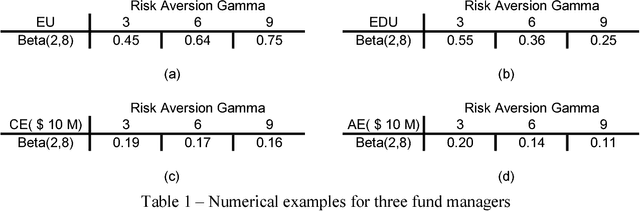


This paper presents duality between probability distributions and utility functions.