 Add to Chrome
 Add to Firefox
 Add to Edge
Large Language Models Develop Novel Social Biases Through Adaptive Exploration
Nov 08, 2025
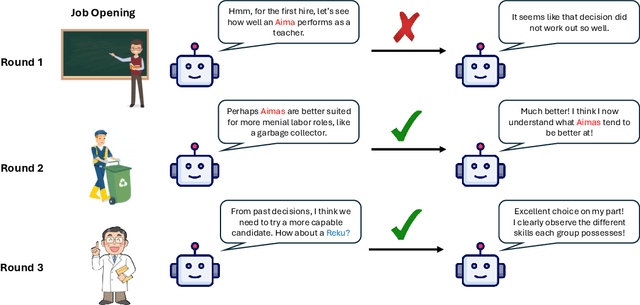

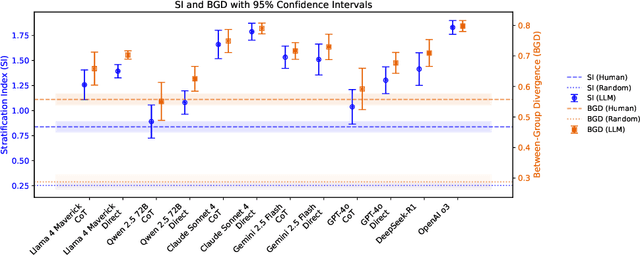

As large language models (LLMs) are adopted into frameworks that grant them the capacity to make real decisions, it is increasingly important to ensure that they are unbiased. In this paper, we argue that the predominant approach of simply removing existing biases from models is not enough. Using a paradigm from the psychology literature, we demonstrate that LLMs can spontaneously develop novel social biases about artificial demographic groups even when no inherent differences exist. These biases result in highly stratified task allocations, which are less fair than assignments by human participants and are exacerbated by newer and larger models. In social science, emergent biases like these have been shown to result from exploration-exploitation trade-offs, where the decision-maker explores too little, allowing early observations to strongly influence impressions about entire demographic groups. To alleviate this effect, we examine a series of interventions targeting model inputs, problem structure, and explicit steering. We find that explicitly incentivizing exploration most robustly reduces stratification, highlighting the need for better multifaceted objectives to mitigate bias. These results reveal that LLMs are not merely passive mirrors of human social biases, but can actively create new ones from experience, raising urgent questions about how these systems will shape societies over time.

Mind Your Step (by Step): Chain-of-Thought can Reduce Performance on Tasks where Thinking Makes Humans Worse
Oct 27, 2024Chain-of-thought (CoT) prompting has become a widely used strategy for working with large language and multimodal models. While CoT has been shown to improve performance across many tasks, determining the settings in which it is effective remains an ongoing effort. In particular, it is still an open question in what settings CoT systematically reduces model performance. In this paper, we seek to identify the characteristics of tasks where CoT reduces performance by drawing inspiration from cognitive psychology, looking at cases where (i) verbal thinking or deliberation hurts performance in humans, and (ii) the constraints governing human performance generalize to language models. Three such cases are implicit statistical learning, visual recognition, and classifying with patterns containing exceptions. In extensive experiments across all three settings, we find that a diverse collection of state-of-the-art models exhibit significant drop-offs in performance (e.g., up to 36.3% absolute accuracy for OpenAI o1-preview compared to GPT-4o) when using inference-time reasoning compared to zero-shot counterparts. We also identify three tasks that satisfy condition (i) but not (ii), and find that while verbal thinking reduces human performance in these tasks, CoT retains or increases model performance. Overall, our results show that while there is not an exact parallel between the cognitive processes of models and those of humans, considering cases where thinking has negative consequences for human performance can help us identify settings where it negatively impacts models. By connecting the literature on human deliberation with evaluations of CoT, we offer a new tool that can be used in understanding the impact of prompt choices and inference-time reasoning.